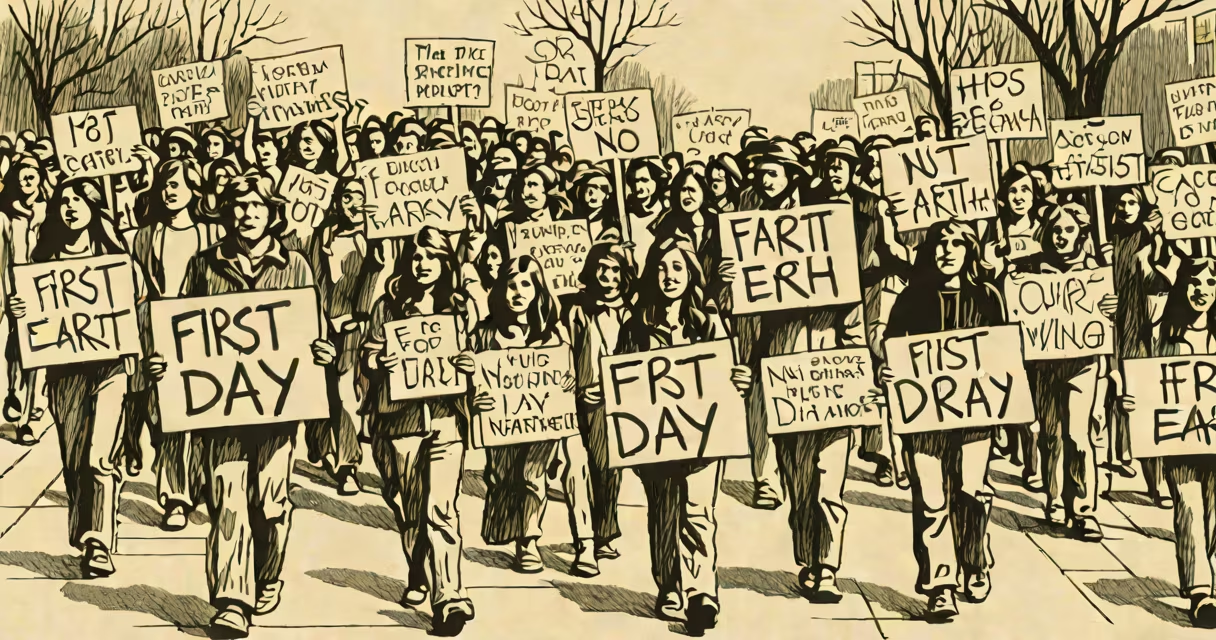
First Earth Day was a national environmental demonstration held on April 22, 1970, mobilizing 20 million people across the United States to demand action on pollution, conservation, and climate awareness. It marked the first large-scale public event focused on environmental protection and catalyzed the creation of the U.S. Environmental Protection Agency and key environmental laws.
The idea emerged from growing public concern over industrial pollution, oil spills, and deteriorating air and water quality. Senator Gaylord Nelson, a Democrat from Wisconsin, proposed a national teach-in on the environment after witnessing the devastation of the 1969 Santa Barbara oil spill. He envisioned a day that would bring environmental issues into mainstream political discourse.
Organizers coordinated events in cities and towns nationwide. Students led marches, schools hosted educational programs, and local groups staged cleanups. The event drew participation from diverse communities, including labor unions, religious organizations, and civic leaders. It was not a single rally but a decentralized wave of activism spanning over 2,000 colleges and hundreds of cities.
First Earth Day operated through grassroots coordination. Local organizers received toolkits from the national campaign, which included sample speeches, poster templates, and suggested activities. Events were designed to be accessible-rallies, tree plantings, recycling drives, and classroom discussions.
Each city tailored its event to local concerns. In New York City, activists gathered at the Lincoln Memorial and marched toward the United Nations. In Los Angeles, students blocked traffic to draw attention to smog. In Seattle, residents held a "Green Festival" with eco-vendors and workshops on composting.
Media coverage amplified the message. The New York Times ran front-page stories. CBS and NBC aired special segments. The visibility helped shift public perception: environmental protection was no longer a niche interest-it was a national priority.
First Earth Day was built on three core elements: public education, political pressure, and community engagement. It combined the energy of student movements with the urgency of scientific warnings about pollution.
Key materials included hand-drawn posters, printed flyers, and radio announcements. Organizers used low-cost tools-postcards, chalkboards, and public address systems-to spread the word. The absence of social media meant outreach relied on word-of-mouth, school networks, and local newspapers.
One notable feature was the use of symbolic imagery. Green ribbons, leaf-shaped badges, and handmade banners with slogans like "Save Our Planet" became visual markers of the movement. These symbols helped unify disparate groups under a shared identity.
First Earth Day was used to galvanize political will. The event succeeded because it demonstrated widespread public support for environmental reform. Before 1970, environmental policy was fragmented and underfunded.
After the event, Congress passed major legislation. The Clean Air Act was strengthened in 1970. The Clean Water Act followed in 1972. The Endangered Species Act was signed in 1973. The Environmental Protection Agency (EPA) was created in December 1970, fulfilling a key demand from Earth Day organizers.
Internationally, the momentum inspired similar days. Canada held its first Earth Day in 1971. By 1990, Earth Day had grown into a global event with 200 million participants in 141 countries. Today, it is observed annually on April 22 in over 190 nations.
| Type | Description | Example |
|---|---|---|
| Political | Used to push legislative change | Pressure led to passage of the Clean Air Act |
| Educational | Targeted schools and youth | Classroom lessons on recycling and biodiversity |
| Civic | Community-led cleanups and tree plantings | Seattle's Green Festival in 1970 |
First Earth Day is often mistaken as a single event in Washington, D.C., but it was a distributed network of actions. The largest gathering was in New York City, not the nation's capital.
Another error is claiming it was organized by a single group. The movement was coordinated by a coalition of environmentalists, educators, and politicians. Key figures included Denis Hayes, who managed logistics and helped scale the event nationally.
A lesser-known fact: the original name was "National Environmental Teach-In." The term "Earth Day" was adopted later during planning to make the event more emotionally resonant. The shift from "teach-in" to "day" reflected a move from academic discussion to mass civic action.
In New York City, over 100,000 people gathered near Central Park and marched to the United Nations headquarters. They carried signs reading "Pollution Kills," "Save the Whales," and "No More Smog." The march was organized by a coalition of student groups, labor unions, and environmental nonprofits.
Participants included high school students from Brooklyn, factory workers from Queens, and professors from Columbia University. One attendee, a 17-year-old from Staten Island, later recalled, "I'd never seen so many people care about something I didn't even know existed. We were angry about the river being toxic, but we felt hopeful too."
That afternoon, the mayor issued a statement supporting environmental regulations. Within weeks, state legislators introduced bills to ban leaded gasoline and regulate industrial waste. The event proved that collective action could influence policy.
First Earth Day differs from other environmental observances in scale and intent. While Earth Day is now global, the 1970 version was uniquely American in origin and impact. It was not a ceremonial holiday but a political intervention.
Unlike Earth Day's focus on collective action, earlier efforts like the founding of the Sierra Club in 1892 were advocacy-based and limited to conservationists. First Earth Day brought environmentalism into the mainstream by appealing to everyday citizens, not just experts.
It also predates modern climate activism. Movements like Fridays for Future, which began in 2018, are rooted in youth-led protests but rely on digital platforms. First Earth Day succeeded without email, social media, or apps-proving that physical presence and local organization remain useful tools.
One key difference: First Earth Day was not tied to a specific theme. It addressed air and water pollution, deforestation, and wildlife extinction-all at once. Modern Earth Days often focus on one issue, such as plastic reduction or renewable energy. The broad scope of the original event reflects the interconnectedness of environmental challenges.
I attended a 2010 Earth Day event in Portland, Oregon, where a group of elders recounted their 1970 experiences. One woman, then a college student, described carrying a handmade sign that read "The Earth Is Sick-We Must Heal Her." She said the crowd's energy felt electric-not because of speeches, but because people believed change was possible.
Her story underscored a truth missed in most summaries: First Earth Day worked because it made environmentalism feel personal. It wasn't about distant ecosystems or abstract science. It was about the smell of smoke in the air, the fish dying in rivers, and the right to breathe clean air.