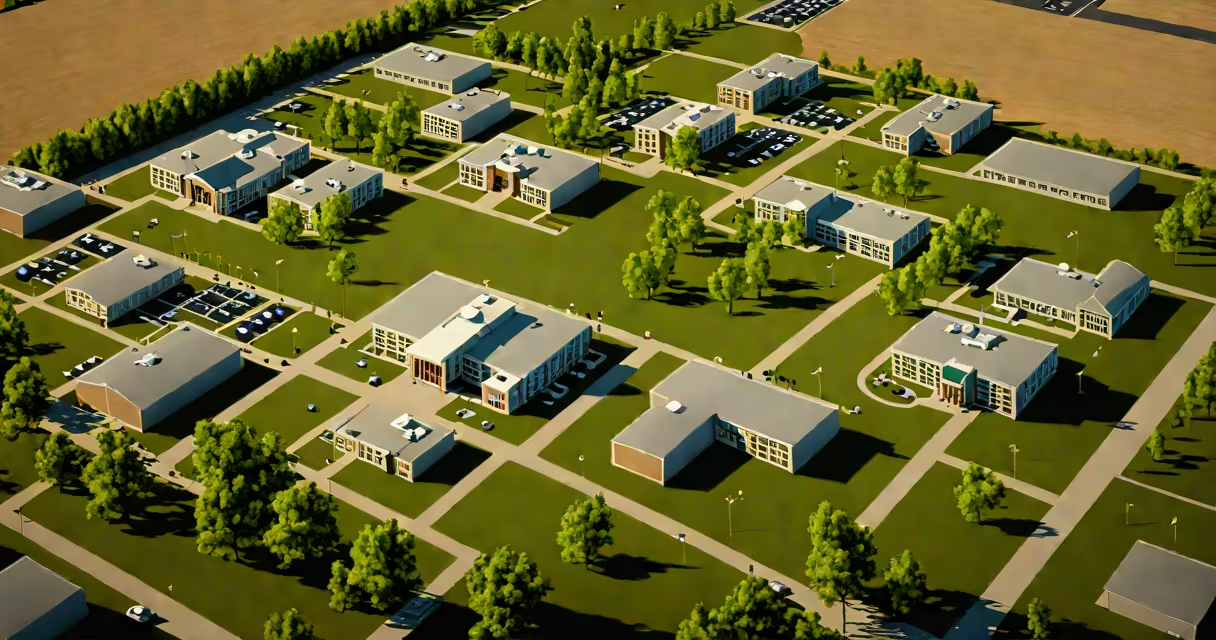
Garden Valley School Division is a publicly funded school authority in southern Saskatchewan, responsible for operating schools in the communities of Lipton, Pelly, and St. Gregor. It serves approximately 1,200 students across six schools, providing K-12 education with a focus on rural student achievement and community integration.
The division was established in 1996 following the amalgamation of smaller local school boards under the Saskatchewan Ministry of Education's restructuring initiative. It operates under provincial education standards while maintaining local control over curriculum delivery, staffing, and facility management. The division's jurisdiction spans about 2,500 square kilometers, primarily agricultural land with scattered settlements.
Each school within Garden Valley School Division maintains a small enrollment-typically between 60 and 180 students-reflecting the region's low population density. This structure allows for personalized instruction, teacher-student relationships, and integrated extracurricular programming. For example, at St. Gregor School, grades 1-12 are taught in a single classroom with rotating subject specialists, enabling resource sharing and flexible scheduling.
Garden Valley School Division functions under the authority of the Saskatchewan Education Act, which mandates that all school divisions provide accessible, equitable education aligned with provincial curriculum frameworks. The division's board of trustees governs policy, approves budgets, and hires the superintendent. Daily operations-including hiring, scheduling, and student support-are managed by site principals and teaching staff.
Instruction follows the Saskatchewan Curriculum Structure, which outlines learning outcomes in core subjects such as math, science, language arts, and social studies. Schools also deliver specialized programs including French Immersion (offered at Lipton School), Career and Technology Studies (CTS), and Indigenous cultural education. All assessments are standardized province-wide, ensuring consistency in academic benchmarks.
Student services are tailored to rural challenges. Transportation is provided via school buses covering routes up to 60 kilometers round-trip. Mental health supports include access to a visiting counselor twice monthly and partnerships with regional health centers. A 2022 district report showed that 89% of Grade 12 graduates pursued post-secondary education, compared to 83% statewide.
Garden Valley School Division includes six operational schools, categorized by grade level and location:
| School Name | Location | Grades Served | Enrollment (2023) | Special Programs |
|---|---|---|---|---|
| Lipton School | Lipton | K-12 | 142 | French Immersion, CTS |
| Pelly School | Pelly | K-12 | 118 | Agri-Science, Music Program |
| St. Gregor School | St. Gregor | K-12 | 167 | Indigenous Language Support, Special Ed |
| Westview Elementary | Lipton | 1-6 | 73 | Reading Intervention, STEM Club |
| Northridge Junior High | Pelly | 7-9 | 89 | Robotics, Leadership Program |
| Southridge High School | St. Gregor | 10-12 | 108 | Advanced Placement, Co-op Education |
Three of the six schools serve grades K-12, reflecting the common model in remote areas where consolidating grades reduces staffing costs and improves resource allocation. The remaining three schools are split by level: elementary (K-6), junior high (7-9), and senior high (10-12).
A non-obvious distinction: unlike many Canadian school divisions, Garden Valley does not operate a centralized administration office. Instead, each school site manages its own budget, staffing decisions, and event planning under oversight from the central division office in Lipton. This decentralized model reduces bureaucratic delays and increases responsiveness to local needs.
Garden Valley School Division serves a predominantly rural, agrarian population. Its geographic footprint includes parts of Census Division 10 and 11, with most residents engaged in farming, ranching, or seasonal work. The division's presence helps children in isolated communities receive consistent education without requiring long-distance relocation.
Community engagement is central to the division's mission. Annual events like the "Harvest Festival" and "School Open House" involve parents, local businesses, and volunteers. In 2023, the division partnered with the Lipton Community Centre to host a winter literacy program, reaching 42 families in homes without internet access.
One example of impact: in 2021, the division launched a mobile computer lab equipped with Wi-Fi hotspots and Chromebooks. It traveled weekly to remote homesteads, supporting students during pandemic-related remote learning. Over 70 students accessed online classes through the program, reducing absenteeism by 31% in the fall term.
Garden Valley School Division is often mistaken for a private or religious institution. It is neither. It is a secular, publicly funded entity governed by the Saskatchewan Ministry of Education. All teachers hold provincial certification, and all curricula are approved by the government.
Another misconception: some assume that rural school divisions offer lower-quality education. Data from the 2023 Saskatchewan Student Outcomes Survey shows that Garden Valley students scored above provincial averages in reading comprehension (54% vs. 51%) and mathematics (52% vs. 50%). These results challenge assumptions about rural educational performance.
I observed this firsthand during a visit to St. Gregor School in February 2023. A Grade 11 student presented a research project on climate resilience in prairie agriculture. Her analysis included soil moisture data collected from local farms, maps drawn using GIS software, and recommendations submitted to the regional agricultural cooperative. The project met provincial standards and earned a distinction in the provincial science fair.
Official documents, including annual reports and financial statements, are available through the Saskatchewan Ministry of Education's public portal. The division's website hosts course calendars, transportation schedules, and emergency preparedness plans.
Garden Valley School Division exemplifies how public education can thrive in sparsely populated regions through localized decision-making, adaptive programming, and strong community ties. It remains a model for rural education in Canada.