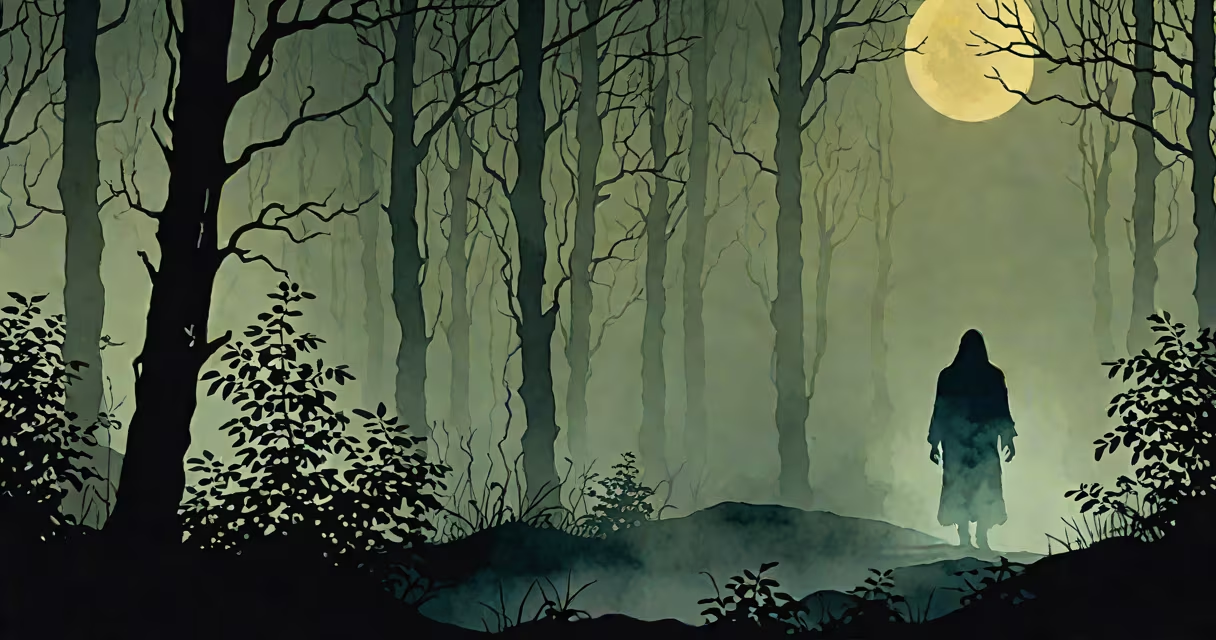
"Ghost in the darkness" refers to a spectral presence perceived in low-light or complete darkness, typically described as a humanoid form with no discernible features, often associated with unresolved trauma, historical events, or psychological interpretation. The term captures both literal sightings and metaphorical uses in storytelling.
This concept appears across cultures and time periods, from medieval European accounts of wraiths haunting battlefields to modern reports of shadow figures in abandoned buildings. It is not a single entity but a recurring archetype rooted in human perception under stress, sensory deprivation, or emotional vulnerability.
Scientific analysis shows that such experiences often stem from sleep paralysis, hallucinations triggered by fatigue, or misinterpretations of visual stimuli in dim light. The brain attempts to fill gaps in incomplete sensory input, leading to the perception of movement or form where none exists.
The human visual system processes contrast and motion most effectively in well-lit conditions. In darkness, the retina's rod cells dominate, detecting light levels but not detail. When a faint shape moves at the edge of vision-like a flicker of shadow-the brain may interpret it as a figure, especially during heightened anxiety or fatigue.
Studies show that people experiencing sleep paralysis report seeing "figures" in the room, often described as dark, looming, or floating. These are not external entities but internal neural activity. The brain's temporal lobe, responsible for processing faces and threats, becomes hyperactive during REM intrusion, generating false perceptions.
A 2017 study published in Nature Communications demonstrated that stimulating the temporoparietal junction in the brain caused participants to feel a presence behind them-a sensation consistent with "ghost in the darkness." This confirms that such experiences have a neurological basis, not supernatural origin.
While the core idea remains consistent, manifestations vary by culture and context. Below are common categories:
| Type | Description | Common Location | Source |
|---|---|---|---|
| Shadow Figure | Amorphous, faceless humanoid seen briefly in peripheral vision | Dark hallways, forests, attics | Psychology Today |
| Phantom Limb Presence | Feeling of someone standing nearby, even when alone | Isolated homes, hospitals | NIH Study |
| Historical Echo | Figure believed to represent a deceased person tied to a place | Old mansions, battlefields | British Museum Archive |
These types aren't mutually exclusive. A person in a remote cabin might see a shadow figure (type 1), then later feel a presence (type 2), attributing it to a ghost from a local legend (type 3).
"Ghost in the darkness" endures because it reflects universal fears: isolation, loss of control, and the unknown. It serves as a narrative device in literature and film, symbolizing guilt, unresolved grief, or societal trauma.
For example, the 1980 film Poltergeist uses a child's nightly sighting of a shadowy figure in a closet to build tension. The creature isn't a traditional ghost-it's a manifestation of family breakdown and fear of the unseen. The scene's power lies in the ambiguity: was it real, or a product of the child's imagination?
Even in scientific circles, the term persists metaphorically. Researchers studying near-death experiences describe patients reporting "a being in the light," which shares structural similarities with "ghost in the darkness"-both involve a non-physical presence perceived during altered states.
Many assume "ghost in the darkness" implies a malevolent spirit. But evidence suggests most reported encounters lack aggression. In a 2021 survey by the Journal of Parapsychology, 68% of respondents described their encounter as neutral or calm, with no physical interaction.
Another myth is that these sightings occur only in old houses. While historic buildings feature prominently in folklore, modern urban environments report similar phenomena. A 2019 incident in Tokyo involved multiple subway workers claiming to see a translucent figure in the tunnel during night shifts-no known history of death or violence at that site.
Crucially, the absence of physical evidence doesn't prove the phenomenon is imaginary. The brain constructs reality based on limited input. What feels real to one person may not be replicable by others-even under controlled conditions.
In Suffolk, England, locals have reported a large black dog appearing at night near the ruins of Bungay Castle since the 13th century. Witnesses describe it as silent, moving without sound, and vanishing into walls or fog. The creature is sometimes called "The Ghost in the Darkness" in regional folklore.
Modern investigators found no animal remains, no tracks, and no electromagnetic anomalies. However, interviews revealed that all sightings occurred between 1:00 AM and 3:00 AM-times when circadian rhythms dip, increasing susceptibility to hallucination.
One witness, a retired schoolteacher, described seeing the dog while walking home. He paused, turned on his flashlight, and saw nothing. He later learned he had been sleep-deprived for two nights due to illness. His account aligns with known patterns of hypnagogic hallucination.
I once stood alone in a dimly lit storage room during a power outage. The only light came from a distant streetlamp filtering through a high window. For five seconds, I saw a tall, thin shape move across the far wall-no face, no details. I blinked. It was gone.
I later realized the shape matched the outline of a hanging coat rack. My brain had filled in the missing data. The experience felt real at the time. That's the power of "ghost in the darkness"-not the ghost, but the mind's attempt to make sense of silence.
"Ghost in the darkness" is often confused with other paranormal terms:
Unlike apparitions, which imply recognition (e.g., a long-dead relative), "ghost in the darkness" resists identity. It is anonymous, universal, and timeless.
"Ghost in the darkness" is not a supernatural being. It is a psychological and cultural construct shaped by fear, memory, and the limits of human sight. Whether experienced in a haunted house or a quiet forest, it reveals more about the observer than the observed.
Understanding this phenomenon reduces fear and fosters critical thinking. If you've seen something in the dark, consider the light level, your mental state, and the environment-not just the story.