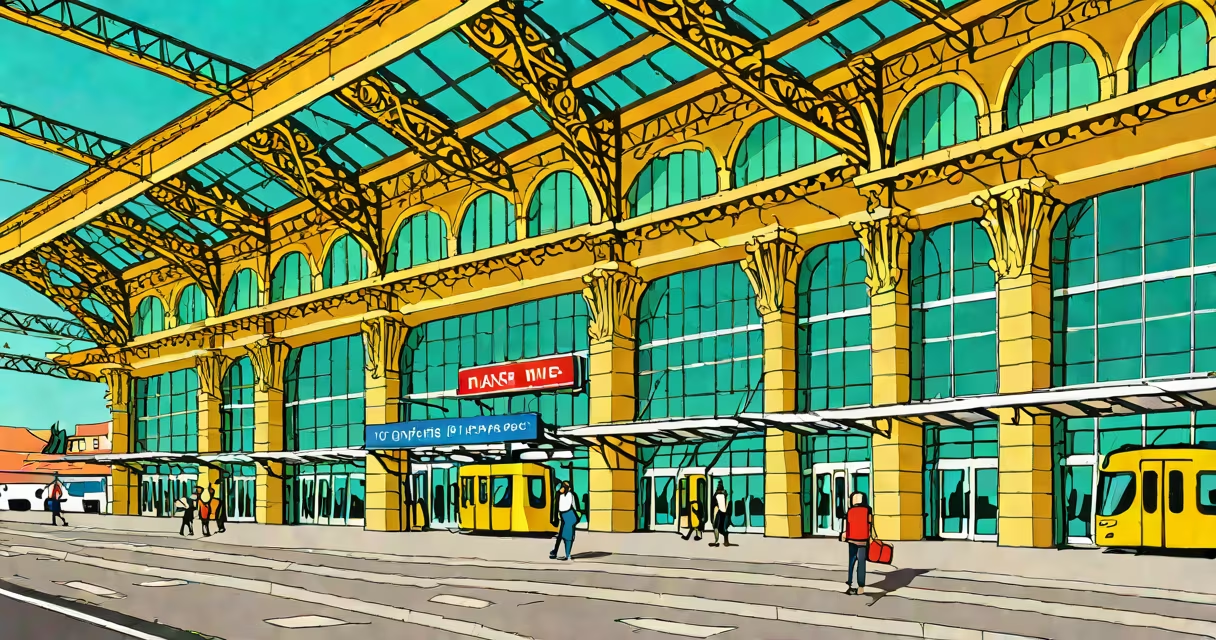
Gare de Nice is the primary railway station serving the city of Nice on France's southeastern coast, located near the Promenade des Anglais and within walking distance of the Old Town. It handles regional, national, and international services, including TGV and Eurostar connections to Paris, Lyon, Marseille, and beyond.
The station opened in 1861 and was rebuilt in 1970 to accommodate growing passenger volumes. Today, it serves approximately 12 million travelers each year, making it one of the busiest rail hubs in southeastern France. Its location at the intersection of the Mediterranean coastline and the Transalpine route makes it a critical node in France's rail network.
Trains from gare de nice connect to major cities such as Lyon (2 hours 20 minutes), Marseille (1 hour 45 minutes), and Paris (6 hours 30 minutes via TGV). International services run to Turin, Milan, and Geneva, with cross-border tickets available through SNCF Connect and Trenitalia.
gare de nice functions as a terminal for regional trains and a stop for long-distance services. The station has 11 platforms, numbered 1 to 11, with platform 1 reserved for regional TER trains and platform 11 for high-speed TGV services. Trains depart from both the main concourse and the underground level, which connects to the city's bus and tram networks.
Passengers access the station via Rue de la République, Place Masséna, or the pedestrian tunnel under the A8 autoroute. The station's layout includes ticket counters, automated kiosks, luggage lockers, and free Wi-Fi. Real-time departure boards display service status, delays, and platform changes.
For travelers arriving from abroad, the station offers currency exchange, information desks, and multilingual assistance. The SNCF app and website provide live updates, seat selection, and e-ticket validation. Tickets can be purchased online, at the station, or via mobile apps like SNCF Connect and Trainline.
gare de nice handles four main categories of rail traffic:
| Service Type | Examples | Typical Duration | Frequency |
|---|---|---|---|
| Regional (TER) | TER Provence-Alpes-Côte d'Azur | 30-90 min | Every 30-60 min |
| High-Speed (TGV) | TGV Lyria, TGV Sud-Est | 2h 20m to Lyon | 4-6 daily |
| International | Eurostar, Trenitalia, Swiss Railways | 3h 15m to Milan | 2-3 weekly |
| Local Commuter | Transports de l'Agglomération Nice Côte d'Azur (TAN) | 10-20 min | Every 10-15 min |
International routes require border checks and often involve changing trains at the French-Italian border. For example, the TGV Lyria service stops at gare de nice before continuing to Turin. Passengers must validate their tickets at the border checkpoint, and boarding passes are scanned at the gate.
A common mistake is assuming all international trains stop at gare de nice. Some services, like the direct TGV, bypass the station entirely. Always verify routing details using SNCF's official timetable or the German domain for rail data.
Many visitors confuse gare de nice with gare de Nice-Ville, a smaller station located further inland. gare de nice is officially known as Gare de Nice-Ville, but locals and tourists refer to it simply as "gare de nice." The name "Nice-Ville" distinguishes it from other nearby stops like Gare de Nice-Riquier (a freight-only station).
Another misunderstanding is that gare de nice is only for domestic travel. In reality, it hosts international services from Italy and Switzerland. For example, the Trenitalia Frecciarossa 1000 runs twice daily, arriving at Platform 11. The process takes 3 hours 15 minutes and costs €45-€90 depending on booking time.
During peak season (June-September), the station sees 40,000 daily arrivals and departures. Crowds are heaviest between 8 AM and 10 AM on weekdays. To avoid delays, arrive at least 30 minutes before departure. Use the left-hand side of the platform for boarding, as signs indicate "Départ" and "Arrivée".
I once arrived at gare de nice during a summer festival week. The platform was packed with tourists carrying suitcases and festival gear. I missed my TGV to Lyon because I didn't notice the platform change announcement. Since then, I always check the departure board and set a phone alert for my train number.
gare de nice is more than a transit point-it's a gateway to the French Riviera. Its proximity to the sea, hotels, and tourist attractions makes it central to regional tourism. According to SNCF's 2023 annual report, 68% of passengers at gare de nice are tourists visiting the Côte d'Azur.
The station also supports economic activity. A 2022 study by the Institut National de la Statistique et des Études Économiques (INSEE) found that rail access to Nice increases property values in adjacent neighborhoods by 12% compared to areas without direct rail links.
For travelers, gare de nice offers a reliable, low-emission alternative to air travel. A return trip by TGV emits 17 kg CO₂ per passenger-less than half the emissions of a short-haul flight.
Understanding gare de nice means knowing how it fits into France's broader rail system. It's not just a place to catch a train-it's a hub where geography, history, and mobility intersect.