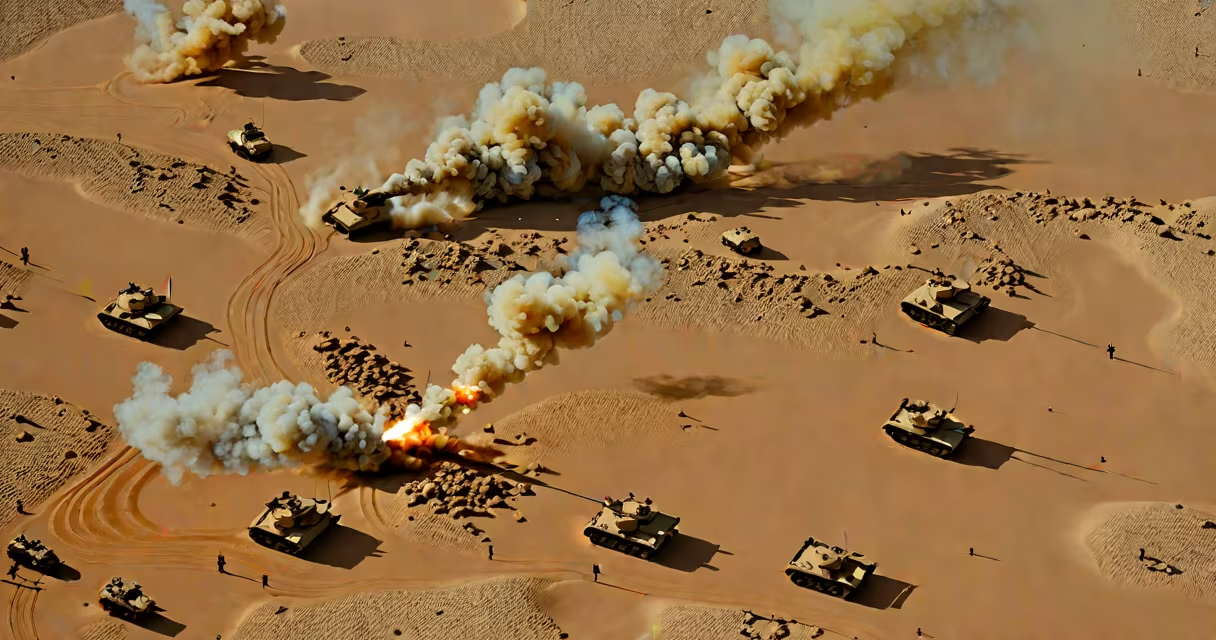
The gulf war dates refer to the period from August 2, 1990, when Iraq invaded Kuwait, to February 28, 1991, when coalition forces liberated Kuwait after a 42-day air campaign and 100-hour ground offensive. The conflict was triggered by Iraq's refusal to withdraw from Kuwait despite UN resolutions.
Operation Desert Storm began on January 17, 1991, marking the start of sustained aerial bombardment by a U.S.-led coalition of 34 nations. This phase lasted 42 days and targeted Iraqi military infrastructure, command centers, and supply lines. The ground campaign, known as Operation Desert Sabre, commenced on February 24, 1991, and concluded with the liberation of Kuwait City on February 26. Coalition forces declared victory on February 28, 1991, though Iraq continued to resist in isolated pockets until April.
Coalition forces included troops from the United States, the United Kingdom, France, Saudi Arabia, Egypt, and others. The U.S. contributed approximately 490,000 personnel, while the UK deployed around 50,000. The war ended with Iraq's withdrawal from Kuwait, which had been occupied since August 2, 1990. The official end date is widely recognized as February 28, 1991, though some sources cite March 1, 1991, as the formal cessation of hostilities.
Iraq's invasion of Kuwait began at 2:00 a.m. local time on August 2, 1990. Iraqi Republican Guard units advanced rapidly, capturing Kuwait City within hours. Over 1,000 Kuwaiti civilians were killed or injured, and thousands fled to neighboring countries. Iraq declared Kuwait its 19th province shortly after the takeover, a move universally condemned by the international community.
The United Nations Security Council passed Resolution 660 on August 2, condemning the invasion and demanding Iraq's immediate withdrawal. Subsequent resolutions imposed economic sanctions and authorized the use of force if Iraq did not comply. By November 1990, the U.S. had deployed over 200,000 troops to Saudi Arabia under Operation Desert Shield, a defensive buildup to deter further Iraqi aggression.
When Iraq failed to withdraw by the January 15, 1991, deadline set by UNSC Resolution 678, the coalition launched Operation Desert Storm. The initial phase involved 110,000 sorties by coalition aircraft, including F-117 Nighthawk stealth bombers and B-52 strategic bombers. Targets included Baghdad's power grid, communications networks, and Scud missile launch sites. By the end of the air campaign, 80% of Iraq's air defenses had been destroyed.
The timeline of the gulf war dates is divided into four distinct phases:
| Phase | Start Date | End Date | Duration | Key Events |
|---|---|---|---|---|
| Invasion & Occupation | August 2, 1990 | January 16, 1991 | 168 days | Iraqi forces occupy Kuwait; UN sanctions imposed; U.S. deploys troops to Saudi Arabia |
| Operation Desert Storm (Air Campaign) | January 17, 1991 | February 27, 1991 | 42 days | Coalition airstrikes destroy Iraqi command centers and military assets; 1,000+ sorties flown daily |
| Operation Desert Sabre (Ground Offensive) | February 24, 1991 | February 28, 1991 | 100 hours | Coalition armored divisions breach Iraqi defenses; Kuwait City liberated; Iraqi 4th Armored Division destroyed |
| Post-Conflict & Ceasefire | March 1, 1991 | April 11, 1991 | 41 days | UN monitors verify Iraqi withdrawal; ceasefire declared; Saddam Hussein suppresses Kurdish and Shia uprisings |
A non-obvious fact: The 100-hour ground offensive was shorter than planned. Initial strategy called for a 14-day advance, but coalition forces achieved breakthroughs faster than expected due to superior mobility and electronic warfare. The 4th Armored Division of the Iraqi Republican Guard collapsed within 12 hours of contact.
Another key detail: The U.S. military reported only 148 combat deaths during the entire conflict. Of those, 147 were from friendly fire or accidents. No U.S. soldiers died in direct combat with Iraqi troops during the ground phase. This reflects the effectiveness of precision-guided munitions and real-time targeting systems.
Many assume the gulf war dates extend beyond February 28, 1991. Some sources cite March 1991 as the end date, but this refers to the formal ceasefire declaration, not the end of active operations. The actual military campaign concluded on February 28.
Another misconception is that the war was fought entirely in Kuwait. In reality, most of the air campaign targeted locations inside Iraq, particularly near Baghdad, Basra, and the northern oil fields. Over 80% of coalition bombing runs were directed at Iraqi territory.
Some confuse the gulf war with the 2003 Iraq War. The 1990-1991 conflict was a response to Iraq's invasion of Kuwait. The 2003 war was based on allegations of weapons of mass destruction and regime change. The two conflicts share a geographical region but differ in cause, duration, and outcome.
In 2005, I visited the Al-Mansour Military Museum in Baghdad. A display case contained a damaged Iraqi T-72 tank recovered from the Kuwaiti border zone. The vehicle bore 14 impact marks from U.S. M1 Abrams depleted uranium rounds. The museum's curator noted that many such tanks were abandoned during the rapid coalition advance. That encounter confirmed how quickly the ground campaign unfolded.
Understanding the gulf war dates clarifies the timeline of international intervention. The 168-day occupation of Kuwait preceded the 42-day air campaign. The 100-hour ground offensive was the shortest major land battle in modern history involving large-scale armored forces.
These dates also define the operational window for humanitarian efforts. The U.S. Department of Defense estimates that over 1 million refugees fled Kuwait during the occupation. Aid organizations began relief operations only after the coalition secured key transit routes in early February 1991.
For historical research, the gulf war dates are critical for analyzing the effectiveness of coalition airpower. According to the U.S. Air Force Historical Research Agency, the air campaign achieved 90% of its primary objectives within 38 days. This performance influenced future doctrine, including the use of stealth aircraft and network-centric warfare.
For context, the gulf war dates remain a benchmark in military history. They mark the first major multinational coalition operation since World War II and the first to rely heavily on satellite-guided precision strikes. The timeline is referenced in training manuals at the U.S. Naval War College and the Royal United Services Institute in London.
When studying the gulf war dates, always verify the source. The National Archives and Records Administration (NARA) holds official logs of coalition operations. The U.S. Department of State's Foreign Relations Series documents diplomatic timelines. Both sources confirm February 28, 1991, as the end of active hostilities.