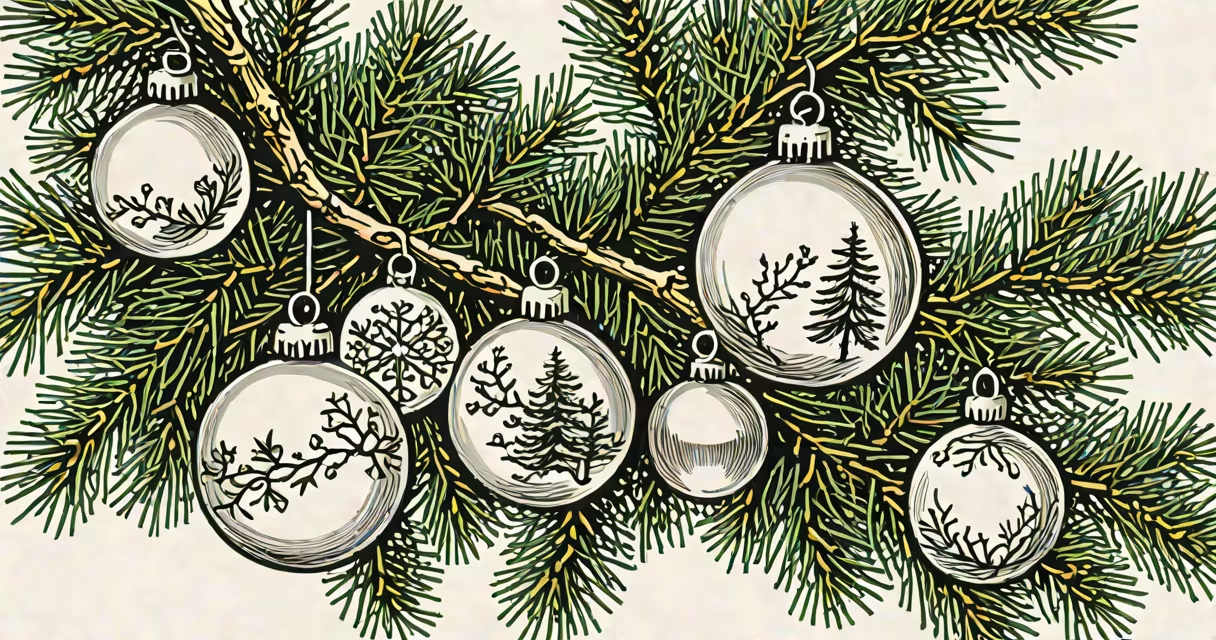
Christmas ornaments originated in 16th-century Germany as handcrafted decorations for evergreen trees, evolving from religious symbols into mass-produced holiday icons. They began as apples, nuts, and paper shapes, later becoming glass spheres with painted designs. Today's ornaments reflect centuries of cultural exchange, regional craftsmanship, and seasonal symbolism.
The earliest known Christmas ornaments were simple, symbolic items placed on trees during winter festivals. In 16th-century Strasbourg, families hung apples on fir trees to represent the Garden of Eden, a tradition tied to the Feast of Adam and Eve. These apples were often made of red cloth or wood, sometimes decorated with gold leaf. By the 17th century, artisans in the Erzgebirge region began crafting small glass balls, using local glassblowing techniques passed down through generations.
By the 1800s, glass ornaments became central to Christmas celebrations in Europe. The first documented glass Christmas ball was created in 1847 by Johann Gottfried Keller in Lauscha, Thuringia. His design featured a clear glass sphere with a silvered interior and hand-painted floral motifs. These early ornaments were fragile and expensive, accessible only to wealthy households. By 1850, over 10,000 glassblowers in Lauscha produced ornaments sold across Europe and North America.
| Type | Origin | Materials | Key Feature |
|---|---|---|---|
| Glass Ball | Germany (1840s) | Blown glass, silver lining, painted details | First mass-produced ornament style |
| Wooden Nativity | Italy (1500s) | Carved pine or walnut | Hand-sculpted figures of Mary, Joseph, and Christ child |
| Paper Chain | Central Europe (1800s) | Colored paper strips | Used in schools and homes to teach counting and faith |
| Wreath | England (1800s) | Evergreen branches, ribbons, dried fruit | Symbolized eternal life; hung on doors and walls |
Ornament styles spread globally through trade and migration. German immigrants brought glass balls to the United States in the 1850s. American manufacturers adapted the designs, introducing new colors and materials. By 1900, U.S. factories produced over 2 million ornaments annually. The introduction of electric lights in 1917 increased demand for larger, more durable ornaments suitable for indoor display.
A common misconception is that Christmas ornaments were always decorative. Early versions carried religious meaning. In 17th-century Austria, families hung wooden angels to symbolize divine presence. In Russia, painted eggs (pysanky) were used as both spiritual and festive items. These objects weren't merely aesthetic-they marked time, conveyed belief, and reinforced community identity.
One non-obvious fact: the term "ornament" did not originally describe tree decorations. In 18th-century English usage, "ornament" referred to architectural embellishments or jewelry. The word only entered holiday context in the 1840s, after Queen Victoria and Prince Albert popularized the decorated tree in Britain. Their Christmas tree, depicted in *The Illustrated London News* in 1848, included glass baubles and candles. This image circulated widely, influencing European and American customs.
I once spent a weekend sorting through a box of 1920s-era glass ornaments at a rural Pennsylvania antique shop. Most had tiny cracks from temperature shifts, but one-painted with a blue star and gold trim-still held its original silver lining. The label read "Lauscha, Germany - 1912." That single piece connected me to a lineage of craft that predates my family's arrival in the U.S. by decades.
Modern ornaments continue to reflect historical roots while embracing innovation. In Japan, paper lantern-style ornaments are made from washi paper and bamboo. In Mexico, artisans create sugar skull ornaments using clay and edible glaze. The 2023 National Ornament Show in New York featured 47 handmade pieces from 12 countries, including a 3D-printed snowflake from Finland and a ceramic reindeer from Ukraine.
Ornaments are not interchangeable with other holiday decorations. While wreaths, garlands, and lights serve functional roles in seasonal lighting and framing, ornaments are distinct in their focus on individuality and narrative. A glass ball may carry a name, year, or event-like a wedding or birth. This personalization transforms them from mere decoration into heirlooms.
For example, a 1958 blue glass ornament from Lauscha, now part of a private collection, features a painted scene of a train crossing a bridge. The artist signed it "F. Schmitt - Lauscha." It was given as a gift to a U.S. Army officer stationed in West Germany. Decades later, it remains in his family's tree, unchanged. Its value lies not in market price but in continuity-each year it is hung, it reaffirms a memory.
Historical accuracy matters. Some sources claim that the first Christmas ornament was a 12th-century carved nut. This is incorrect. While nuts were used in medieval winter feasts, there is no evidence of them being hung on trees before the 16th century. The earliest documented tree decoration appears in a 1521 letter from a Lutheran pastor in Strasbourg describing a fir tree adorned with apples and paper flowers.
According to the Smithsonian Institution's National Museum of American History, the oldest surviving Christmas ornament dates to 1840 and is a glass ball from Lauscha. It is currently on display in the "American Holiday Traditions" exhibit. The museum notes that early ornaments were not intended for children's play-many were too delicate to survive rough handling.
Another key source is the German Historical Museum in Berlin, which maintains records of Lauscha's glassblowing guilds from 1830 onward. Their archives show that by 1870, over 80% of exported ornaments bore the mark "Made in Lauscha," a certification of quality and origin.
Today, the tradition continues through both preservation and adaptation. Families pass down ornaments across generations. Museums document their evolution. Craftsmen still use hand-blown techniques in regions like Czech Republic and Poland. Even digital versions exist-some apps allow users to "hang" virtual ornaments on a digital tree, tracking family memories over time.
Understanding the history Christmas ornaments reveals more than festive trivia. It shows how small objects carry deep cultural weight. From religious symbols to global trade goods, from handmade crafts to mass-produced keepsakes, each ornament tells a story of connection, memory, and celebration.