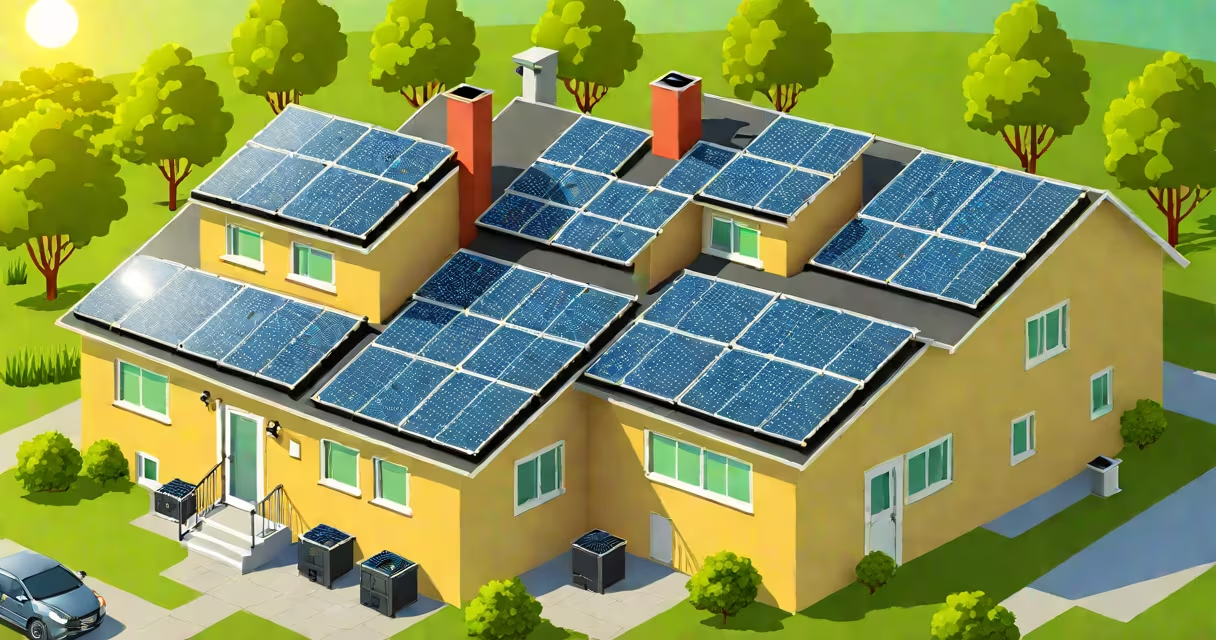
Solar panels generate electricity by converting sunlight into direct current (DC) using photovoltaic cells, which then powers homes, businesses, and off-grid systems through inverters and electrical grids.
Solar panels work through the photovoltaic effect: when photons from sunlight strike semiconductor materials like crystalline silicon, they dislodge electrons, creating an electric current. This DC electricity flows to an inverter, which converts it into alternating current (AC) usable by household appliances and the power grid.
Modern solar installations typically include mounting hardware, wiring, a charge controller (for off-grid systems), and a monitoring system. The entire setup connects to a building's electrical panel or feeds excess power back into the utility grid via net metering.
Residential, commercial, and utility-scale solar installations differ in scale and function. Residential systems usually range from 3 kW to 10 kW and are designed to offset household electricity bills. Commercial systems often exceed 100 kW and serve offices, factories, and retail centers.
Utility-scale solar farms can span hundreds of acres and produce enough electricity for tens of thousands of homes. The largest operational solar farm in the U.S., the Topaz Solar Farm in California, covers 9.5 square miles and generates 550 megawatts (MW) of power.
| System Type | Typical Size | Primary Use | Power Output Example |
|---|---|---|---|
| Residential | 3-10 kW | Home electricity, reducing grid dependence | 4,000 kWh/year (average U.S. home) |
| Commercial | 10-1,000 kW | Business operations, HVAC, lighting | 100,000 kWh/year (small office) |
| Utility-scale | 10 MW - 500+ MW | Grid supply, regional power distribution | Topaz Solar Farm: 550 MW |
Off-grid systems rely on battery storage to provide power during nighttime or cloudy periods. These are common in remote cabins, rural clinics, and mobile applications like RVs and boats. A typical off-grid setup includes 4-8 solar panels, a 48-volt battery bank, and a charge controller.
Proper orientation and tilt maximize sun exposure. In the Northern Hemisphere, panels face south at an angle equal to the site's latitude. For example, a home in Seattle (latitude ~47°) should have panels tilted at 47 degrees for optimal annual yield.
Roof-mounted systems are most common in urban areas. Ground mounts are used where rooftops are unsuitable or shaded. A ground-mounted range in Arizona, for instance, can achieve 25% higher output than a roof system due to better airflow and adjustable angles.
After installation, the system must be inspected and approved by local authorities and utility companies. In many U.S. states, the process takes 2-6 weeks. Once approved, the system can be connected to the grid and begin generating credits through net metering.
Many assume solar panels only work in sunny climates. But Germany, which receives less sunlight than Florida, leads Europe in solar energy adoption, producing over 12% of its electricity from solar in 2023. Modern panels operate efficiently even under diffuse light.
Another misconception is that solar panels require frequent maintenance. Most systems need cleaning only once or twice a year. Rain typically washes away dust and debris. A study by the National Renewable Energy Laboratory (NREL) found that performance degradation averages 0.5% per year-well below the 1% assumed in older models.
Some believe solar panels are ineffective at night. That's correct-but they don't need to run at night. Excess daytime production is stored in batteries or credited to the grid. When solar generation drops, the system draws power from the grid or battery backup.
A homeowner in Austin installed a 7.2 kW solar system with 24 panels (300 W each) on a south-facing roof. The system produces about 10,000 kWh annually, covering 90% of their electricity usage. They use a 10 kWh lithium-ion battery for nighttime power and backup during outages.
During peak summer months, the system generates more than the home consumes. The excess 2,500 kWh is sent to the grid, earning the homeowner $350 in credits annually through net metering. Over 25 years, this offsets $12,000 in electricity costs, according to the U.S. Department of Energy's Solar Energy Technologies Office.
I installed a similar system on my own home in 2021. After the initial setup, I've only replaced the inverter once due to a power surge. Monitoring software shows consistent output within 2% of predictions.
People sometimes mix up solar panels with solar thermal collectors. While both use sunlight, solar panels generate electricity. Solar thermal systems heat water or fluids for space heating or industrial processes. A solar water heater in a California home can reduce gas usage by 50%, but it doesn't produce electricity.
Another confusion is between solar panels and solar-powered devices. A solar-powered calculator uses a small panel to run a microprocessor. A rooftop solar range powers an entire house. The scale and application differ drastically.