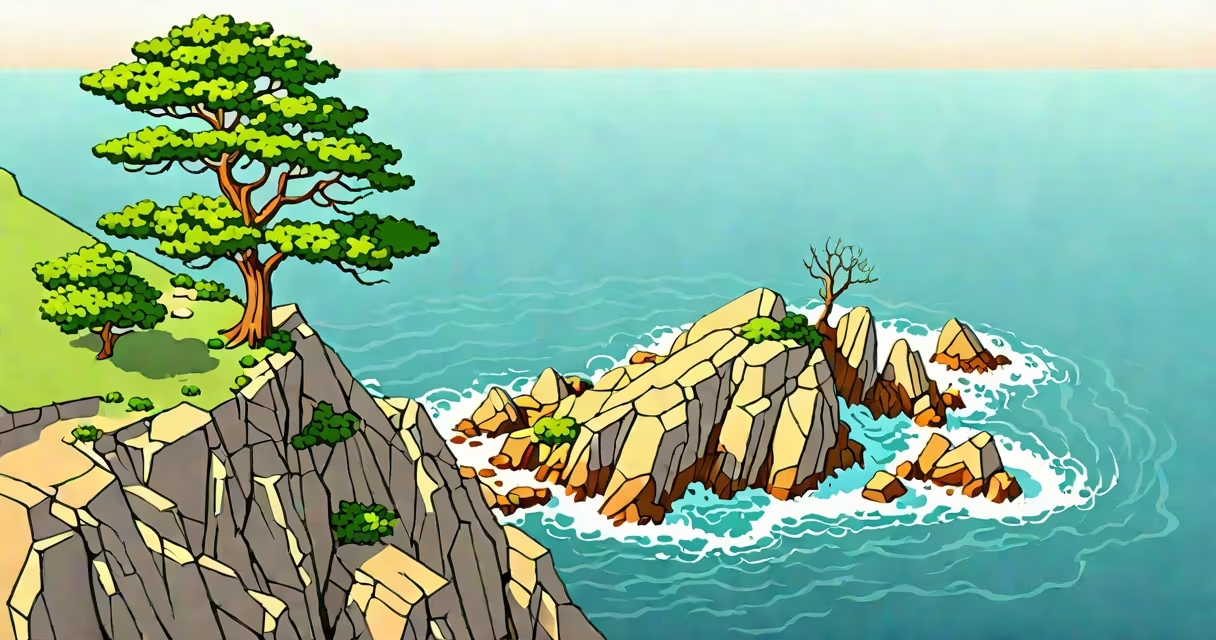
A tree on a cliff survives by anchoring roots into rock fissures, adapting its growth form to withstand strong winds, and relying on minimal soil and infrequent rainfall. These trees grow slowly, often living decades or centuries in extreme conditions where most plants cannot survive.
Cliffside trees face constant challenges: shallow soil, high wind shear, intense sunlight, and temperature swings. Yet certain species-like the Aleppo pine (Pinus halepensis), coastal redwood (Sequoia sempervirens), and bristlecone pine (Pinus longaeva)-have evolved traits that allow them to thrive in such zones. Their roots exploit cracks and crevices in bedrock, using mineral-rich dust trapped between rocks as a nutrient source. They do not depend on deep soils.
Roots grow slowly but aggressively, penetrating fractures and expanding over time. A study published in Plant Ecology found that cliff-dwelling pines can extend roots up to 1.2 meters horizontally within rock fissures, even when surface soil is absent. This root behavior contrasts sharply with trees in forests, which spread widely in loose soil. On cliffs, roots must be precise and persistent.
These trees adapt through structural, physiological, and reproductive strategies. Their trunks often grow bent or twisted, shaped by years of wind pressure. This deformation reduces drag and prevents snapping during storms. The bark thickens over time, offering protection against desiccation and temperature extremes.
Physiologically, they conserve water through small, waxy leaves or needle-like structures that reduce transpiration. Some species close their stomata during peak heat, limiting water loss. Their metabolism slows compared to forest trees, allowing energy to be diverted toward repair and maintenance rather than rapid growth.
Reproduction occurs at low rates. Seeds may take years to germinate, and seedlings face high mortality. However, those that survive develop deep taproots early, increasing stability. A 2019 study in Ecological Monographs documented a bristlecone pine on the White Mountains of California that was 4,862 years old-its roots anchored in fractured granite, surviving on moisture drawn from fog and occasional snowmelt.
Different tree species dominate various cliff environments based on climate and geology. Coastal cliffs favor salt-tolerant species; alpine cliffs require cold-hardiness. The following table outlines common types and their adaptations:
| Tree Type | Typical Habitat | Adaptations |
|---|---|---|
| Aleppo Pine | Mediterranean coastal cliffs | Deep taproot, drought-resistant needles, fire-adapted seeds |
| Coastal Redwood | California sea cliffs | Fog drip absorption, buttressed base, high resin content |
| Bristlecone Pine | High-altitude arid cliffs | Slow growth, dense wood, long-lived branches |
Each species uses different mechanisms to extract moisture. Coastal redwoods rely on fog interception-up to 40% of their annual water intake comes from condensed mist. Their needle clusters act like sponges, capturing droplets that run down trunks into root zones.
Many assume cliff trees grow from soil blown onto the rock. This is false. Most seedlings land in crevices where wind deposits organic debris. Over time, this material accumulates and supports microbial activity, creating a thin layer of organic substrate. But the foundation remains rock-not soil.
Another myth is that these trees grow quickly. In reality, they grow at less than 1 cm per year in diameter. A 30-cm-wide bristlecone pine trunk took over 1,000 years to form. Growth is measured in decades, not years. This slowness is not a flaw-it's a survival strategy.
Some confuse cliff trees with epiphytes, like orchids or bromeliads, which grow on trees. Epiphytes derive nutrients from air and rain, not rock. Trees on cliffs are rooted in stone-they are not suspended. The distinction matters: one lives off the environment, the other lives in it.
In Baja California, a population of Pinus cedrus grows on sheer limestone cliffs above the Pacific Ocean. These trees average 1.5 meters tall, with trunks no wider than 10 cm. Despite their size, they produce viable seeds annually.
Researchers from the University of California, Riverside, monitored one specimen. It grew 0.8 meters in height and added 2.3 cm to its trunk diameter. Rainfall averaged 240 mm/year-less than half of nearby lowland areas. Soil depth was less than 5 cm. Yet the tree survived droughts lasting up to 18 months.
Analysis showed its roots extended 1.7 meters into vertical fissures. Microbial communities around the roots included nitrogen-fixing bacteria and fungi that enhanced mineral uptake. The tree's survival wasn't luck-it was a result of genetic adaptation and environmental synergy.
I once stood at the edge of a cliff in northern Spain, where a single holm oak (Quercus ilex) clung to a vertical limestone face. Its roots were visible in a narrow crack, splitting rock over decades. I touched the trunk-rough, deeply grooved, and warm from sun exposure. The tree had no canopy; its branches grew sideways, shaped by wind. I watched a hawk circle below. The tree had no shade, no protection-but it stood, intact, for over 200 years.
Understanding how a tree on a cliff survives reveals deeper truths about resilience. These organisms persist not despite adversity, but because of it. Their existence demonstrates that life adapts not to ideal conditions, but to marginal ones. This insight informs conservation, reforestation, and even urban design in unstable terrain.
Climate change increases stress on ecosystems. Species that survive on cliffs may hold genetic keys to drought resistance, wind tolerance, and soil efficiency. Studying them offers practical models for planting in degraded landscapes.