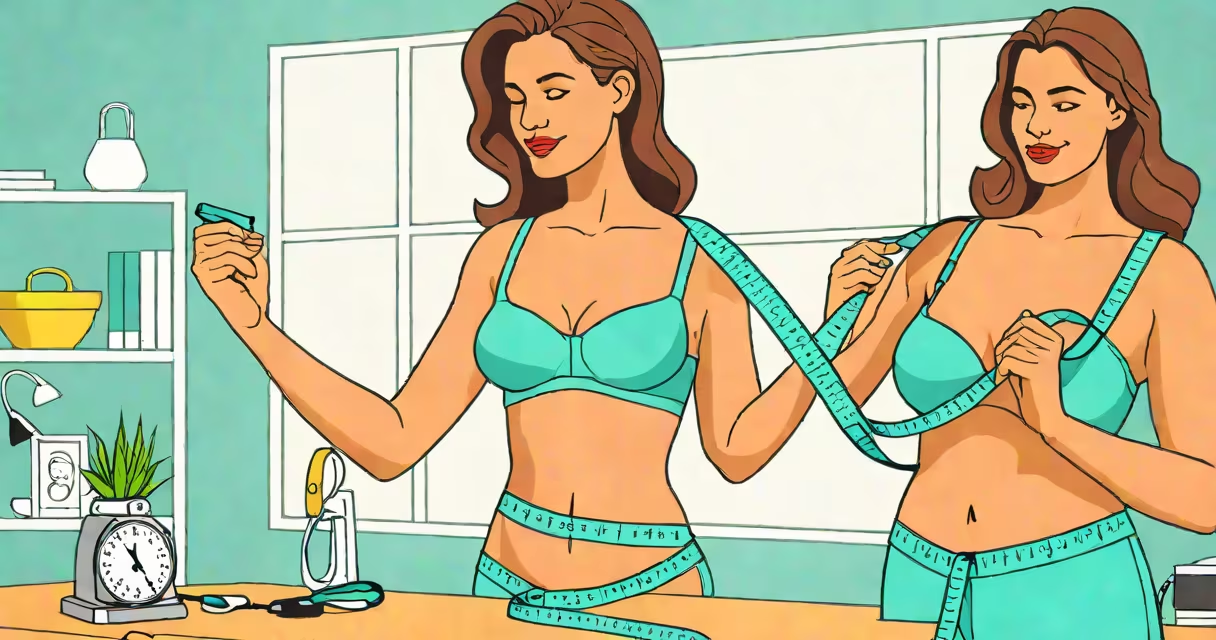
To measure for a new bra, wrap a flexible measuring tape around your ribcage just below the bust, then measure the fullest part of your bust. Subtract the first number from the second to determine your cup size. Use these numbers to find your correct bra size.
Proper bra fit starts with precise measurements. A bra that's too tight or too loose causes discomfort, poor support, and long-term posture issues. The most common error is assuming your size based on clothing or past purchases. Body shape changes over time due to weight shifts, pregnancy, or aging. Measuring ensures accuracy.
Use a soft, non-stretch measuring tape-standard sewing or tailor's tape works best. Avoid rigid metal tapes or elastic ones. Measure in a neutral posture: stand upright, arms relaxed at your sides. Wear a fitted tank top or no bra during measurement to avoid interference.
Wrap the tape snugly around your ribcage, just below the bust, under the armpits. Keep the tape level and parallel to the floor. Do not pull tight-just enough to lie flat against the skin. The tape should not dig in or sag.
Take the measurement at the nipple line. This is typically the narrowest part of the torso. If your ribcage is uneven, measure at the lowest point where the tape lies smoothly. Record the number in inches. Round to the nearest half-inch. For example, if the tape reads 32.5 inches, round to 32.5.
Band sizes are standardized. Add 4 inches to the measurement if it ends in .5 (e.g., 32.5 becomes 36.5 → size 36). If it ends in .0, add 4 inches directly (e.g., 34.0 becomes 38 → size 38). This adjustment accounts for the stretch in the band material.
Measure the fullest part of your bust while standing upright. Keep the tape horizontal and parallel to the floor. Do not lift or compress the breast tissue. The tape should follow the natural curve of the chest.
Record this measurement in inches. For example, if the tape reads 38.5 inches, write down 38.5. Compare this number to your band size. Subtract the band measurement from the bust measurement. The difference determines your cup size:
| Difference (inches) | Cup Size |
|---|---|
| 1 | A |
| 2 | B |
| 3 | C |
| 4 | D |
| 5 | DD |
| 6 | D |
| 7 | E |
| 8 | F |
For example: band size 34 inches, bust size 38 inches. Difference = 4 inches → cup size D. Final size: 34D.
Many people wear bras that are off by one or two sizes. A study by the American Council on Exercise found that 85% of women wear the wrong bra size. Ill-fitting bras contribute to back pain, shoulder strain, and reduced confidence.
Support systems like the National Breast Cancer Foundation emphasize consistent fit. They recommend re-measuring every six months or after significant life events such as childbirth, weight gain, or menopause. Breast tissue composition changes over time, affecting volume and shape.
Common mistakes include measuring over a thick sweater, letting the tape hang low, or measuring while lying down. These errors skew results. Always measure standing, in a light top, and with the tape level.
Not all bra styles require the same measurement method. Full-coverage bras and sports bras rely heavily on band fit. Strapless and plunge styles demand precise cup depth and center-front width to prevent gaping or slipping.
For strapless bras, measure both the band and bust, then check the center-back width. A wide center-back reduces pressure on the shoulders. If the center-back measures over 5 inches, consider a larger band size. This adjustment prevents slippage during movement.
When measuring for a push-up or balconette bra, focus on the underbust and full bust. These styles often have molded cups that don't conform to natural shape. Use the measurement to select a size that fits the mold, not the body.
One widespread myth is that bra size correlates directly to clothing size. A woman who wears a size 10 in jeans may wear a 34D or 36C. Clothing and bra sizing are unrelated systems. You cannot infer bra size from dress or pant size.
Another error is assuming that a "full" bust means a large cup. Cup size depends on the difference between band and bust, not absolute size. A woman with a 32-inch band and 36-inch bust is a 32C. Another with a 36-inch band and 40-inch bust is also a 36C. The cup size is relative to the band.
As someone who once wore a 34D for years, I discovered through measurement that my actual size was 36C. My breasts were not larger-they were shaped differently. The band was too tight, pulling the cups inward. After switching to the correct size, I experienced immediate relief from shoulder indentations and back tension.
Once you have your band and cup measurements, consult a size chart from a reputable brand. Sizes vary slightly between manufacturers. For example, a 34D from one brand may be equivalent to a 36C in another.
Always try on multiple sizes. Even with accurate measurements, fit varies by style and construction. Look for even coverage, no bulging at the edges, and straps that stay in place without digging.