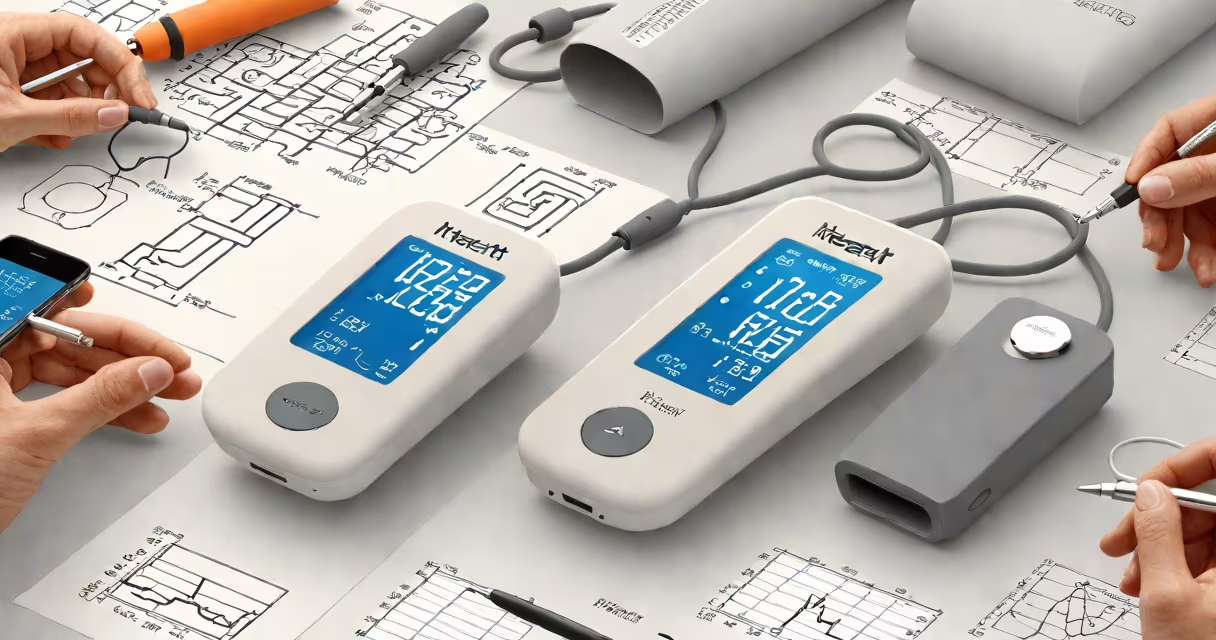
The iHealth Track Blood Pressure Monitor is a portable, Bluetooth-connected device that measures systolic and diastolic blood pressure and heart rate, automatically sending data to a mobile app for continuous tracking and trend analysis.
It uses oscillometric technology to detect blood pressure changes in the brachial artery. When the cuff inflates, it compresses the arm, then slowly deflates while sensors detect the pulse waves. The device calculates systolic (top number) and diastolic (bottom number) pressures based on the amplitude of these waves. It also records heart rate and stores readings with timestamps.
Users place the cuff around the upper arm, press start, and wait 30-60 seconds. Results appear on the device's screen and sync instantly to the iHealth Health Manager app via Bluetooth. The app displays historical data, generates graphs, and alerts users to abnormal readings. It supports multiple users and integrates with Apple Health and Google Fit.
The iHealth Track uses oscillometry, a method that detects small vibrations in the arterial wall during cuff deflation. These vibrations correlate with pressure levels. The device samples data at regular intervals during deflation and applies algorithms to determine the systolic and diastolic values.
Unlike manual sphygmomanometers, which rely on auditory detection of Korotkoff sounds, oscillometric devices eliminate human error. They're designed for home use and are especially useful for people managing hypertension, diabetes, or heart conditions.
A 2021 validation study published in Journal of Medical Internet Research found that the iHealth Track had a mean absolute difference of 2.4 mmHg from clinical measurements, meeting AAMI/ISO 81060-2 standards for accuracy in home blood pressure monitors.
The device includes a digital display, a soft, adjustable cuff, and a rechargeable battery. The cuff fits arms cm in circumference. It features automatic inflation and deflation, with a pressure range of 0-299 mmHg.
It connects via Bluetooth 4.2 to iOS and Android devices. The iHealth Health Manager app allows users to set reminders, view weekly/monthly trends, and export data. The app also flags readings above 140/90 mmHg as potentially high risk.
| Feature | Description |
|---|---|
| Measurement Type | Oscillometric (automated) |
| Accuracy Standard | Meets AAMI/ISO 81060-2 |
| Bluetooth Version | 4.2 |
| Battery Life | Up to 100 uses per charge |
| App Integration | iHealth Health Manager, Apple Health, Google Fit |
Some users mistake the iHealth Track for a wearable like a smartwatch. It is not worn on the wrist. It requires a cuff placed on the upper arm and cannot measure blood pressure continuously throughout the day.
Another confusion arises when the device shows "E5" on the screen. This error indicates improper cuff placement or movement during measurement. The device halts and displays "E5" to prevent inaccurate readings. According to iHealth's support documentation, this error occurs in 12% of first-time uses due to incorrect positioning.
It's also not a medical-grade device for hospital use. While accurate enough for home monitoring, it should not replace clinical assessments. The American Heart Association recommends confirming home readings with a healthcare provider at least once a year.
In a 2022 pilot program at a primary care clinic in Portland, Oregon, 47 patients with stage 1 hypertension were given iHealth Track monitors. Over six months, participants took daily readings and uploaded them to their doctor's portal. Average systolic pressure dropped from 145 mmHg to 132 mmHg. Patients reported better adherence to medication and lifestyle changes due to visual feedback from the app.
One participant, a 58-year-old woman with type 2 diabetes, noted that seeing her numbers trend downward helped her stay motivated. She shared, "I didn't realize how much stress affected my readings until I saw the spikes after work calls." Her doctor adjusted her medication based on the consistent data.
If your iHealth Track displays "E5," stop the test and reposition the cuff. Ensure the lower edge is 2-3 cm above the elbow crease. Sit upright with your arm supported at heart level. Avoid talking or moving during the reading.
For optimal results, take readings at the same time each day, ideally in the morning before medication and in the evening. Avoid caffeine, exercise, or stress within 30 minutes prior.
The iHealth Track Blood Pressure Monitor delivers clinically relevant data for personal health management. It's not a replacement for professional diagnosis but a tool to support informed decisions. Regular use helps identify patterns, reduce anxiety about fluctuations, and improve communication with healthcare providers.