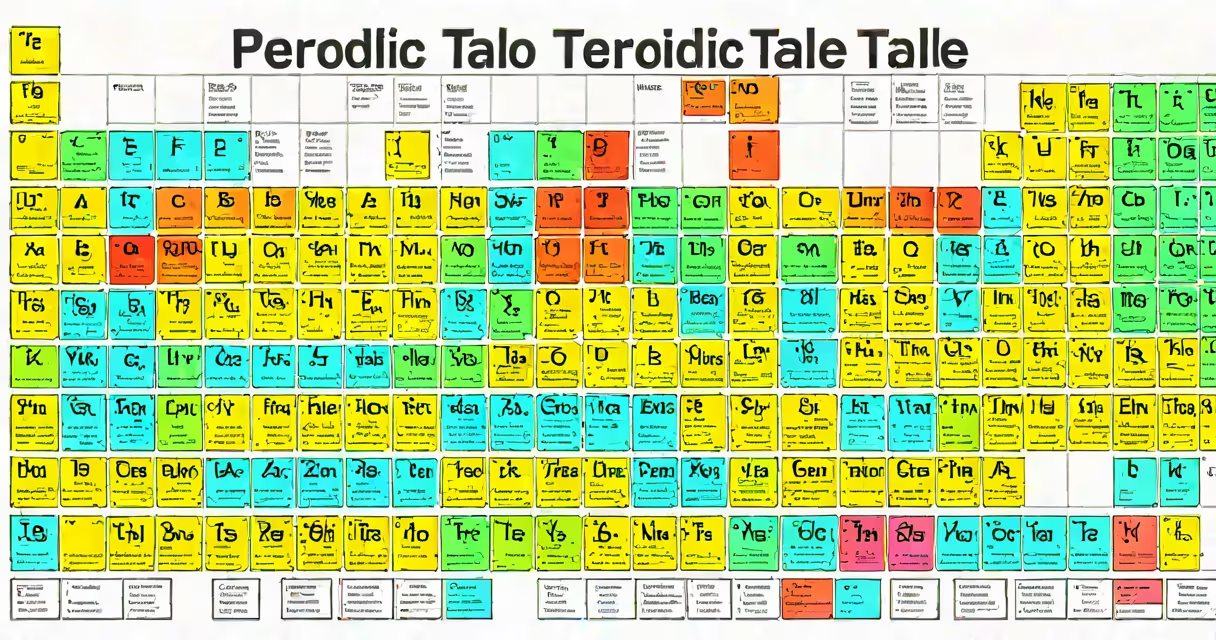
The periodic table is a structured arrangement of all known chemical elements, ordered by increasing atomic number and grouped by similar chemical and physical properties. It displays 118 confirmed elements, from hydrogen (atomic number 1) to oganesson (118), revealing patterns in reactivity, electron configuration, and elemental behavior.
Elements are listed in rows called periods and columns called groups. Each box contains the element's symbol, atomic number, and average atomic mass. The layout reflects the periodic law: when elements are arranged by atomic number, their properties recur periodically. This organization allows scientists to predict how an element will behave based on its position.
For example, fluorine (F, atomic number 9) sits in Group 17, the halogens. Like chlorine and bromine, it forms salts with metals and reacts vigorously with water. Its placement explains why it gains one electron in reactions-consistent with other halogens. This predictive power is central to the table's utility.
Each element's position is determined by its atomic number-the number of protons in its nucleus. Hydrogen has one proton, helium has two, lithium three, and so on. As atomic numbers increase, electrons fill energy levels in a predictable sequence. The table's structure mirrors this electron shell filling.
Periods represent energy levels. Period 1 holds only two elements (H and He), corresponding to the first electron shell's capacity. Period 2 includes eight elements (Li through Ne), matching the second shell's maximum of eight electrons. The longer periods (4-7) contain transition metals and inner transition metals (lanthanides and actinides), which fill d and f orbitals.
Groups (columns) share valence electron configurations. Group 1 elements (alkali metals) have one valence electron and lose it easily to form +1 ions. Group 18 (noble gases) have full outer shells and rarely react. These patterns make the table a tool for predicting bonding, ion formation, and reaction outcomes.
The standard periodic table divides elements into four main blocks based on electron subshell filling:
| Block | Subshell | Elements | Examples |
|---|---|---|---|
| s-block | s-orbital | Groups 1-2, plus He | Lithium (Li), Calcium (Ca) |
| p-block | p-orbital | Groups 13-18 | Boron (B), Oxygen (O), Krypton (Kr) |
| d-block | d-orbital | Groups 3-12 | Iron (Fe), Nickel (Ni), Copper (Cu) |
| f-block | f-orbital | Lanthanides & actinides | Cerium (Ce), Uranium (U) |
Transition metals (d-block) often form colored compounds and exhibit multiple oxidation states. Iron (Fe, atomic number 26) can exist as Fe²⁺ or Fe³⁺, important in hemoglobin. Nickel (Ni, 28 on periodic table) is used in stainless steel and batteries due to its resistance to corrosion and ability to form stable alloys.
A common misconception is that the periodic table was always complete. When Dmitri Mendeleev published his version in 1869, he left gaps for undiscovered elements like gallium and germanium. He predicted their properties accurately-such as gallium's melting point (29.8°C) and density (5.9 g/cm³)-which were later confirmed. His foresight demonstrated the table's predictive strength.
People often assume the periodic table is purely alphabetical or sorted by weight. It is not. Elements are ordered by atomic number, not atomic mass. For example, argon (Ar, atomic number 18) has a higher average atomic mass than potassium (K, atomic number 19), yet it appears first in the sequence.
Another error is thinking the table is static. New elements are added when synthesized in labs. Nihonium (Nh, 113), moscovium (Mc, 115), tennessine (Ts, 117), and oganesson (Og, 118) were officially recognized between 2015 and 2016. These elements exist only briefly-some for milliseconds-and are created via particle accelerators.
Some believe the table is only useful in advanced chemistry. In reality, it underpins everyday applications. Water (H₂O) is understood through oxygen's position in Group 16 and hydrogen's in Group 1. Sodium chloride (NaCl) makes sense because sodium (Group 1) donates an electron to chlorine (Group 17). Without the periodic table, modern materials science, medicine, and electronics would lack foundational clarity.
I once built a small-scale model of the periodic table using colored paper squares and magnets. I placed iron (Fe, 26) near nickel (Ni, 28) and cobalt (Co, 27) to show how transition metals cluster together. When I tested the magnetic pull between them, I noticed they all attracted to the same surface-just like how their chemical behaviors align. That tactile experience reinforced how structure predicts function.
Consider titanium (Ti, 22 on periodic table). It's lightweight, strong, and resistant to corrosion. Its position in Group 4 and period 4 explains its high melting point (1,668°C) and low density (4.5 g/cm³). These traits make it ideal for aerospace components and medical implants. Engineers rely on the periodic table to select materials that meet performance demands.
Understanding introducing the periodic table begins with recognizing it as more than a chart-it's a language of matter. It connects atomic structure to observable behavior. Whether analyzing a compound in a lab or designing a new alloy, the periodic table provides a consistent structure for discovery.