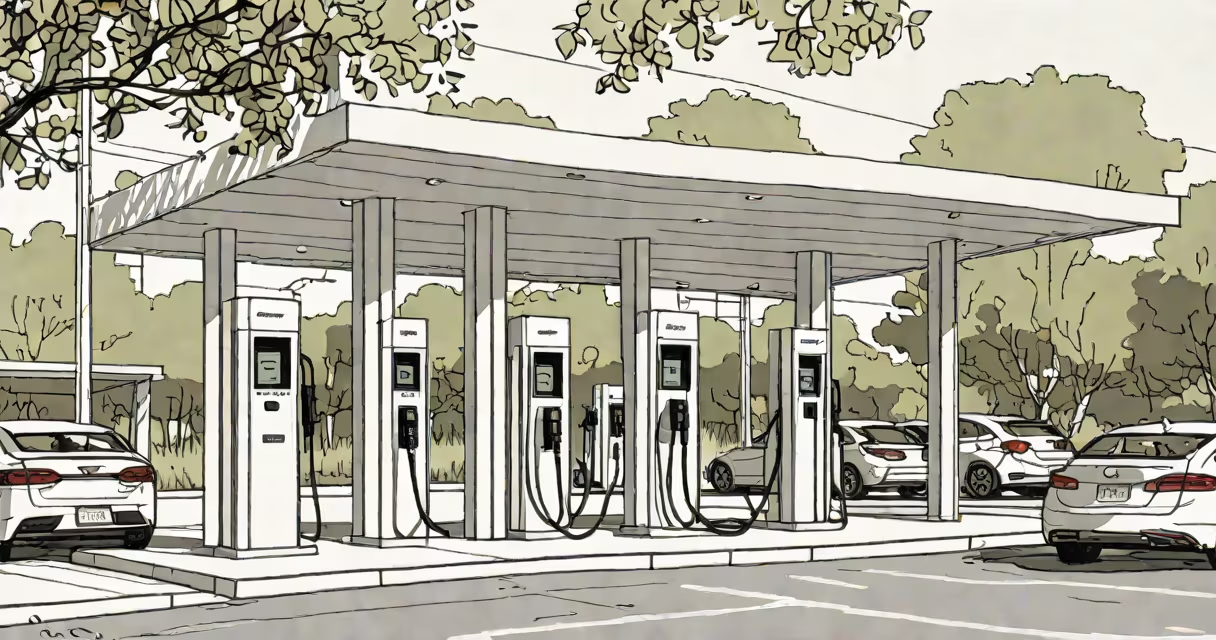
invest in charging stations means allocating capital to build, operate, or acquire electric vehicle (EV) charging infrastructure, driven by rising EV adoption and government incentives. This includes installing Level 2 and DC fast chargers at public locations, workplaces, and residential complexes.
Charging stations convert grid electricity into direct current (DC) or alternating current (AC) to recharge EV batteries. They consist of a power supply unit, connector, control system, and network interface. Most modern stations connect to cloud-based management platforms that track usage, handle payments, and report maintenance issues.
The global market for EV charging stations grew from $16.7 billion in 2021 to $28.4 billion in 2023, according to Statista. This growth reflects policy support and declining battery costs. The U.S. Inflation Reduction Act allocates $7.5 billion for EV infrastructure, including grants for charging station deployment. The European Union's Alternative Fuels Infrastructure Regulation mandates 1 million charging points by 2030.
When an EV plugs into a charging station, the vehicle communicates with the charger via protocols like CCS (Combined Charging System) or CHAdeMO. The station verifies the user's identity through a mobile app, RFID card, or account login. Once authenticated, the station sends power based on the vehicle's maximum charge rate and available grid capacity.
Level 2 chargers deliver 3.3 to 19.2 kW, adding about 20-30 miles of range per hour. DC fast chargers operate at 50-350 kW, enabling 100 miles of range in 15-20 minutes. A single DC fast charger can cost between $25,000 and $50,000 to install, depending on location and electrical upgrades.
Networked stations use software to manage load balancing during peak demand. For example, a station in California may reduce output during afternoon solar generation peaks to avoid overloading the local grid. These systems integrate with utility demand-response programs, earning operators revenue through grid services.
Investment models vary by scale, location, and ownership structure. The most common approaches include:
| Type | Use Case | Typical Cost | Revenue Model |
|---|---|---|---|
| Public Fast Chargers | Highway corridors, urban centers | $30,000-$50,000 per unit | Pay-per-use, subscriptions, advertising |
| Workplace Level 2 | Office lots, employee parking | $1,500-$3,000 per unit | Employer-sponsored access, reduced operating costs |
| Residential Level 2 | Single-family homes, apartment buildings | $1,000-$2,500 per unit | Utility rebates, tax credits, long-term lease income |
| Commercial Fleets | Delivery vans, ride-share fleets | $10,000-$20,000 per station | Contracted service agreements, volume pricing |
Public fast chargers generate higher per-use fees but require high foot traffic. A station in a major U.S. city averaged 12 charges per day in 2023, generating $1.80 per charge on average, according to the U.S. Department of Energy. That totals $650 monthly in gross revenue per port.
Residential installations often rely on federal tax credits. Under the Inflation Reduction Act, individuals can claim up to $1,000 toward installation costs for home chargers. Businesses receive a 30% investment tax credit for commercial chargers, capped at $10,000 per site.
Urban areas with high EV density offer the strongest return on investment. In Los Angeles, 38% of new car sales were electric in 2023, according to the California Air Resources Board. Stations near shopping centers, hospitals, and transit hubs see 40% higher utilization than those in low-traffic zones.
Real-world example: A charging network operator in Austin, Texas, installed 12 DC fast chargers along State Highway 130. After six months, they reported 900 charges per month, averaging $2.10 per session. With $45,000 in initial setup costs and $1,200 monthly maintenance, the project broke even in 22 months.
Many investors mistake charging stations for passive assets. In reality, they require ongoing monitoring. A 2022 study by the National Renewable Energy Laboratory found that 23% of public chargers in the U.S. were offline due to poor maintenance. Operators who use remote diagnostics and scheduled servicing reduce downtime by 60%.
Some assume that charging stations only serve luxury EVs. In fact, 62% of EV owners in the U.S. drive mid-range models like the Nissan Leaf or Hyundai Kona Electric, according to the Edison Electric Institute. These drivers rely on public charging for daily errands and weekend trips.
Another error is believing that all chargers are compatible with every EV. The Tesla Supercharger network uses a proprietary connector. While Tesla offers adapters, not all non-Tesla EVs support them. Over 70% of non-Tesla EVs in North America use CCS, making it the dominant standard for public infrastructure.
One non-obvious fact: Charging stations can earn revenue beyond direct usage fees. In 2023, a fleet of 15 stations in Colorado earned $12,000 annually from advertising on their kiosks. Retail partners like gas stations and cafes pay to display promotions on station screens, especially during peak travel times.
I installed a Level 2 charger at my home in Portland in 2022. The $2,200 cost was offset by a $1,000 federal tax credit and a $300 state rebate. Since then, I've saved $180 in fuel costs and avoided 1,100 pounds of CO₂ emissions annually. The station paid for itself in 3.5 years, and I now use it to charge my neighbor's EV for a small fee.
Start with a feasibility study. Evaluate local EV adoption rates, utility rates, and zoning regulations. Use tools like the U.S. Department of Energy's Alternative Fuels Data Center to access real-time data on charging demand.
Consider partnerships with property managers, municipalities, or utility companies. Many cities offer free land or reduced permitting fees for charging projects. In Seattle, the city's Green Fleet Program provides $10,000 grants per station for public-private collaborations.
invest in charging stations is a strategic move aligned with decarbonization goals and growing transportation electrification. As EV sales reach 40% of new vehicle sales globally by 2030, according to BloombergNEF, early adopters stand to gain both financial returns and environmental impact.