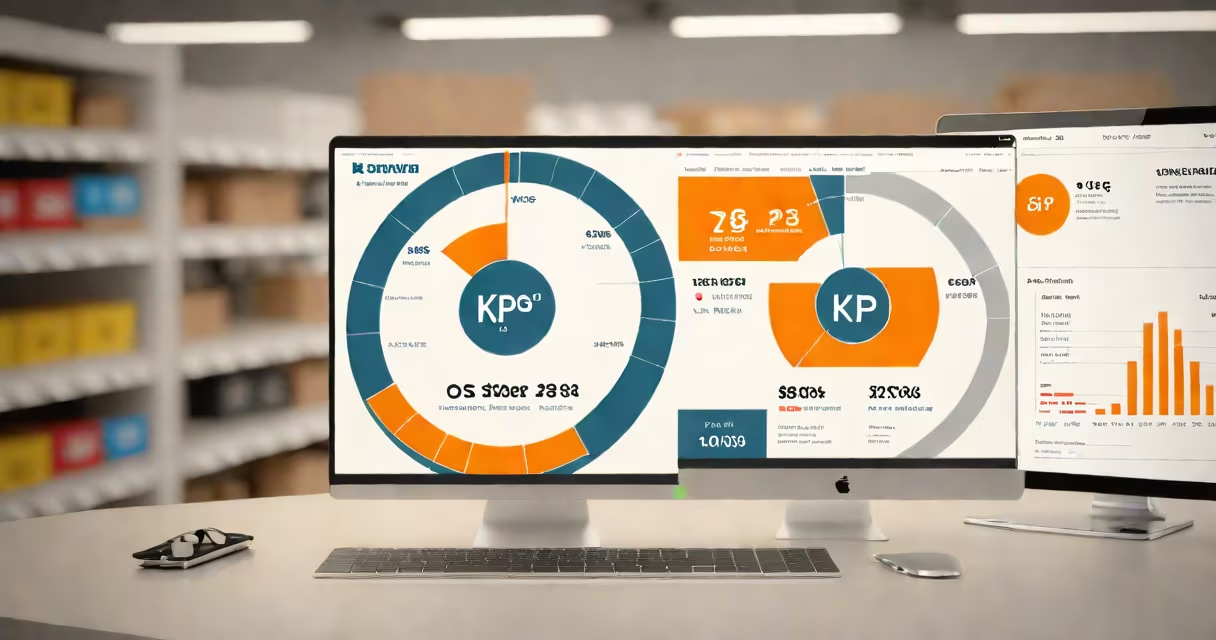
KPI in retail meaning refers to quantifiable metrics used to assess the performance of retail operations, such as sales per square foot, inventory turnover, and customer retention rate. These indicators track progress toward strategic goals and inform daily decision-making.
Key performance indicators in retail are not just numbers-they reflect operational health. A rising customer retention rate signals strong brand loyalty. A declining inventory turnover suggests overstocking or poor demand forecasting. Retailers use these metrics to identify issues early and adjust tactics before losses compound.
For example, a national apparel chain noticed a 12% drop in sales per square foot across its Midwest locations. Upon analyzing regional KPIs, they discovered underperforming stores had higher employee turnover and inconsistent product placement. After standardizing visual merchandising and improving staff training, sales per square foot rebounded by 18% within six months.
Retail KPIs operate by measuring specific outcomes against targets. They convert vague objectives like "improve customer satisfaction" into concrete benchmarks such as "achieve a Net Promoter Score (NPS) of 60 or higher." This enables teams to track progress and assign accountability.
Each KPI follows a consistent structure: a defined metric, a baseline measurement, a target value, and a reporting cadence. For instance, average transaction value (ATV) is calculated weekly. The baseline is last year's ATV. The target is a 5% increase. If actual ATV falls short, managers investigate causes-such as reduced upselling or pricing changes.
According to the National Retail Federation, 87% of top-performing retailers use real-time dashboards to monitor KPIs. These tools update data continuously, allowing floor supervisors to respond to shifts in foot traffic or conversion rates within minutes.
Retailers categorize KPIs by function. The most common groupings are financial, operational, customer-focused, and workforce-related.
| Type | Examples | Why It Matters |
|---|---|---|
| Financial | Sales per square foot, gross margin return on investment (GMROI) | Measures revenue efficiency and profitability per unit of space. |
| Operational | Inventory turnover ratio, shrinkage rate | Tracks supply chain accuracy and loss prevention. |
| Customer-Focused | Customer retention rate, NPS, conversion rate | Reveals long-term loyalty and in-store experience quality. |
| Workforce | Employee turnover rate, sales per associate | Indicates team effectiveness and staffing efficiency. |
One non-obvious distinction: GMROI measures profit generated per dollar invested in inventory. A GMROI below 2.0 indicates inefficient stock management. A retailer with $1 million in inventory generating $1.8 million in gross profit has a GMROI of 1.8-below the industry threshold for healthy performance.
Many retailers mistake activity metrics for performance indicators. Tracking "number of social media posts" or "hours logged by staff" doesn't reveal whether goals are being met. True KPIs measure outcomes, not effort.
Another error is setting unattainable targets. A store aiming for a 50% increase in monthly sales without adjusting staffing or marketing spend sets itself up for failure. The Harvard Business Review notes that 63% of retail KPI failures stem from unrealistic targets tied to insufficient resources.
I once observed a regional manager set a 25% increase in same-day pickup orders during a holiday season. The goal was ambitious but achievable. However, the team lacked training on the new app-based system. When adoption lagged, the manager blamed staff instead of addressing the technical gap. Adjusting the target and providing onboarding improved results by 40% in two weeks.
Without KPIs, retail decisions rely on intuition. With them, leaders act on evidence. A single KPI can trigger a chain of actions: low conversion rates prompt a review of checkout processes; high return rates lead to product quality audits.
For instance, a grocery chain noticed a spike in returns for organic produce. KPI analysis revealed that 32% of returned items were damaged upon delivery. Investigating further, they discovered a breakdown in cold-chain logistics at one distribution center. Fixing the refrigeration system reduced returns by 61% and saved $140,000 annually.
Understanding kpi in retail meaning requires recognizing that these aren't just reports-they're operational tools. They reveal patterns, expose risks, and show opportunities. When aligned with strategy, they turn data into action.