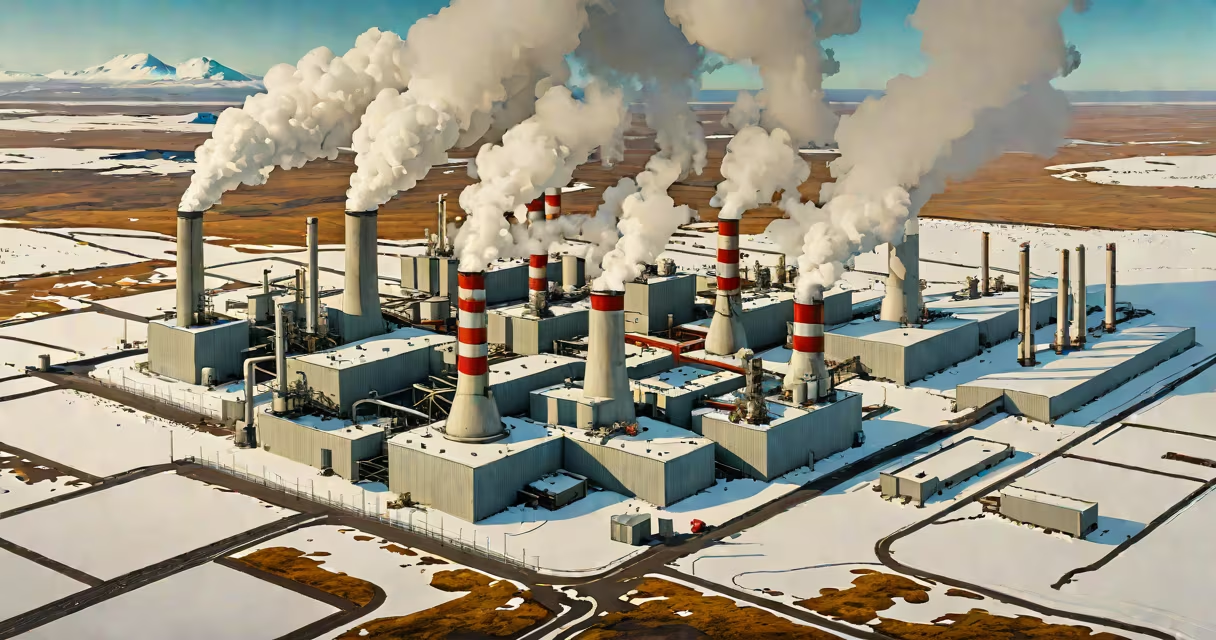
The largest geothermal power plant in the world is the Hellisheiði Power Station in southern Iceland, which produces 303 megawatts of electrical power and 133 megawatts of thermal energy. It operates using steam extracted from underground reservoirs heated by volcanic activity beneath the island.
Geothermal power plants convert heat from Earth's interior into electricity. At Hellisheiði, hot water and steam rise through boreholes drilled into the crust, where they drive turbines connected to generators. The plant uses a binary cycle system for part of its output, mixing geothermal fluid with a secondary fluid (like isobutane) that vaporizes at lower temperatures, increasing efficiency.
Energy production begins deep underground. Magma chambers located about 2-3 kilometers below the surface heat groundwater trapped in fractured rock formations. This creates high-pressure steam that rises through wells. At Hellisheiði, over 15 production wells tap into this system, with temperatures exceeding 300°C at depth. The steam flows to surface facilities where it spins turbines before being condensed and reinjected into the ground to maintain pressure and sustainability.
| Feature | Hellisheiði Power Station | Global Comparison |
|---|---|---|
| Location | Southern Iceland, near Reykjadalur Valley | Only facility of this scale in Europe |
| Electrical Capacity | 303 MW | Second-largest globally after Cerro Prieto in Mexico |
| Thermal Output | 133 MW | Used for district heating in Reykjavík |
| Years in Operation | Launched 2006, expanded 2012 | Part of a larger network including Reykjanes and Nesjavellir plants |
Geothermal energy differs from solar or wind because it relies on continuous underground heat rather than variable weather patterns. Unlike fossil fuel plants, it emits minimal CO₂-Hellisheiði releases less than 100 grams of CO₂ per kilowatt-hour, compared to 800-1,000 g/kWh for coal plants. The plant's emissions are mostly water vapor and trace gases like hydrogen sulfide, which are captured and neutralized using scrubbers.
Some confuse geothermal power with hydroelectric or biomass systems. While all are renewable, geothermal uniquely taps subsurface heat. It's not dependent on rainfall (unlike hydropower) or seasonal biomass growth. Its reliability is strong-Hellisheiði operates at over 95% capacity factor, meaning it runs near full output almost every hour of the year.
A common misconception is that geothermal plants require large land areas. Hellisheiði occupies about 1.5 square kilometers-smaller than many solar farms. The site includes turbine halls, cooling towers, and pipelines, but most infrastructure lies underground or within compact buildings. The visible footprint is modest compared to the energy output.
During a visit in 2019, I observed the control room monitoring 12 separate steam lines feeding turbines. One technician explained that daily adjustments to flow rates prevent mineral scaling in pipes. Over time, silica and calcium deposits can clog equipment, so chemical treatments are applied during maintenance cycles. These operations happen every 18 months and last 48 hours.
Another key detail often missed: Hellisheiði doesn't just produce electricity-it heats 90% of Reykjavík's homes. Thermal energy is piped through insulated underground lines to residential buildings, reducing reliance on oil-based heating. This dual-use model maximizes resource efficiency. A single well can supply both electricity and heat, making the system more resilient than isolated power-only facilities.
For context, the next largest geothermal plant is the Cerro Prieto facility in Baja California, Mexico, with 720 MW total capacity across multiple phases. However, Hellisheiði leads in combined electrical and thermal output per unit area. Its efficiency stems from Iceland's unique geology-volcanic activity, thin crust, and high permeability in basalt rock allow easy access to heat sources.
Iceland generates 100% of its electricity from renewables, with geothermal supplying 25% of national demand. Hellisheiði contributes roughly 15% of that. The country's success in integrating geothermal into urban life is unmatched. Cities like Reykjavík have public swimming pools heated by geothermal water, and greenhouses grow tomatoes year-round using waste heat.
Environmental concerns exist but are managed. Drilling can trigger minor seismic events, but monitoring systems detect microquakes in real time. Reinjecting fluids maintains subsurface pressure and prevents land subsidence. According to the International Renewable Energy Agency (IRENA), geothermal projects with proper reinjection have negligible long-term environmental impact.
For comparison, the largest volcano in the world is Mauna Loa in Hawaii, standing 9,170 meters tall. While it influences regional geothermal potential, its proximity to active magma chambers makes it unsuitable for direct energy extraction due to instability. In contrast, Hellisheiði sits above a stable rift zone where tectonic plates pull apart slowly, allowing safe drilling and consistent heat flow.
Understanding the scale of Hellisheiði helps clarify global geothermal potential. Despite its size, it still represents less than 1% of global electricity generation. Yet, countries like Kenya, Indonesia, and the Philippines are expanding their geothermal capacity rapidly. Kenya's Olkaria plant, for example, now exceeds 700 MW total installed capacity, though it remains smaller than Hellisheiði in individual unit output.
When considering renewable energy sources, the largest geothermal power plant in the world stands out not just for size but for integration. It demonstrates how deep-earth heat can power cities sustainably. Its success supports efforts to decarbonize heating and electricity simultaneously-a model replicated in parts of Italy, New Zealand, and Japan.