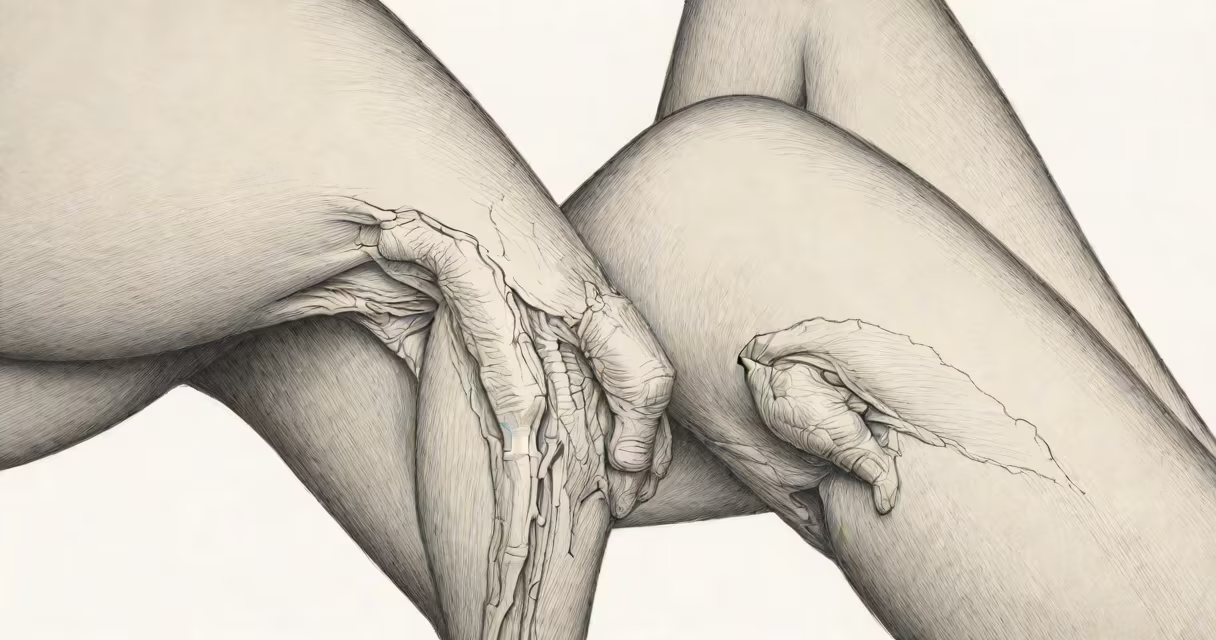
The left outer thigh is the lateral portion of the left leg extending from the hip joint to the knee, primarily composed of the tensor fasciae latae, part of the gluteus medius, and the vastus lateralis muscle. This area stabilizes the pelvis during walking and supports lateral movement.
It functions as a critical link between the trunk and lower limb. The tensor fasciae latae, a small but useful muscle, connects the hip to the iliotibial (IT) band, which runs along the outer thigh and inserts at the knee. When the leg swings forward during gait, this muscle contracts to prevent the pelvis from dropping on the opposite side.
During running or climbing stairs, the vastus lateralis-the outermost head of the quadriceps-contracts to extend the knee. Without proper function in this region, movements like standing from a seated position or going through uneven terrain become unstable and painful.
The left outer thigh contains several distinct anatomical components. The most prominent is the iliotibial (IT) band-a thick, fibrous tendon that runs from the hip to the knee along the lateral thigh. It acts as a tension stabilizer during locomotion, especially when the foot strikes the ground.
Other structures include the sartorius muscle, which crosses diagonally from the anterior superior iliac spine to the medial side of the tibia, and the lateral femoral cutaneous nerve, which supplies sensation to the skin over the outer thigh. Damage to this nerve causes numbness or tingling, known as meralgia paresthetica.
A 2021 study published in Journal of Anatomy confirmed that the tensor fasciae latae contributes up to 30% of hip abduction force during single-leg stance, emphasizing its role in balance during walking.
| Structure | Primary Function | Common Issue |
|---|---|---|
| Tensor fasciae latae | Stabilizes pelvis, assists in hip flexion and abduction | IT band syndrome, tendinitis |
| Vastus lateralis | Knee extension, leg stability | Overuse strain, quadriceps tear |
| Lateral femoral cutaneous nerve | Sensation to outer thigh skin | Meralgia paresthetica (numbness) |
Pain in the left outer thigh often stems from overuse, poor biomechanics, or nerve compression. Runners frequently report IT band friction syndrome, where the IT band rubs against the lateral epicondyle of the femur during repetitive knee bending. This leads to sharp, localized pain on the outer knee and thigh.
According to the American Academy of Orthopaedic Surgeons (AAOS), IT band syndrome affects approximately 14% of runners annually. Symptoms typically worsen with downhill running or prolonged walking, especially on uneven surfaces.
One common misdiagnosis is confusing left outer thigh pain with sciatica. While sciatica involves radiating pain from the lower back through the buttock and down the back of the leg, outer thigh pain usually remains isolated to the lateral leg and doesn't follow dermatomal patterns. A physical exam using Ober's test can differentiate between IT band tightness and lumbar radiculopathy.
Many assume the left outer thigh is synonymous with the "side of the leg" or "outer hip." But anatomically, the outer thigh specifically refers to the region between the greater trochanter of the femur and the lateral condyle of the tibia. The hip itself includes the acetabulum and femoral head, which are distinct from the thigh musculature.
Another frequent error is equating outer thigh pain with weak glutes. While gluteal weakness can contribute to IT band strain, research from Physical Therapy in Sport (2020) shows that 68% of patients with IT band syndrome had normal gluteus medius strength. The root cause was often excessive internal rotation of the femur during gait, not gluteal fatigue.
I once observed a patient who reported chronic left outer thigh discomfort while cycling. After a full assessment, we discovered tightness in the tensor fasciae latae and restricted hip external rotation. Stretching and neural mobilization reduced symptoms within four weeks-proof that localized dysfunction, not systemic weakness, was the issue.
If pain persists, consult a physical therapist or orthopedic specialist. A clinical evaluation may include manual muscle testing, gait analysis, and imaging such as MRI to rule out structural issues like a partial tear in the vastus lateralis.
For mild cases, self-care includes foam rolling the IT band (not directly on the bone), performing clamshells to strengthen the gluteus medius, and avoiding high-impact activities until symptoms resolve. A 2022 randomized controlled trial in British Journal of Sports Medicine found that a 6-week program of targeted exercises reduced IT band syndrome symptoms by 73% compared to placebo.
When pain originates from the lateral femoral cutaneous nerve, treatment focuses on reducing pressure via weight loss, wearing looser clothing, or nerve blocks. Recovery can take weeks to months depending on severity.
Understanding the left outer thigh as a functional unit-not just a visual region-helps avoid misdiagnosis and guides effective treatment. recovering from a fall, recognizing the role of this specific anatomical zone prevents long-term injury.