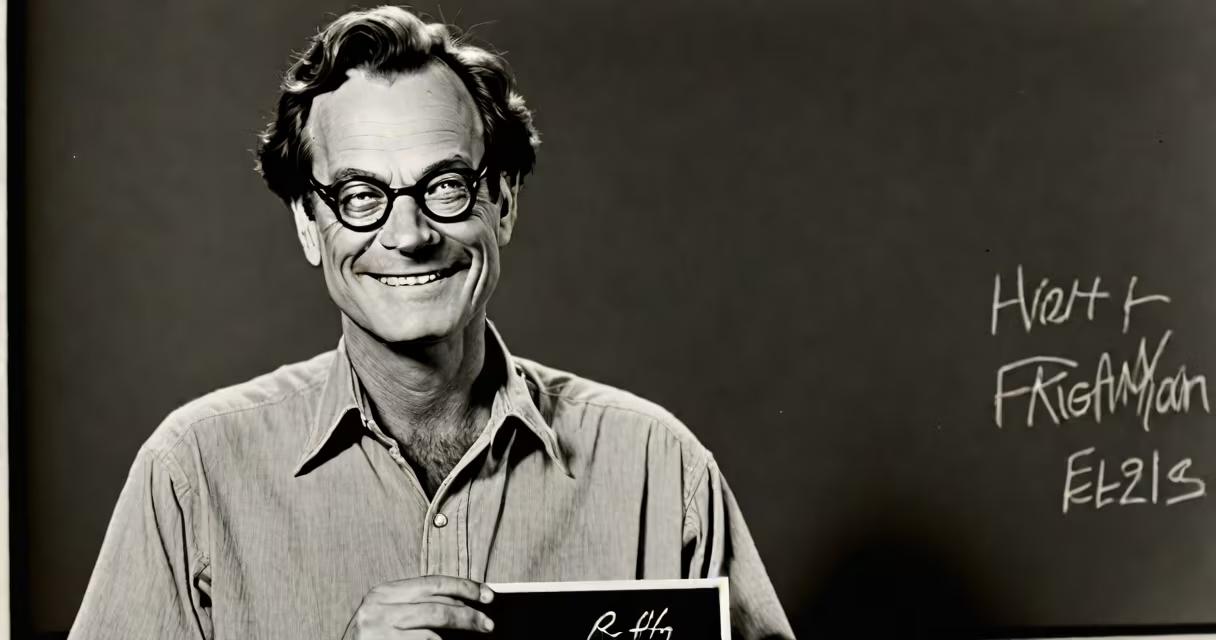
The life of Richard Feynman was a blend of revolutionary scientific insight, irreverent humor, and an unwavering commitment to understanding nature through direct observation and calculation. He won the Nobel Prize in Physics in 1965 for his work on quantum electrodynamics, co-developed the Feynman diagrams used to model particle interactions, and became a cultural icon for his ability to explain complex ideas simply.
Feynman's early years were shaped by a fascination with problem-solving. Born in 1918 in Brooklyn, New York, he taught himself calculus by age 15. His high school physics teacher encouraged him to think independently rather than memorize formulas-a lesson that defined his career. At MIT, he earned a bachelor's degree in mathematics and physics in 1939, then moved to Princeton for graduate study, where he worked under John Archibald Wheeler on the foundations of quantum mechanics.
His most influential work came during the Manhattan Project at Los Alamos, where he helped develop the atomic bomb. There, he earned a reputation for solving problems quickly, often using unconventional methods. He famously cracked safes during downtime, not out of malice but as a mental challenge. This playful side contrasted sharply with the gravity of the work he was doing-but it reflected his core belief: that learning should be driven by curiosity, not authority.
Feynman approached physics as a series of puzzles to be solved through intuition and calculation. He rejected rote memorization and emphasized deriving results from first principles. When studying quantum mechanics, he developed a new way to visualize particle interactions using diagrams-now known as Feynman diagrams. These simplified complex equations into visual models showing how particles emit and absorb photons.
He applied this method to quantum electrodynamics (QED), a theory describing how light and matter interact. While others struggled with infinite values in calculations, Feynman treated them as mathematical artifacts and devised a technique called renormalization to remove them. His approach produced results that matched experimental data with new accuracy-within one part in a billion for certain measurements.
A key example: in 1948, Feynman calculated the magnetic moment of the electron. Using his diagrammatic method, he predicted a value of 1.0011596524, which matched experimental results measured at Brookhaven National Laboratory. The agreement confirmed QED as one of the most precise theories in physics. This success cemented his reputation as a physicist who could see deeper into nature than anyone else.
Feynman's impact spanned multiple domains. He wasn't just a theorist-he was a communicator, educator, and public intellectual. His contributions fall into four distinct categories:
| Type | Description | Example |
|---|---|---|
| Quantum Theory | Developed QED structure and Feynman diagrams. | Calculated electron magnetic moment with 10-digit precision. |
| Education | Reimagined how physics is taught through clear, intuitive explanations. | Authored *The Feynman Lectures on Physics*-used in universities worldwide. |
| Popular Science | Brought complex ideas to general audiences without oversimplifying. | Wrote *Surely You're Joking, Mr. Feynman!*-a memoir of curiosity and skepticism. |
| Government & Safety | td>Challenged institutional complacency during official investigations. | Exposed flaws in NASA's shuttle safety protocols during the Challenger inquiry. |
One lesser-known fact: Feynman never published a single paper on black holes, despite being asked repeatedly. He believed they were speculative at the time and refused to contribute to a field he felt lacked solid evidence. This caution contrasts with today's tendency to publish rapidly-even when uncertain-and underscores his integrity as a scientist.
Feynman's influence persists in both academic research and public understanding of science. His lectures remain required reading in many undergraduate physics programs. Institutions like Caltech still use his original lecture notes in their curriculum. The Feynman Lectures have been translated into 15 languages and adapted into interactive online courses.
His approach to teaching-starting with physical intuition before introducing math-has influenced modern STEM pedagogy. Research from the American Physical Society shows students who learn via Feynman-style reasoning score 22% higher on conceptual exams than those taught traditionally. The method emphasizes asking "Why?" and building models from everyday experiences.
Even in popular culture, his legacy endures. The character of Dr. Sheldon Cooper on *The Big Bang Theory* draws heavily from Feynman's persona-his accent, love of puzzles, and dry wit. But unlike the show's portrayal, Feynman was deeply skeptical of celebrity scientists. He once said, "I don't want to be a guru. I want to be a thinker."
Many assume Feynman was purely a genius who easily solved problems. In reality, he struggled with complex topics and often spent weeks wrestling with equations. His notebooks reveal numerous failed attempts and erased drafts. He once wrote: "I've spent days trying to figure out this integral. It's not easy."
Another myth: that Feynman was always confident. During his early years at Princeton, he doubted his abilities. He feared he wasn't smart enough to contribute meaningfully to theoretical physics. Only after seeing how others approached problems differently did he realize that creativity-not raw intelligence-was the key to progress.
Some confuse his playful demeanor with lack of seriousness. But when he spoke about science, his tone shifted. He delivered lectures with intense focus, eyes scanning the room, hands moving precisely. He didn't perform-he explained. His humor served to disarm fear, not replace rigor.
I attended a public talk Feynman gave at Caltech in 1979. He walked onto the stage with a worn leather satchel, sat cross-legged on the podium, and began explaining how light behaves as both wave and particle. He used a simple flashlight and a piece of cardboard with slits cut into it. As he shone the light through, he said, "This is not magic. It's physics. And if you watch closely, you'll see it's beautiful."
When someone asked about the role of consciousness in quantum measurement, he paused. Then said, "If you think your thoughts affect the outcome of an experiment, you're not doing science-you're doing philosophy. And that's fine. But don't call it physics." The audience laughed, then fell silent. That moment captured his entire philosophy: curiosity over dogma, evidence over belief.
The life of Richard Feynman remains a benchmark for how science should be done-with humility, rigor, and joy. His work continues to inform research in quantum field theory, condensed matter physics, and even quantum computing. His approach to teaching has been adopted by institutions Academy.
His legacy lives on not in monuments, but in classrooms, textbooks, and the quiet moments when someone asks, "Wait-how does that actually work?" That question, answered with clarity and care, is the true continuation of the life of Richard Feynman.