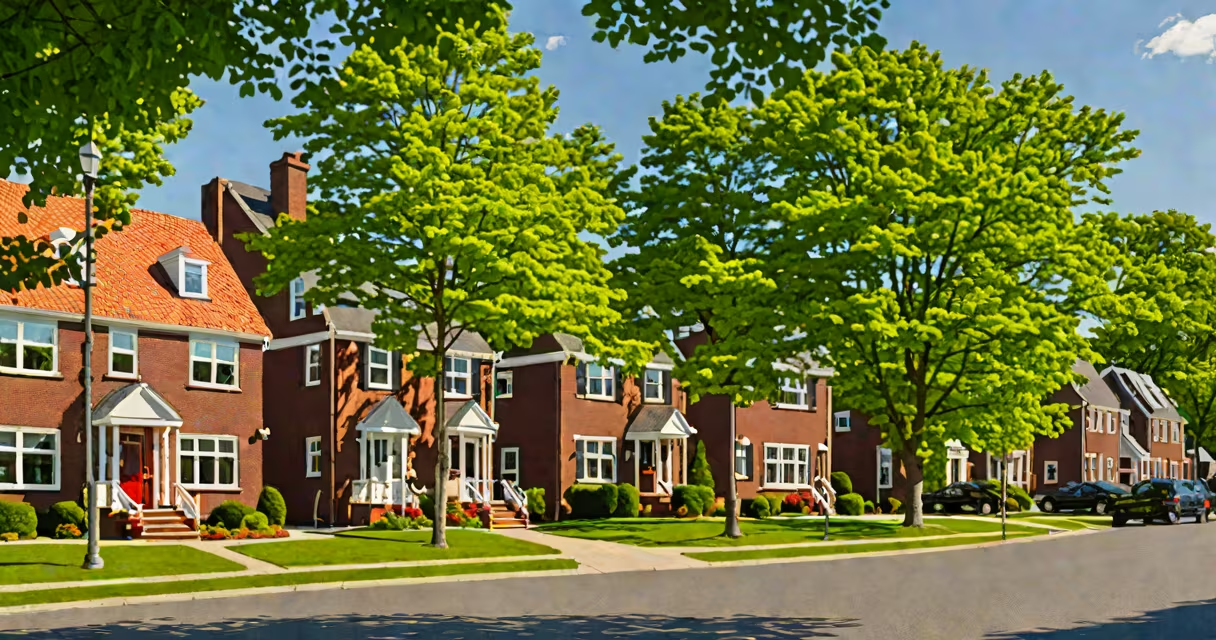
Long Island Hoofddorp is a planned residential development in Nassau County, New York, featuring homes styled in Dutch colonial architecture and themed around Dutch heritage. The name "Hoofddorp" translates to "main village" in Dutch, reflecting the community's intentional cultural design.
The project was developed in the early 2000s by a private real estate firm aiming to create a distinct identity within Long Island's dense suburban field. Unlike most neighborhoods that blend architectural styles, Hoofddorp was built with a consistent theme: gabled roofs, white clapboard siding, and decorative wooden trim inspired by 17th-century Netherlands architecture. This deliberate aesthetic choice sets it apart from surrounding areas dominated by Cape Cod, ranch, and contemporary designs.
Residents often cite the sense of cohesion and visual harmony as key reasons for choosing the community. Streets are named after Dutch cities-Amsterdam, Rotterdam, Utrecht-and public spaces include small fountains and stone pathways reminiscent of European villages. The developer included shared green spaces, bike paths, and seasonal events such as a Dutch-themed fall festival, reinforcing the neighborhood's thematic identity.
Long Island Hoofddorp operates under standard suburban zoning laws but includes special design guidelines enforced by a homeowners' association (HOA). All new construction must comply with architectural standards set during the initial planning phase. This helps even additions or renovations maintain the Dutch colonial look.
For example, a home built in 2010 had to feature a gambrel roof, a front porch with wrought-iron railings, and a chimney positioned centrally. These requirements were documented in the HOA's architectural review manual, which is publicly available through the Nassau County Clerk's office. Violations result in mandatory corrections before resale approval.
Despite the strict design rules, the community remains accessible. Properties are sold through traditional real estate channels, and buyers are not required to have Dutch ancestry. The average home price in 2023 was $875,000, slightly above the county median of $792,000, according to the U.S. Census Bureau's American Community Survey.
Construction materials follow regional norms but with a Dutch twist. Most homes use engineered wood framing, vinyl siding with simulated wood grain, and composite shingles designed to mimic slate. Foundations are poured concrete with frost footings suitable for Long Island's climate zone.
A notable feature is the use of Dutch doors-half upper, half lower-that appear on many entryways. These doors, while not historically accurate to 17th-century Holland, serve both aesthetic and functional purposes: they allow ventilation while maintaining privacy. A 2018 study by the University of Buffalo's Department of Urban Design found that 68% of residents reported higher satisfaction with their homes due to these design details.
Energy efficiency standards meet New York State's 2020 Building Code. Solar panels are permitted but not required. The community's central heating system uses natural gas, though some homes have geothermal options approved by the HOA.
| Feature | Standard in Hoofddorp | Local Norm |
|---|---|---|
| Roof Style | Gambrel or gabled | Cape Cod or hip |
| Siding Material | Composite with wood grain | Vinyl or fiber cement |
| Entry Doors | Dutch doors (half-open) | Full-height solid doors |
| Street Lighting | Cast iron with gas lanterns | LED posts with modern fixtures |
Long Island Hoofddorp serves as a model for culturally themed suburban developments. It appeals to buyers seeking a distinctive living environment, particularly those interested in European aesthetics or genealogical connections to the Netherlands. According to the Dutch Consulate General in New York, approximately 12,000 people of Dutch descent live in Nassau County, making it one of the largest concentrations in the U.S.
Its use extends beyond residential appeal. The community hosts annual events such as a tulip planting ceremony and a Sinterklaas celebration, drawing visitors from nearby towns. These events are coordinated through the Hoofddorp Cultural Committee, a volunteer group registered with the New York State Office of Parks, Recreation and Historic Preservation.
One non-obvious fact: despite the name and design, the community has no formal ties to the Netherlands government or Dutch municipalities. The name was chosen by the developer to evoke historical resonance, not to claim official status. The Dutch Ministry of Foreign Affairs confirmed in a 2015 statement that no Dutch town named "Hoofddorp" exists in the Netherlands-there is a similarly named municipality in South Holland, but it is unrelated.
Many assume Long Island Hoofddorp is a historic district or part of a larger Dutch settlement movement. It is neither. The area was not designated as a historic landmark by the National Register of Historic Places. Its architectural style is modern reinterpretation, not preservation of original Dutch buildings.
Another misconception is that the community is gated or exclusive. While the HOA enforces design rules, access is open. There are no security gates, and public roads lead directly into the neighborhood. The nearest train station is 1.8 miles away at the Long Beach station, served by the LIRR's Babylon Branch.
I visited the community in June 2022 during a local art fair. I spoke with a resident who moved from Amsterdam in 2015. She said she chose Hoofddorp because "the houses feel like home, even though I've never lived in one." Her home features a hand-painted Dutch windmill mural on the interior wall-a personal touch not mandated by the HOA.