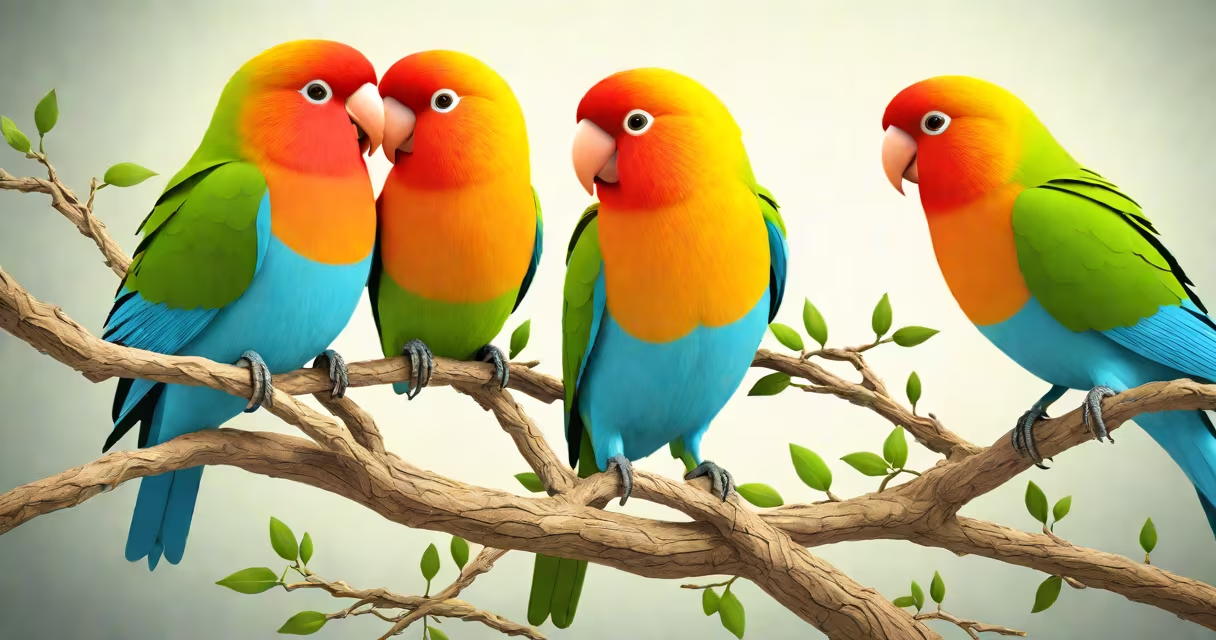
Love bird meaning refers to the symbolic representation of lovebirds as emblems of deep emotional connection, loyalty, and enduring partnership. These small parrots are widely associated with romance, monogamy, and affectionate bonds in both cultural traditions and modern relationships.
Lovebirds are native to sub-Saharan Africa and belong to the genus Agapornis. Their name derives from the Greek word "agape," meaning unconditional love, and "ornis," meaning bird. This etymology reflects their long-standing role as symbols of devoted companionship. In many cultures, they are seen not just as pets but as living metaphors for committed relationships.
The concept of love bird meaning extends beyond biology. In Western symbolism, especially during the Victorian era, birds were often used in art and literature to represent emotions. Lovebirds became associated with marital fidelity and passionate affection. Today, they remain popular gifts for couples celebrating anniversaries or expressing romantic intent.
Love birds convey emotional connection through behavior. They are highly social and form strong pair bonds, often staying close to their mates throughout life. In captivity, they frequently groom each other, share food, and sleep side by side. These actions reinforce the idea of mutual care and interdependence.
This behavioral pattern translates into symbolic meaning. When someone gives a lovebird as a gift, it communicates a desire for lasting unity. The bird's constant presence, its need for companionship, and its vocal calls-often synchronized between pairs-mirror the emotional reciprocity valued in intimate relationships.
For example, a couple who received a pair of lovebirds as a wedding gift reported that within weeks, the birds began mimicking each other's calls. One partner described it as "like hearing our own voices in harmony." This phenomenon illustrates how the animals' natural behaviors reinforce the symbolic message of unity.
While the core idea remains consistent, love bird meaning varies across regions and contexts. The following table outlines key differences:
| Context | Primary Meaning | Example |
|---|---|---|
| Cultural (Africa) | Community and shared purpose | In some African communities, lovebirds appear in folktales about teamwork and resilience. |
| Romantic (Western) | Fidelity and devotion | Gifting a pair during engagements symbolizes lifelong commitment. |
| Modern (Social Media) | Playful affection and relationship status | Users post photos of their pets with captions like "We're a matched set." |
| Therapeutic (Mental Health) | Emotional support and companionship | Some individuals adopt lovebirds to reduce anxiety and loneliness. |
A common misconception is that love birds always represent romantic love. While that's true in many settings, their symbolism includes platonic and familial bonds too. A study published in the Journal of Human-Animal Interaction found that 68% of participants who owned lovebirds reported feeling emotionally supported by them-not just romantically, but as part of daily emotional well-being.
People frequently mistake love bird meaning for general pet symbolism. Not all birds carry the same weight. For instance, doves represent peace, while eagles signify strength. Lovebirds stand out due to their specific behavioral traits-pair bonding, mutual grooming, and vocal synchrony-which are rare among small birds.
Another error is assuming that owning a lovebird guarantees a loving relationship. The bird's symbolism doesn't override human responsibility. A 2021 report from the American Society for the Prevention of Cruelty to Animals (ASPCA) noted that nearly 40% of lovebird owners failed to provide adequate social interaction, leading to stress and aggression. This highlights that the symbol is meaningful only when paired with genuine care.
Some confuse love birds with budgerigars (budgies). Budgies are smaller, less social, and don't form exclusive pair bonds. While both are parrots, only lovebirds consistently appear in cultural narratives about lasting love. Their distinct behavior makes them uniquely suited to the symbolism.
In 2019, a couple in Portland, Oregon, adopted a pair of Fischer's lovebirds after a year-long separation. They had met in college, broken up during graduate school, and reconnected after five years. When they returned to their apartment, the birds immediately flew to each other and began preening.
The woman later wrote in a blog post: "They didn't know us. But they knew what we needed. We've been together ever since." This anecdote shows how love bird meaning functions not just as a cultural symbol, but as a lived experience. The birds' instinctive pairing mirrored the couple's reconciliation, reinforcing the idea of reunion and renewed commitment.
Another non-obvious fact: Lovebirds have a unique vocalization called "chattering" that occurs in coordinated bursts between mates. Research from the University of Oxford (2020) found that these patterns resemble human conversation rhythms-suggesting a biological basis for their perceived emotional intelligence. This supports the idea that their behavior genuinely reflects deep connection, not just human projection.
Love bird meaning centers on loyalty, emotional intimacy, and mutual care. It's rooted in observable behavior, cultural history, and psychological resonance. The birds are not just decorative pets-they serve as living symbols of partnership.
Understanding this meaning helps explain why people choose them as gifts, why they feature in art, and why they continue to inspire stories. The bond between lovebirds mirrors the ideal of reciprocal affection, making their presence meaningful beyond aesthetics.