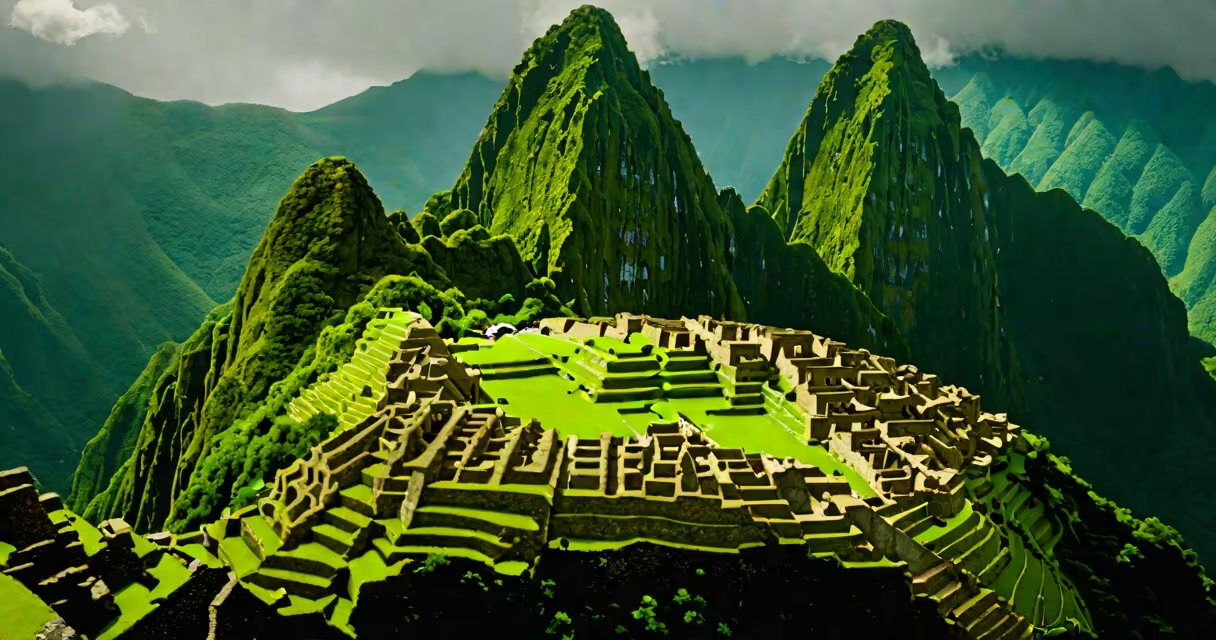
Machu Picchu in Peru is a 15th-century Inca citadel located 2,430 meters above sea level in the Andes Mountains, built without mortar using precisely cut stones. It was abandoned during the Spanish conquest and remained unknown to the outside world until 1911, when American explorer Hiram Bingham rediscovered it.
The site consists of over 150 structures, including temples, residential buildings, and agricultural terraces. Its layout reflects Inca cosmology, aligning with celestial events such as solstices. The Intihuatana stone, a ritual carving, served as a solar calendar and astronomical observatory. The city's design integrates natural rock formations, suggesting sacred architecture shaped by the field.
Archaeologists estimate Machu Picchu was constructed around 1450 under the reign of Inca emperor Pachacuti. It likely functioned as a royal retreat or religious sanctuary rather than a permanent settlement. Recent research using LiDAR scanning and soil analysis confirms the presence of extensive irrigation systems and terraced farming, indicating advanced land management.
Inca builders used a technique called ashlar masonry, shaping stones to fit together perfectly without mortar. Stones were quarried from nearby ridges and transported using wooden sledges and human labor. Workers carved blocks with bronze tools and shaped them through repeated grinding and polishing.
Structures were designed to withstand earthquakes. Walls feature inward-leaning angles and interlocking joints that allow flexibility during seismic shifts. This engineering principle, known as "flexible architecture," helped preserve many walls despite multiple major quakes in the region.
A 2017 study published in *Antiquity* analyzed the orientation of key buildings and confirmed alignment with the winter solstice sunrise. The Temple of the Sun, for example, receives direct sunlight on December 21, marking the shortest day of the year. This precision suggests deep astronomical knowledge and spiritual significance tied to seasonal cycles.
The site includes distinct functional zones: ceremonial, residential, agricultural, and administrative. Each area reveals different aspects of Inca society and belief systems.
| Type | Purpose | Key Example | Features |
|---|---|---|---|
| Ceremonial | Ritual worship and astronomical observation | Temple of the Sun | Curved walls, carved stone altar, precise solar alignment |
| Residential | Living quarters for nobility and priests | House of the Priest | Small rooms with stone hearths, narrow doorways |
| Agricultural | Farming on steep slopes | Granaries and terraces | Stone-lined fields, drainage channels, crop rotation evidence |
| Administrative | Storage and recordkeeping | Coricancha-like courtyard | Central plaza, storage niches, access to water channels |
These zones were not isolated. Water flowed through stone channels from mountain springs into fountains and baths, linking living areas with ritual spaces. The system distributed water evenly across the site, preventing erosion and supporting agriculture.
Historical records suggest the site was deserted within decades of its construction. The Spanish invasion of the Inca Empire began in 1532, leading to civil war among Inca rulers. After the capture of Atahualpa and the fall of Cusco, many Inca leaders fled inland.
Some scholars argue Machu Picchu was never inhabited by large populations. A 2020 study by the University of California, Berkeley, used radiocarbon dating of organic material from the site and found minimal human occupation between 1450 and 1532. Most artifacts date to the early 16th century, suggesting short-term use.
Its remote location may have protected it from Spanish forces. Unlike other Inca centers, Machu Picchu was not mentioned in colonial documents. When Bingham arrived in 1911, he found only vegetation-covered ruins and no surviving Inca descendants in the immediate area.
Machu Picchu is often described as a "lost city." This is inaccurate. The Inca knew of its existence. Local Quechua communities near the Urubamba River had oral traditions about the site long before Bingham's expedition. The term "lost" reflects Western colonial narratives, not historical reality.
Another myth is that the site was built by aliens or Atlanteans. No credible archaeological evidence supports this. The construction techniques match known Inca practices. Stone-cutting methods have been replicated by modern researchers using only tools available in the 15th century.
Some visitors assume Machu Picchu was a military fortress. Its lack of defensive walls, absence of weapons, and focus on ritual and astronomy contradict this. The site's layout emphasizes harmony with nature, not warfare.
Entry requires a timed ticket and a permit. Daily visitor numbers are capped at 2,500 to protect the site. Tickets must be purchased in advance through the official Peruvian government portal or authorized tour operators.
I visited Machu Picchu in 2019 during the dry season. I took the train Calientes, then hiked the 2-hour path up to the entrance. The morning mist lifted slowly, revealing terraces and temples rising from the cloud forest. I stood at the Sun Gate (Inti Punku) at dawn, watching light spill across the valley. The silence was profound-only birdsong and distant wind.
Security measures include bag checks, metal detectors, and mandatory guides for all tourists. Guides must be licensed by the Ministry of Culture of Peru. They provide context on Inca religion, architecture, and environmental adaptation.
Environmental concerns are growing. Foot traffic erodes stone surfaces. The Peruvian government has introduced a new entry system that rotates access routes to reduce wear on sensitive areas. Visitors are encouraged to stay on marked paths and avoid touching structures.
Machu Picchu in Peru represents one of the most intact examples of pre-Columbian Andean civilization. It demonstrates advanced knowledge of geology, hydrology, and astronomy. The site was designated a UNESCO World Heritage Site in 1983 and recognized as one of the New Seven Wonders of the World in 2007.
According to UNESCO, Machu Picchu "is a masterpiece of architectural and field design." The site's integration with the natural environment, use of local materials, and symbolic layout reflect a worldview centered on balance and reciprocity with nature.
Today, Machu Picchu in Peru draws over 1.5 million visitors annually. It is a symbol of cultural resilience and a reminder of the sophistication of Indigenous American civilizations. Understanding it requires moving beyond tourist myths and engaging with archaeological evidence, local histories, and ongoing conservation efforts.