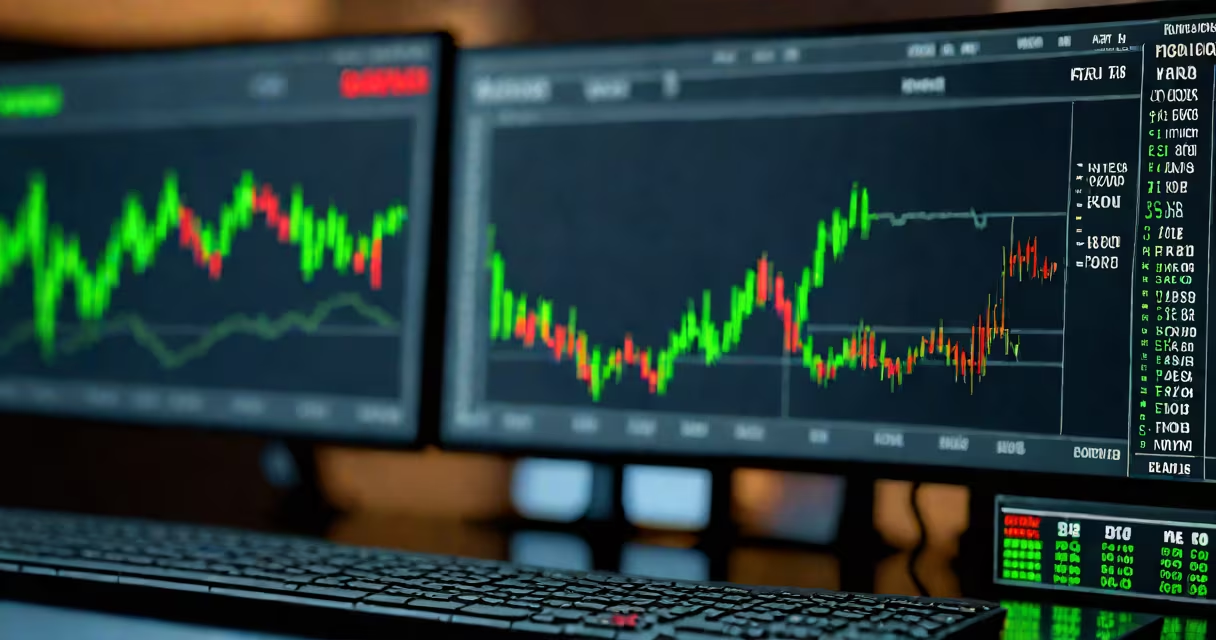
The meaning of stock trading is the act of buying and selling shares of ownership in publicly traded companies through exchanges like the New York Stock Exchange or NASDAQ, with the goal of profiting from price fluctuations. Traders execute trades based on analysis of company performance, economic indicators, or market sentiment.
Stock trading operates on the principle that share prices change daily due to supply and demand. When investors believe a company's value will rise, they buy shares. If the price increases, they sell at a higher price to realize a gain. Conversely, if they expect a decline, they may sell short-borrowing shares to sell now and buy back later at a lower price.
Trading occurs in real time during market hours, typically 9:30 AM to 4:00 PM Eastern Time on weekdays. Orders are processed electronically through brokers, who act as intermediaries between buyers and sellers. The process is governed by regulations enforced by the Securities and Exchange Commission (SEC) to ensure transparency and fairness.
When you trade stocks, you're exchanging ownership in a company. Each share represents a small portion of that company's equity. For example, owning 100 shares of Apple Inc. means you hold a fraction of Apple's total outstanding shares-about 0.00003% as of 2023.
Trades happen via brokerage accounts. You place an order-market, limit, or stop-loss-through a platform like Fidelity, Charles Schwab, or Robinhood. A market order executes immediately at the current best available price. A limit order sets a maximum purchase price or minimum sale price. A stop-loss triggers a sale when the price drops below a set threshold, protecting against large losses.
Settlement occurs two business days after the trade date (T+2). This means funds and shares are exchanged within 48 hours. Failure to settle can result in penalties or account restrictions.
Traders differ by time horizon and method. Day traders buy and sell within the same day, capitalizing on short-term volatility. They often use technical analysis-charts, patterns, and indicators-to make decisions. A day trader might enter and exit five positions in a single session based on moving averages or volume spikes.
Swing traders hold positions for several days to weeks, aiming to capture medium-term trends. They analyze both technical and fundamental factors. For example, a swing trader might buy Tesla stock after a positive earnings report and sell it a week later when momentum slows.
Long-term investors hold stocks for months or years, relying on fundamentals such as revenue growth, profit margins, and industry position. Warren Buffett, a renowned investor, focuses on companies with durable competitive advantages and consistent earnings. He avoids frequent trading, believing that long-term ownership generates superior returns.
| Trader Type | Time Horizon | Primary Method | Example Goal |
|---|---|---|---|
| Day Trader | Minutes to hours | Technical analysis | Profit from intraday price swings |
| Swing Trader | Days to weeks | Technical + news-based | Capture trend movements |
| Long-Term Investor | Months to decades | Fundamental analysis | Build wealth through compounding |
Many people confuse stock trading with gambling. While both involve risk, trading relies on research, strategy, and discipline. Gambling outcomes depend purely on chance; trading involves analyzing data, managing risk, and adjusting behavior based on results.
A less obvious error is assuming that high-frequency trading (HFT) dominates the market. While HFT firms use algorithms to execute thousands of trades per second, they represent a small fraction of volume. According to the SEC, HFT accounts for roughly 50% of daily volume on U.S. equities markets-but most retail investors never interact with HFT directly. Their trades go through the same matching systems as everyone else.
Consider a scenario involving Amazon.com Inc. (AMZN). On January 15, 2024, AMZN closed at $168.20 per share. A trader using technical analysis notices a breakout above a 50-day moving average and a rising volume spike. They place a market order to buy 100 shares at $168.25.
The trade executes instantly. Two days later, AMZN reports stronger-than-expected quarterly earnings. The stock rises to $175.00. The trader sells the 100 shares at $174.95, realizing a $670 profit before fees.
This example shows how timing, information, and execution influence outcomes. The trader didn't predict the earnings report-it was a surprise. But they acted on a pattern that suggested upward momentum, which played out in real time.
Stock trading differs from investing in time frame and intent. Investing typically involves holding assets for years to benefit from growth and dividends. Trading seeks short-term gains through price movement. The S&P 500 index has returned about 10% annually since 1926, according to Yale University's Robert Shiller. That return supports long-term investing. But individual stocks can swing wildly-Amazon rose 400% in five years while Netflix dropped 70% in another period.
Trading also differs from options and futures. Options give the right, but not the obligation, to buy or sell a stock at a set price. Futures are contracts to buy or sell assets at a future date. These instruments carry higher risk and require specialized knowledge. The CBOE reported that over 80% of options expire worthless-underscoring the complexity involved.
Understanding the meaning of stock trading requires recognizing that it's not a single activity but a spectrum of behaviors, tools, and goals. It includes everything from a teenager buying a few shares of GameStop during a meme-driven rally to institutional investors executing billion-dollar trades based on macroeconomic models.
My first trade was in 2017-a single share of Netflix. I bought it because I liked the show *Stranger Things*. The stock was $140 at the time. I sold it six months later at $180. Not because I analyzed the company, but because I believed in the brand. That experience taught me that emotion-driven decisions rarely lead to consistent success. Since then, I've focused on research and risk management.