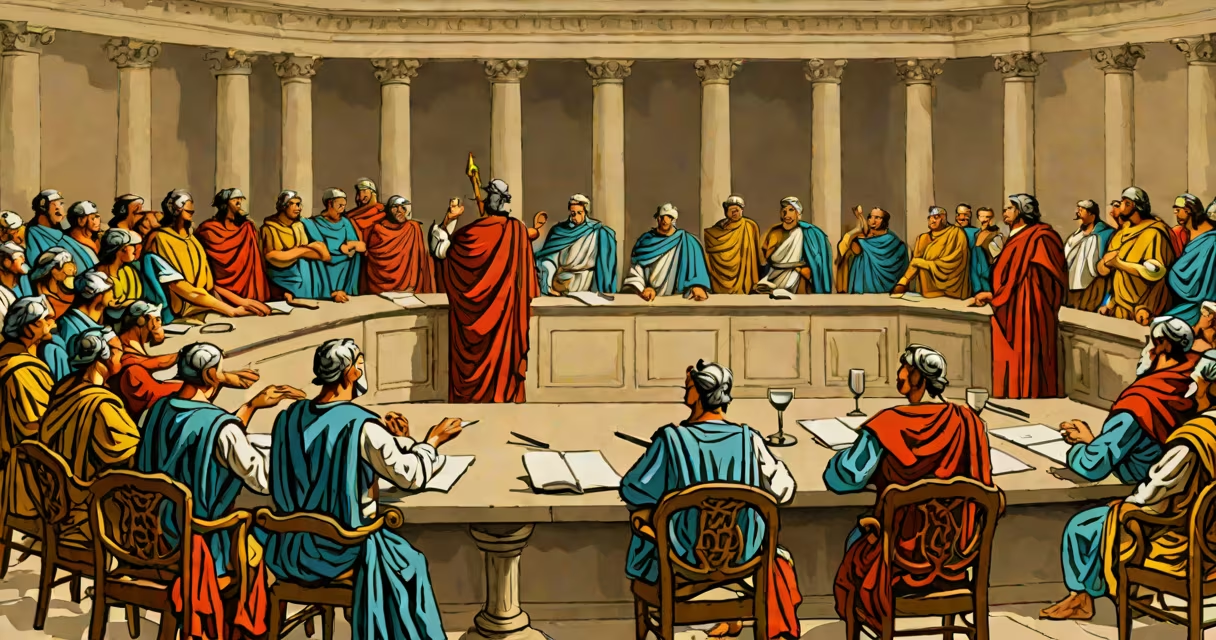
The term "republic" refers to a form of government in which power resides in elected representatives chosen by the people, rather than in a hereditary monarch or dictator. It originates from the Latin phrase "res publica," meaning "public affair" or "commonwealth."
Republics are structured around representative institutions such as legislatures, courts, and executive bodies. These institutions operate under a constitution or legal structure that limits authority and protects individual rights. The United States, France, and India are modern examples of republics where leaders are elected through democratic processes.
Unlike monarchies, where leadership passes through bloodlines, republics emphasize merit, accountability, and civic participation. Power is derived from the consent of the governed, not divine right or inherited status. This structure aims to prevent concentration of power and reduce the risk of tyranny.
A republic operates through a system of checks and balances among branches of government. The legislative branch makes laws, the executive enforces them, and the judiciary interprets them. This separation prevents any single entity from dominating decision-making.
Elections are central to republican governance. Citizens vote for officials who represent their interests in lawmaking bodies. In the U.S., for example, members of Congress are elected every two years, while the president serves a four-year term. These cycles ensure regular turnover and responsiveness to public opinion.
Constitutional protections play a key role. The U.S. Constitution, for instance, includes the Bill of Rights-ten amendments that guarantee freedoms like speech, religion, and due process. These safeguards exist to preserve individual liberties even when majorities may seek to override them.
Republics have evolved across time and geography. Ancient Rome established one of the earliest known republics, lasting from 509 BCE to 27 BCE. During this period, citizens elected magistrates and participated in assemblies, though only male property owners had voting rights.
Modern republics differ in structure. Some are unitary systems (like France), where national laws apply uniformly. Others are federal systems (like the United States), dividing powers between national and regional governments. Federal republics often feature bicameral legislatures-two chambers-to balance representation between populous and less populous regions.
| Type | Key Features | Examples |
|---|---|---|
| Unitary Republic | National government holds most power; local authorities follow central policy | France, Japan |
| Federal Republic | Power divided between national and regional governments; shared sovereignty | United States, Germany, Canada |
| Confederal Republic | Regional entities retain primary authority; central government limited to coordination | Historical Swiss Confederation (1815-1848) |
Not all republics are democratic. Authoritarian regimes can adopt republican structures while suppressing free elections and dissent. North Korea's official name is the Democratic People's Republic of Korea, yet it lacks competitive elections and independent institutions. This illustrates that the label "republic" does not guarantee freedom or fairness.
Many assume that "republic" and "democracy" are interchangeable. They are not. A democracy is a system where citizens vote directly or through representatives. A republic is a specific type of government that uses elected officials and constitutional limits. All republics are not democracies, and not all democracies are republics.
For example, Switzerland combines direct democracy with a federal republic model. Citizens vote on laws and constitutional changes in referendums, making it both a democracy and a republic. In contrast, Iran is officially a Islamic Republic, but its leadership is selected by religious councils, not popular election. This shows that the term "republic" can coexist with non-democratic rule.
A lesser-known distinction: the word "republic" implies collective ownership of public affairs. It reflects the idea that the nation belongs to the people, not a ruler. This contrasts with "monarchy," where the state is seen as the personal domain of a sovereign.
I once visited the Palazzo della Civiltà Italiana in Rome, where a replica of the Roman Forum stands. There, I saw inscriptions from the late Republic period-citizens debating land reform and military command. The site reminded me that the concept of a republic was not theoretical. It emerged from daily civic engagement, not just grand declarations.
Today, the functioning of a republic depends on active citizenship. Voter turnout in U.S. presidential elections averages 55%-lower than in many European nations. Countries like Belgium and Sweden report turnout above 80%. Low participation weakens the legitimacy of elected institutions, undermining the core principle of self-governance.
Research from the Pew Research Center shows that 62% of Americans believe the country is headed in the wrong direction, citing distrust in government. Yet 78% still support the idea of a republic as a foundation for fair governance. This gap highlights the tension between ideals and implementation.
When evaluating political systems, ask whether institutions are transparent, whether leaders are removable through lawful means, and whether citizens have meaningful access to decision-making. These criteria distinguish functional republics from those that merely wear the label.