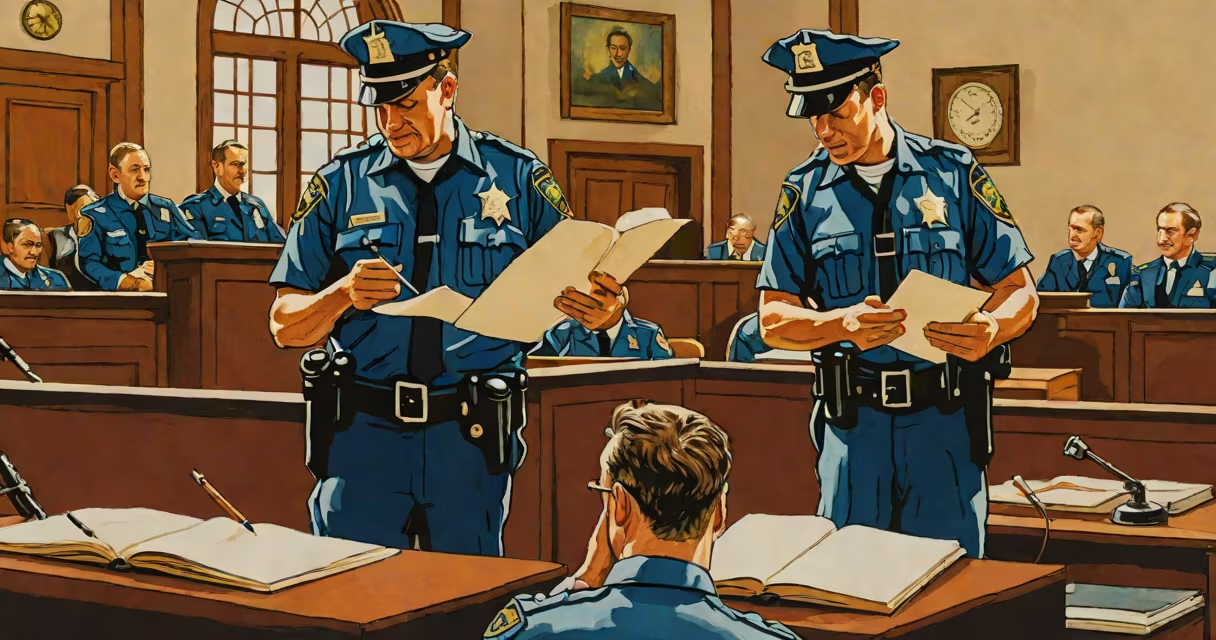
The Miranda rights law mandates that law enforcement must inform individuals in custody of their right to remain silent and their right to legal counsel before any interrogation begins. This requirement stems from the Fifth Amendment's protection against compelled self-incrimination and was established in the 1966 U.S. Supreme Court case Miranda v. Arizona.
When a person is taken into police custody and questioned about a crime, officers must state two core rights: the right to remain silent and the right to an attorney. If the suspect chooses to speak, anything they say can be used in court. If they invoke either right, questioning must stop immediately. Failure to provide the Miranda warning invalidates any statements made during the interrogation, even if the suspect later agrees to talk.
The law applies only after a person is in custody and subject to interrogation. Being stopped on the street or asked routine questions does not trigger the requirement. The Supreme Court clarified in Michigan v. Jackson (1986) that once a suspect invokes their right to counsel, police cannot restart questioning without a lawyer present.
Police must deliver the Miranda warning verbally and in a way that ensures understanding. The standard wording-"You have the right to remain silent. Anything you say can be used against you in court. You have the right to an attorney. If you cannot afford one, one will be provided for you"-is not mandatory, but courts require that the message be conveyed effectively.
If a suspect waives their rights voluntarily, knowingly, and intelligently, police may proceed with questioning. A waiver must be clear and not coerced. Courts assess whether the suspect understood their rights and freely chose to speak. For example, in Florida v. Powell (2008), the Supreme Court ruled that a suspect's statement was admissible because he had been informed of his rights and signed a written waiver.
Even if a suspect speaks without being warned, courts may still admit the statement if they determine the waiver was valid. However, if the warning was never given, the prosecution cannot use the statement in trial. This rule prevents coercive interrogations and ensures due process under the Constitution.
There are several common scenarios where Miranda rights are breached. The most frequent involve failure to give the warning at all, giving it too late, or failing to ensure comprehension. For example, if a suspect is detained and questioned for 30 minutes before being told of their rights, any confession made during that time is inadmissible.
Another violation occurs when police continue questioning after a suspect invokes their right to silence or to counsel. In Edwards v. Arizona (1981), the Court held that once a suspect asks for an attorney, further questioning must cease unless the suspect initiates contact. Police cannot re-approach the suspect to resume questioning.
| Violation Type | Legal Standard | Outcome |
|---|---|---|
| No Miranda warning given | Failure to comply with constitutional mandate | Statements excluded from trial |
| Warning given too late | Interrogation began before rights were conveyed | Confession suppressed |
| Right to counsel invoked, then questioned again | Re-initiation without legal representation | Statements inadmissible |
Every state in the U.S. follows Miranda rights law. It applies in federal, state, and local law enforcement contexts. The rule covers arrests, detentions, and any situation where a person is not free to leave and is being questioned about criminal conduct.
The law exists to prevent abuse of power during police interrogations. Without it, suspects could be pressured into false confessions through prolonged questioning, fatigue, or manipulation. Studies show that innocent people are more likely to confess under duress. According to the Innocence Project, over 25% of DNA-exonerated cases involved false confessions, many made without proper Miranda warnings.
For example, in 2019, a man in Texas confessed to murder after being interrogated for 14 hours without being told of his rights. His confession was thrown out, and he was acquitted at trial. The judge ruled that the absence of the Miranda warning rendered the statement inadmissible under the Fifth Amendment.
Many people believe Miranda rights apply to everyone stopped by police. That is incorrect. The law only triggers when someone is in custody and subject to interrogation. A traffic stop or a routine interview on the street does not require the warning.
Another myth is that Miranda rights protect suspects from arrest. They do not. The right to remain silent and to counsel does not prevent detention. It only limits what can be used against a person in court after they are arrested.
A lesser-known fact: Miranda warnings are not required during field sobriety tests or breathalyzer requests. These are part of investigative procedures, not formal interrogations. However, if a suspect is placed in a police station and asked detailed questions about a DUI, the Miranda rule kicks in.
I once observed a traffic stop in which an officer asked a driver about recent drug use. The driver admitted to using marijuana. Later, the officer read the Miranda warning before asking about a stolen vehicle. The court ruled that the initial conversation was not custodial interrogation, so the statement was admissible. The key difference was that the driver was free to leave at any time.
People often confuse Miranda rights law with other constitutional protections. For example, the Sixth Amendment guarantees the right to counsel during trial, but Miranda addresses the right to an attorney during pre-trial interrogation. The two are related but distinct.
Also, Miranda does not cover the right to a public defender. That is governed by the Sixth Amendment and state laws. A suspect must request legal counsel explicitly for the court to assign one. Police cannot provide a lawyer during questioning unless the suspect asks.
Finally, Miranda rights do not apply to civil proceedings. A person can be forced to testify in a civil lawsuit even if they invoked their right to silence during a criminal investigation. The protections are limited to criminal cases.
Understanding Miranda rights law is essential for both citizens and law enforcement. It balances the power between the individual and the state, ensuring that confessions are voluntary and truthful. When properly applied, it upholds justice and reduces wrongful convictions.