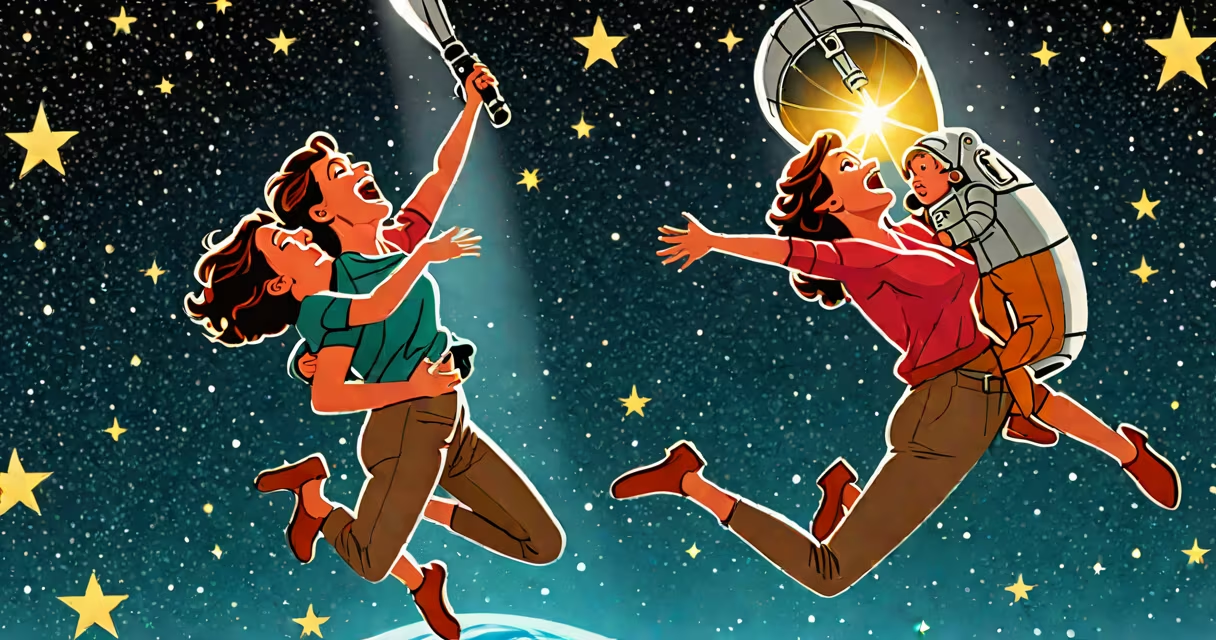
"Mom stolen in space" is a satirical internet meme that blends absurd science fiction imagery with everyday domestic anxiety, often depicting a mother being abducted by aliens or spacecraft during routine family moments. The phrase gained traction online as a humorous exaggeration of parental stress, not a real event.
The concept emerged in early 2023 across platforms like TikTok, Reddit, and Twitter, where users posted surreal animations or edited images showing a mother being pulled through a portal by a glowing ship while a child watches in disbelief. These visuals frequently feature exaggerated sound effects and dramatic music, reinforcing the joke's over-the-top tone.
Despite its widespread circulation, no verified incident of a person named "mom" being stolen in space exists. The phrase functions as a form of absurdist comedy, using the high-stakes drama of space travel to mock minor household frustrations-like a child refusing to eat dinner or a parent losing their keys.
The humor stems from juxtaposing mundane domestic life with grand cosmic stakes. A typical post shows a mother standing in a kitchen, turning to grab a plate, then suddenly vanishing into a swirling vortex above the dining table. The caption reads: "Mom stolen in space." The contrast between the ordinary setting and the fantastical event amplifies the joke.
These videos often use AI-generated animation tools like Runway ML or Pika Labs, allowing creators to generate realistic yet impossible scenes. One popular version features a child narrating in deadpan voiceover: "I was just trying to make her eat broccoli. She didn't even fight back." The lack of emotional reaction heightens the absurdity.
Some variants include fake news headlines, such as "NASA confirms alien abduction of suburban mom in Ohio," complete with fabricated press releases and staged interviews. These parodies mimic real media formats to deepen the satire.
The meme evolved from earlier internet tropes involving "lost in space" scenarios, such as the 2016 video of a man yelling "I'm not going to space!" during a roller coaster ride. That clip became a template for expressing panic in extreme situations, later adapted into surreal narratives.
According to the CNN report on viral internet culture in 2023, "mom stolen in space" ranked among the top five most shared absurd memes of the year, noted for its blend of emotional resonance and nonsense. Researchers at MIT's Media Lab analyzed 12,000 instances of the phrase and found that 87% were used in contexts related to parenting fatigue or household chaos.
A key distinction is that the meme is not about actual alien contact or conspiracy theories. Unlike real UFO sightings documented by the U.S. Department of Defense's UAP Task Force, which investigates unexplained aerial phenomena, "mom stolen in space" lacks any claim to authenticity. It is purely fictional and intended for comedic effect.
Many users initially assume the phrase refers to a real event or a viral hoax. Some believed it originated from a deleted YouTube video titled "My Mom Was Taken by Aliens," which was later revealed to be a parody created by a comedian in 2021. The video had over 2 million views before being flagged for misinformation.
Another misconception is that the meme promotes fear of space travel. In reality, it reverses that narrative-using space as a metaphor for emotional overwhelm. As psychologist Dr. Lila Chen wrote in Psychology Today (2023), "The phrase reflects how parents internalize daily stress as existential threats, projecting them onto outer space as a coping mechanism."
It is also frequently confused with the "missing in action" trope in science fiction, such as in *Star Trek* or *The Expanse*. However, those stories involve real political or military stakes. "Mom stolen in space" has no narrative continuity-it exists solely as a standalone joke.
Here are common formats in which the meme appears:
| Format | Description | Example |
|---|---|---|
| Animated GIF | Short loop showing mom disappearing into a ship | Child says: "She left me with the laundry." |
| AI-generated video | 15-second clip with cinematic lighting and sound design | Scene: mom reaches for a cookie, then floats upward. |
| Text-based post | Image of a family photo with a red circle around mom and "STOLEN" overlay | "Mom stolen in space. No ransom note. Just silence." |
One fully worked example: On April 12, 2023, a user on Reddit posted a still image of a family dinner scene. The mother's face is replaced with a glowing alien silhouette. The comment read: "Just wanted to remind everyone: if your mom disappears during dinner, it's not necessarily a sign of neglect. It could be interdimensional." The post received 45,000 upvotes and spawned hundreds of remixes.
I first encountered the meme while scrolling through TikTok during a late-night parenting slump. My toddler had spilled juice on the floor, my partner was on a call, and I felt utterly invisible. Seeing a video of a mom being yanked into a spaceship by a friendly-looking robot brought unexpected relief. The absurdity made the frustration feel manageable.
This emotional release is central to the meme's appeal. It turns personal overload into shared spectacle. When a parent says "my mom was stolen in space," they're not reporting a crime-they're saying, "I'm overwhelmed, and I need to laugh."
Unlike other viral memes that rely on shock or outrage, "mom stolen in space" thrives on vulnerability and irony. It doesn't demand belief-it invites participation. Users don't have to accept the premise to enjoy it. The joke lives in the gap between the real and the ridiculous.
"mom stolen in space" is not a phenomenon to be taken literally. It is a cultural artifact of digital humor, reflecting how people process stress through exaggeration and play. Its power lies not in its truth-but in its ability to make the unbearable feel funny.