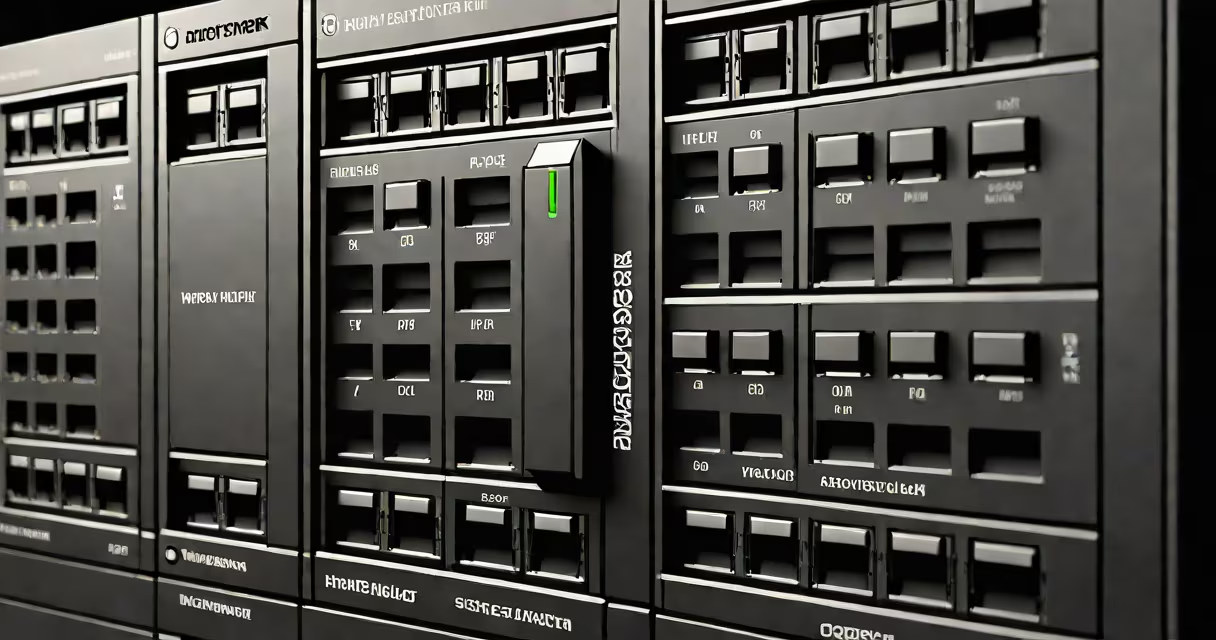
A modular network switch is a high-performance networking device that allows administrators to install and replace individual line cards or modules to adapt to changing network requirements. Unlike fixed-configuration switches, it supports expansion through pluggable components such as fiber-optic, copper, or specialized protocol modules.
These switches form the core of data center and campus networks where traffic volume, speed, and protocol diversity demand flexibility. They are typically installed in standard 19-inch racks and support redundant power supplies and cooling systems for uptime-critical environments.
Modular network switches are engineered for scalability and resilience. They enable organizations to deploy 10G, 40G, 100G, or even 400G interfaces by swapping out line cards, avoiding the need to replace entire chassis. This capability reduces long-term capital expenditure and extends equipment lifecycle.
At its core, a modular network switch uses a central backplane or fabric to connect multiple line cards. Each line card handles a subset of ports and protocols, while the supervisor module manages configuration, routing decisions, and system-wide policies. Traffic flows between devices through the internal fabric, which operates at wire speed to avoid bottlenecks.
When a packet arrives on a port, the switch's ASIC (application-specific integrated circuit) processes it based on VLAN settings, QoS rules, and access control lists. The destination is resolved via MAC address tables or IP routing tables, then forwarded through the appropriate output port on another line card.
For example, a 48-port 10GbE switch might use four 12-port line cards. If a new server requires 100GbE connectivity, a single 100GbE line card can be inserted into an available slot, and the switch automatically detects and configures it. No downtime is required during the upgrade.
Modular switches come in various configurations based on port density, supported speeds, and redundancy features. The most common form factors are 1U and 2U rack units, with higher-end models supporting up to 16 line card slots.
| Feature | Entry-Level | Mid-Range | High-End |
|---|---|---|---|
| Maximum Line Cards | 4 | 8 | 16 |
| Max Port Density | 48 ports | 96 ports | 192 ports |
| Supported Speeds | 1G/10G | 1G/10G/40G | 1G/10G/40G/100G/400G |
| Redundancy | Optional PSUs | Redundant PSUs, fans | Full redundancy: PSUs, fans, supervisor modules |
Line cards are categorized by interface type. Copper modules use RJ-45 connectors for Ethernet over twisted pair. Fiber modules use SFP (small form-factor pluggable) or SFP+ transceivers for optical transmission. Specialized modules exist for InfiniBand, Fibre Channel, or proprietary protocols like Cisco's OTV.
One non-obvious distinction: not all modular switches allow hot-swapping of line cards. Some require a reboot or system pause during insertion. High-end models from vendors like Juniper and Arista support true hot-plug functionality, meaning line cards can be replaced without interrupting traffic.
Modular network switches are deployed in data centers, large campuses, and service provider edge networks. They handle high-throughput workloads such as virtualization clusters, cloud storage, and real-time analytics.
For example, a financial institution running algorithmic trading systems may use a modular switch to connect 200 servers across multiple racks. By installing 100GbE line cards, they achieve low-latency communication between trading engines and market data feeds. The switch's ability to scale bandwidth without replacing the chassis saves $20,000+ per year in hardware refresh cycles.
Another use case is multi-site connectivity. A university with five buildings might use a modular switch at its central data center to aggregate traffic from remote locations via fiber links. Each building connects through a dedicated SFP module, enabling separate VLANs and QoS policies per department.
These switches are also essential in hybrid cloud environments. When integrating on-premises infrastructure with AWS or Azure, modular switches provide consistent policy enforcement across physical and virtual networks.
Many users mistake modular network switches for managed switches. While all modular switches are managed, not all managed switches are modular. A managed switch offers configuration options like VLANs and SNMP monitoring but has a fixed set of ports and cannot accept additional line cards.
Another misconception is that modular switches are always more expensive. While entry-level models start around $10,000, their total cost of ownership is often lower due to longer lifespan and reduced replacement frequency. According to a 2023 report by Gartner, organizations using modular switches reported 32% lower annual infrastructure costs compared to those relying on fixed switches.
Some assume that all SFP ports are interchangeable. This is false. SFP modules are specific to wavelength, distance, and media type. Using a 10km SFP on a 100m link causes signal degradation. Always verify compatibility using vendor documentation or the IEEE 802.3 standards.
I once observed a misconfigured SFP setup during a migration at a hospital IT facility. A team used 10G SFP+ modules meant for 10km fiber on a 500-meter run. The result was intermittent packet loss and failed backups. After replacing them with short-reach modules, performance stabilized within 15 minutes.
modular network switch enables changing scaling of network capacity through interchangeable line cards. It supports high-speed interfaces, redundancy, and centralized management. Its primary advantage lies in adaptability-organizations can evolve their network without replacing core hardware.