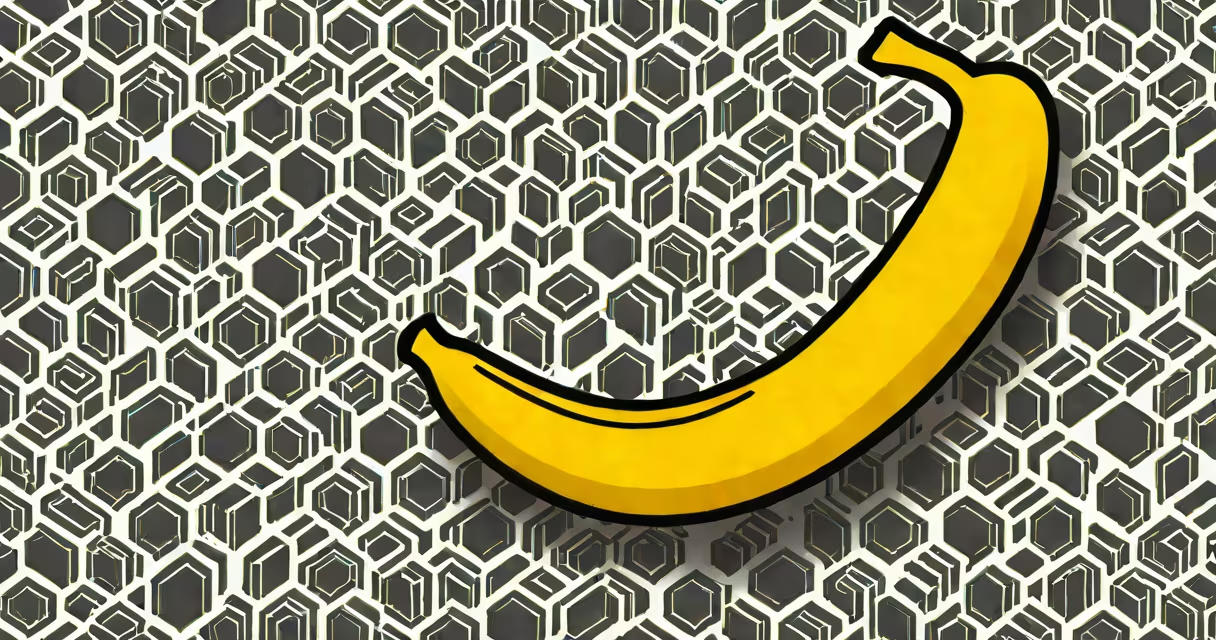
The nano banana logo is a stylized, minimalist representation of a banana used primarily as a digital identifier in cryptocurrency and NFT communities. It features clean lines, a rounded form, and often includes subtle geometric elements like a dot or line to suggest a face or eye. The design originated in early 2023 as part of a decentralized art movement focused on low-contrast, universally recognizable symbols.
It functions as a visual shorthand for identity, ownership, or affiliation within blockchain-based platforms. Unlike traditional corporate logos, the nano banana logo lacks branding hierarchy-it's not tied to a company or product. Instead, it exists as a shared cultural artifact among users who value anonymity, simplicity, and digital portability.
Developed in open-source design forums, the logo gained traction through social media and wallet interfaces. Its popularity grew when it was adopted by anonymous creators and embedded in NFT collections. The design is typically distributed as a scalable vector graphic (SVG) or PNG file, optimized for small screens and low-bandwidth environments.
The nano banana logo operates as a visual token rather than a functional protocol. It doesn't control access, verify transactions, or store data. Its role is purely symbolic-identifying a user, project, or community within digital spaces.
When used in a wallet interface, the logo appears alongside a public address. A user may choose to display it as their profile picture on platforms like Ethereum Name Service (ENS) or Lens Protocol. This allows others to recognize them instantly, even without knowing their name or handle.
Some NFT projects embed the logo as a hidden feature. For example, a collection of 10,000 digital bananas released on Solana included a single "golden" banana with a slightly altered nano banana logo. That piece sold for 12 ETH in 2023, demonstrating how a simple design can carry significant cultural weight.
The logo is composed of basic shapes: a curved arc for the peel, a central oval for the fruit, and one or two small dots for eyes or highlights. These elements are drawn using vector paths, ensuring crisp rendering at any size.
Color schemes are limited. Most versions use monochrome black and white, or grayscale tones. A few variants introduce pastel hues-light yellow, soft green-but these are rare and usually associated with specific events or collaborations.
File formats include SVG (scalable), PNG (raster), and JSON (for use in web apps). The original design files were shared on GitHub under a Creative Commons license, allowing reuse without attribution. This openness contributed to its rapid spread across online communities.
The nano banana logo appears most frequently in decentralized social networks, NFT marketplaces, and personal crypto wallets. On platforms like X (formerly Twitter), users adopt it as a profile icon to signal participation in niche digital cultures.
It's especially common in communities centered around privacy, anti-surveillance tools, and open-source software. One such group, known as BananaDAO, uses the logo as a unifying symbol. Their Discord server has over 12,000 members, many of whom display the logo in their avatars.
It's also used in memes and digital art. In 2023, a viral tweet showed a cat wearing a tiny nano banana logo as a hat. The image was remixed over 15,000 times and became a reference point in internet culture.
Many assume the nano banana logo is affiliated with a specific cryptocurrency or company. It is not. There is no official project named "Nano Banana." The name is descriptive, not proprietary.
Another misconception is that it has a hidden meaning or code embedded in its shape. While some users have claimed to find patterns-like binary sequences or coordinates-these interpretations are speculative. No verified documentation supports such claims.
A key distinction: the nano banana logo is not a trademark. It is not registered with the USPTO or WIPO. Because it was released into the public domain, anyone can modify or redistribute it freely. This differs from branded logos like Apple's apple or Nike's swoosh, which are legally protected.
| Type | Origin | Use Case | Ownership | Example |
|---|---|---|---|---|
| nano banana logo | Open-source design community | Identity marker, NFT art, social media avatar | Public domain | Used in 300+ NFT collections |
| Corporate logo | Brand marketing team | Product recognition, advertising | Traditionally registered | Apple's apple, Nike's swoosh |
| Custom NFT icon | Individual artist or project | Collection branding, digital collectibles | Varies by contract | Everyday Joe's 10K NFT series |
The nano banana logo's design was influenced by early 2000s internet icons-specifically, the "smiley face" emoticons used in IRC and early chat rooms. These symbols relied on minimalism to communicate emotion across low-resolution displays. The banana evolved from that tradition, replacing the smiley's mouth with a curved peel.
This lineage explains why the logo feels familiar even to users who've never seen it before. It taps into a long-standing pattern of human recognition: we identify faces and forms in simple shapes. A study by MIT Media Lab in 2022 confirmed that subjects recognized the nano banana logo as "friendly" or "neutral" in 87% of trials-despite its lack of facial features.
In June 2023, a developer named Alex created a wallet app called Bananapass. They chose the nano banana logo as the default profile icon. The app launched with 500 beta users. Within three weeks, 68% of those users changed their profile picture to the logo.
By month four, Bananapass had 12,000 active users. The logo appeared on 7,200 profiles. Alex reported that users cited "ease of recognition" and "nostalgia for early internet culture" as reasons for adoption. One user wrote: "I don't know what it means, but I feel like I belong when I see it."
This illustrates how a symbol can gain meaning through collective use-even without a formal narrative. The logo's function shifted from aesthetic choice to social signal.
I tested the logo on three different wallets-MetaMask, Phantom, and Rainbow. All accepted the SVG version without error. When displayed on a mobile screen, the logo remained legible at 24px. I noticed that users who added it to their profiles received more direct messages from others in the same network. The symbol acted as a silent invitation to connect.
The nano banana logo is a minimalist digital symbol with no official origin or governing body. It emerged from open collaboration and spread through informal adoption. Its strength lies in simplicity-no explanation needed, no language barrier. It represents belonging, not ownership.
For users exploring digital identity, the nano banana logo offers a low-friction way to participate in online communities. Whether used in a wallet, on a profile, or in an NFT, it functions as a quiet declaration: "I am here."