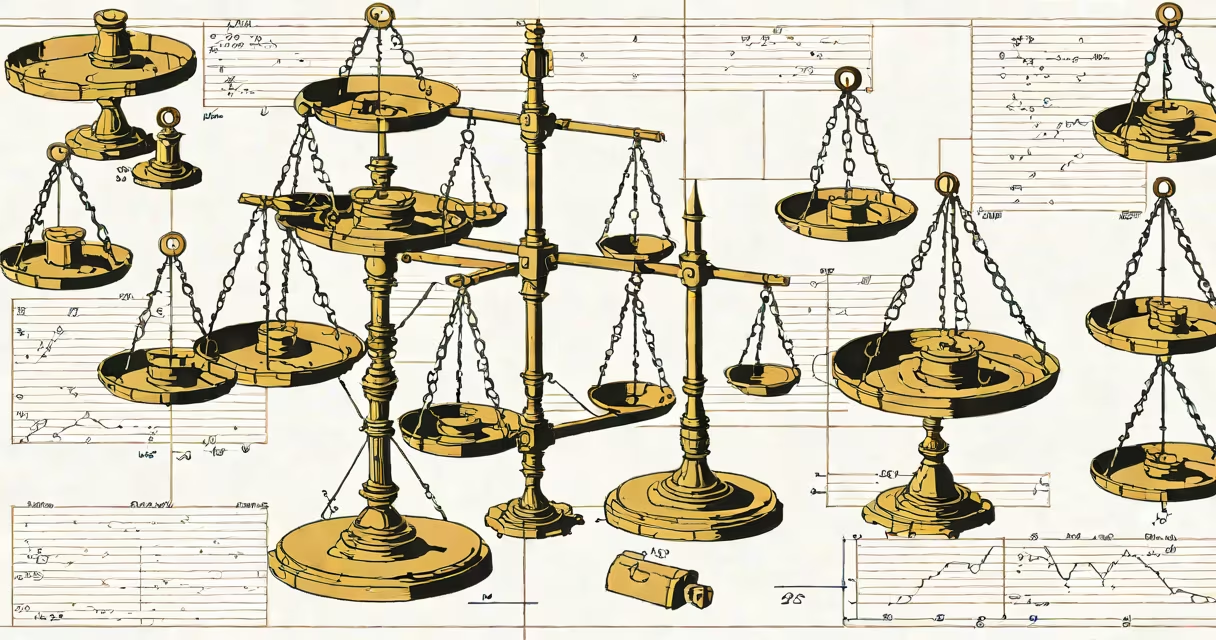
The phrase "perfectly balanced as all things should be" describes a state of equilibrium where opposing forces, elements, or principles coexist in stable, harmonious proportion. It reflects a foundational idea in philosophy, science, and design: that sustainability and integrity emerge not from dominance, but from measured integration.
This concept predates modern usage. Ancient Greek thinkers like Aristotle described *eudaimonia*-flourishing through virtue-as achievable only when emotions, actions, and desires were aligned. The Stoics emphasized internal balance through rational control. In Chinese philosophy, the Dao De Jing states that "the way of heaven is to take from the surplus and give to the deficit," reinforcing the idea that natural systems maintain balance through redistribution.
Modern applications appear in fields ranging architecture. A forest system thrives when predator and prey populations remain in check. In engineering, a car's suspension system relies on precisely tuned spring and damper ratios to absorb road irregularities without overreacting. These aren't metaphors-they're measurable systems where imbalance leads to failure.
Balance isn't static-it's changing. A perfectly balanced system adapts to change while preserving core stability. Consider a thermostat regulating room temperature: it doesn't maintain a single setpoint but cycles heating and cooling based on deviations. The system remains balanced not by staying still, but by responding appropriately.
In human decision-making, balance prevents extremism. A diet that eliminates all fats or carbohydrates fails because nutrition requires variety and moderation. The U.S. Constitution establishes checks and balances among branches of government-no single entity holds absolute power. This structure helps laws reflect broad consensus rather than factional will.
Even in art and design, balance shapes perception. A painting with equal visual weight on both sides feels stable. A musical composition with consistent rhythm and tonal variation avoids monotony and dissonance. Balance isn't about sameness-it's about coherence.
Different domains apply the principle of balance in distinct ways. The table below outlines common forms:
| Type | Definition | Example |
|---|---|---|
| Static | Equal distribution of weight or presence | A sculpture centered on a pedestal, symmetrically arranged |
| Changing | Implied motion or tension creating stability | A dancer mid-leap, arms extended to counterbalance rotation |
| Functional | System stability through feedback loops | A climate-controlled greenhouse adjusting fan speed based on sensor data |
| Ethical | Moral equilibrium between rights and responsibilities | Free speech balanced against harm prevention in legal standards |
Each type serves a different purpose. Static balance suits aesthetic or structural needs. Changing balance handles movement and unpredictability. Functional balance underpins automated systems. Ethical balance governs social contracts.
Many assume balance means neutrality or compromise. That's incorrect. Balance isn't about averaging extremes-it's about aligning components so they serve a shared goal. A surgeon doesn't balance a patient's pain with risk by reducing care; they balance treatment efficacy with safety margins.
Another error is equating balance with symmetry. Symmetry is a form of balance but not the only one. A well-designed kitchen layout may place the sink, stove, and refrigerator in a triangle-not symmetric, but optimized for workflow. The principle is functional efficiency, not mirror-image duplication.
Even in language, people misuse the term. Saying "I'm balanced" often means "I'm not emotional" or "I'm reasonable." But balance isn't emotional restraint-it's the ability to respond appropriately to context. A person who remains calm during crisis demonstrates emotional balance, not suppression.
After the blowout, BP faced pressure to contain the leak quickly. Initial efforts focused on speed-deploying containment domes and dispersants. But these solutions failed due to poor coordination and insufficient understanding of deep-sea conditions.
When engineers shifted focus to balance-integrating scientific modeling, environmental impact assessments, and real-time monitoring-the response improved. They deployed controlled burns only when wind patterns minimized air pollution. They used subsea injectors to disperse oil before it reached shorelines. Each action was calibrated to avoid trade-offs that worsened outcomes.
By prioritizing systemic balance over rapid fixes, the cleanup reduced long-term damage. According to the National Oceanic and Atmospheric Administration (NOAA), this approach prevented an estimated 60% more coastal habitat loss than alternative strategies would have. The lesson wasn't speed-it was equilibrium.
I once oversaw a community garden project in Annapolis Valley, Nova Scotia. We planted crops using companion planting-beans with corn, squash with both. The soil health improved, pests decreased, yields increased. But we didn't just follow recipes. We monitored moisture levels, leaf color, and pollinator activity weekly.
One season, heavy rain flooded the plot. Instead of reacting with panic, we adjusted irrigation timing and added cover crops. The system adapted. Yield dropped 15%, but soil quality rose. The garden recovered faster than neighboring plots that used rigid schedules. That year, the harvest was smaller-but the system remained stable. That's balance in action.
"Perfectly balanced as all things should be" resonates because it captures a universal truth: systems fail when one element dominates. Nature doesn't favor excess. Human societies collapse when wealth concentrates. Machines break when parts wear unevenly.
It's not a slogan. It's a standard. When you hear it in films like *The Matrix* or *Star Wars*, it's not poetic flourish-it's a reference to centuries-old wisdom. The Jedi Code says: "Fear is the path to the dark side. Fear leads to anger. Anger leads to hate. Hate leads to suffering." Balance prevents that cascade.