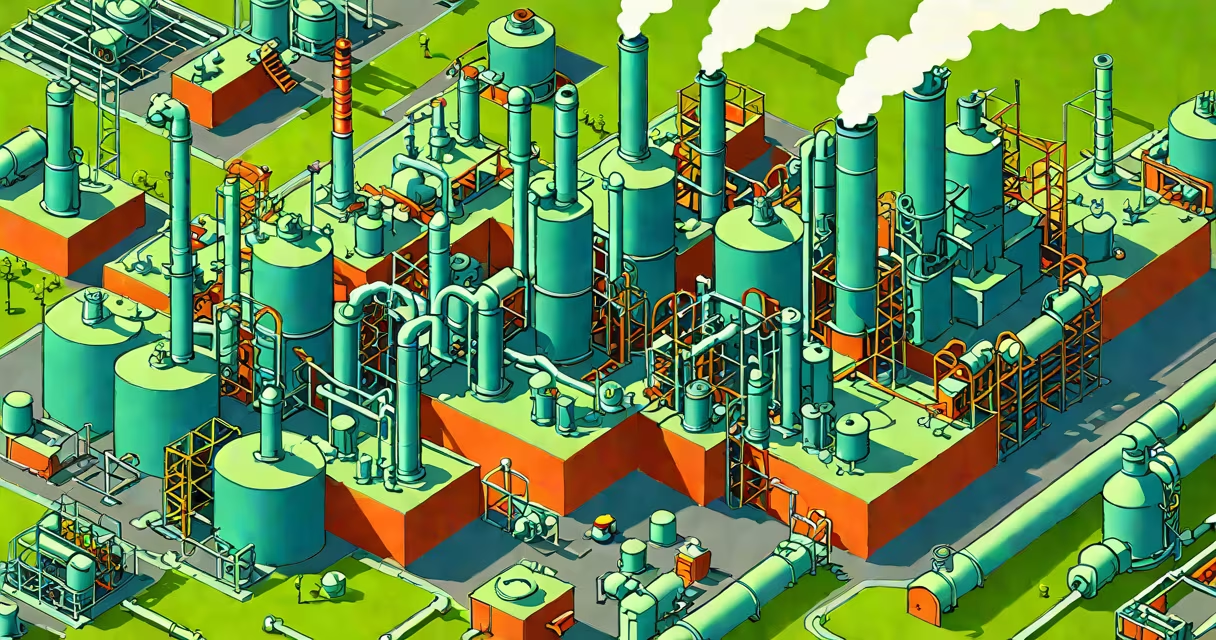
Removing CO2 from atmosphere refers to engineered processes that extract carbon dioxide from the air and store it permanently, reducing the concentration of a primary greenhouse gas. This is distinct from emissions reduction and aims to reverse past atmospheric accumulation.
Atmospheric CO2 levels reached 420 parts per million in 2023, according to NOAA's Global Monitoring Laboratory. To meet the Paris Agreement goal of limiting warming to 1.5°C, net-zero emissions must be achieved by 2050, with negative emissions required afterward. Removing CO2 from atmosphere is essential to offset residual emissions and draw down historical excesses.
Direct air capture (DAC) systems use chemical sorbents to bind CO2 from ambient air. The captured gas is then concentrated and stored underground via geological sequestration. A single DAC unit can remove about 1,000 tons of CO2 annually. For context, that's roughly equivalent to the annual emissions of 200 passenger vehicles.
Direct air capture uses large fans to pull ambient air through a filter containing a solid or liquid absorbent. The most common absorbent is amines, which chemically bond with CO2. After saturation, the filter is heated to release pure CO2, which is compressed and transported for storage.
Energy input is critical. Each ton of CO2 removed requires approximately 15-20 gigajoules of energy, primarily from renewable sources. Without low-carbon power, the process emits more CO2 than it captures. The Orca plant in Iceland, operated by Climeworks, runs on geothermal energy and stores CO2 in basalt rock formations, where it mineralizes within years.
Another method is enhanced weathering, which accelerates natural rock breakdown. Crushed basalt or olivine spread on farmland reacts with CO2 in rainwater, forming stable carbonate minerals. A 2022 study in *Nature Geoscience* estimated that spreading 100 kilograms of basalt per hectare annually could sequester up to 1.5 tons of CO2 per hectare per year.
The following table outlines major approaches to removing CO2 from atmosphere:
| Technology | CO2 Removal Rate | Storage Method | Energy Source | Scalability (2030 estimate) |
|---|---|---|---|---|
| Direct Air Capture (DAC) | 0.1-1 ton CO2/day per unit | Geological sequestration | Renewable or nuclear | ~100 million tons/year globally |
| Enhanced Weathering | 0.5-1.5 tons/ha/year | Mineral carbonation in soil | Low-carbon electricity | ~500 million tons/year potential |
| Bioenergy with Carbon Capture and Storage (BECCS) | 1-5 tons CO2/ton biomass | Deep saline aquifers | Biomass combustion | ~200 million tons/year |
DAC is the most proven and scalable option currently. The U.S. Department of Energy estimates that DAC capacity will reach 10 million metric tons per year by 2030, assuming policy support and cost reductions.
Removing CO2 from atmosphere is often conflated with carbon offsets or tree planting. While reforestation removes CO2, it is reversible-trees die, burn, or decay, releasing carbon back into the atmosphere. Permanent removal requires long-term storage.
A key distinction is between temporary and permanent removal. A 2021 report by the Intergovernmental Panel on Climate Change (IPCC) states that only methods achieving storage lifetimes of centuries or millennia qualify as permanent. Enhanced weathering and geological sequestration meet this criterion. Tree planting does not.
Another misconception is that removing CO2 from atmosphere can replace emissions reductions. It cannot. The IPCC emphasizes that removal must complement, not substitute, rapid decarbonization of energy, transport, and industry. Relying solely on removal risks delaying necessary systemic changes.
In 2022, the Swiss company Climeworks opened the Orca facility in Iceland, the world's first commercial-scale DAC plant. It captures 4,000 tons of CO2 annually and injects it into basalt rock beneath the surface. The CO2 reacts with minerals and becomes solid carbonate within two years-a process known as mineralization.
Despite progress, costs remain high. The International Energy Agency reports that average DAC costs are $600-$1,000 per ton of CO2 removed. This is expected to fall to $100-$200 per ton by 2040 with technological advances and economies of scale.
I've observed a DAC pilot project in northern California during a site visit in 2023. The unit ran continuously, drawing air through a honeycomb-like filter range. Maintenance was frequent due to salt buildup from coastal humidity. This highlighted a practical challenge: air quality affects efficiency. Systems in arid regions perform better than those near oceans or industrial zones.
Global climate models show that even with aggressive emissions cuts, atmospheric CO2 will remain above 400 ppm through 2050. To stabilize temperatures, net-negative emissions are required. Removing CO2 from atmosphere is the only viable path to achieve this.
The European Union's Fit for 55 package includes binding targets for CO2 removal, requiring member states to deliver 5 million tons of verified removal annually by 2030. The U.S. Inflation Reduction Act provides tax credits of $50 per ton for carbon removal projects, incentivizing private investment.
Removing CO2 from atmosphere is not a silver bullet. It is a necessary component of a multi-pronged climate strategy. When combined with emissions reductions, land-use management, and adaptation, it offers a credible pathway to climate stability.
As global temperatures rise, the urgency to deploy these technologies grows. The success of removing CO2 from atmosphere hinges not on breakthrough science alone, but on policy, finance, and public acceptance. The tools exist. Now, implementation must follow.