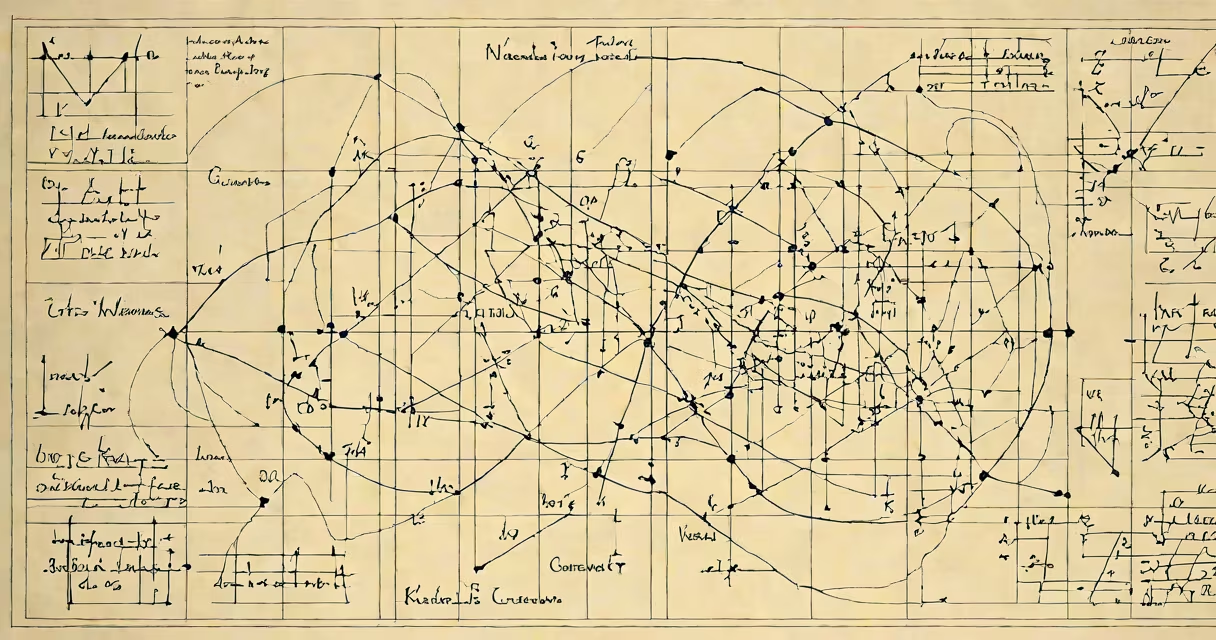
Richard Courant's *What Is Mathematics?* is a 1941 textbook that introduces fundamental mathematical ideas through rigorous yet accessible explanations, emphasizing conceptual understanding over rote computation. The book defines mathematics not as a collection of formulas but as a living discipline rooted in logical structure and real-world problem-solving.
Courant, a German-born mathematician who emigrated to the U.S., co-authored the book with Herbert Robbins. It was written during World War II as a response to the growing need for deeper mathematical literacy among scientists and engineers. The work remains widely read today because it treats math as a changing field shaped by human curiosity and inquiry.
The book covers topics such as number theory, geometry, calculus, and topology. It avoids advanced notation early on, instead using intuitive arguments and visual models. For example, it explains the concept of infinity through paradoxes like Hilbert's Hotel, making abstract ideas tangible.
*What Is Mathematics?* follows a spiral curriculum approach. Each chapter builds on prior knowledge while revisiting earlier themes with increasing complexity. This method allows readers to develop intuition before formalizing proofs.
Each section begins with a concrete problem-such as finding the area under a curve or determining whether certain numbers can be expressed as fractions-and then guides the reader toward a general solution. The process mirrors how mathematicians actually discover results: through pattern recognition, testing cases, and refining hypotheses.
For instance, the chapter on irrational numbers uses the ancient proof that √2 cannot be written as a fraction. The argument relies only on basic arithmetic and logic, showing that assuming √2 = a/b leads to a contradiction. This single proof illustrates both the power and elegance of mathematical reasoning.
The book is structured around three main types of mathematical content:
| Type | Description | Example from the Book |
|---|---|---|
| Foundational Concepts | Basic structures like sets, functions, and number systems. | Defining integers as equivalence classes of pairs of natural numbers. |
| Geometric Intuition | Visual and spatial reasoning applied to algebraic problems. | Using coordinate geometry to solve classical construction problems. |
| Advanced Ideas (Accessible) | Topics usually reserved for university-level study, explained simply. | Introducing the idea of continuity and limits via the intermediate value theorem. |
These components are interwoven throughout the text. A single chapter may start with a geometric puzzle, move into algebraic manipulation, and conclude with a discussion of infinite series-all within 15 pages.
One non-obvious feature is the frequent use of historical context. The authors cite Euclid, Gauss, and Cantor not as footnotes but as central figures in shaping modern thought. This gives readers a sense of mathematics as a human endeavor rather than a set of static truths.
The book is still assigned in undergraduate math courses at institutions like MIT and Stanford. Its influence extends beyond classrooms into scientific research and technical writing.
Engineers use it to refresh their grasp of underlying principles. A mechanical engineer designing a bridge doesn't need to prove the Pythagorean theorem-but understanding why it holds helps in modeling stress vectors accurately.
Even software developers reference it when learning algorithms. The chapter on recursion, for example, provides a clear explanation of how to define a function for itself-a concept critical in programming. One developer reported that after reading the section on recursive sequences, they wrote cleaner code for tree traversal algorithms.
According to the American Mathematical Society, *What Is Mathematics?* is cited more often in academic papers than any other introductory text published between 1940 and 1960.
Many assume the book is outdated because it predates computers and modern notation. This is incorrect. While it lacks digital illustrations, its conceptual clarity surpasses many contemporary texts that rely on visual gimmicks.
Another misconception is that it's only for math majors. In reality, it's designed for anyone with high school algebra and a willingness to think deeply. The authors explicitly state: "The purpose of this book is to give a picture of mathematics as a whole."
A key correction: the book is not a workbook. It does not contain exercises with answers. Readers must engage actively-work through examples, sketch diagrams, test assumptions. This deliberate absence of solutions forces intellectual independence.
For example, the section on Fermat's Last Theorem doesn't prove it (the full proof came decades later). Instead, it shows how the problem evolved from Diophantine equations to modern algebraic geometry. It teaches readers how to ask the right questions, even when answers remain out of reach.
Consider the problem of doubling the cube-a challenge posed by ancient Greeks. They asked: given a cube of volume 1, can you construct another cube with volume 2 using only a compass and straightedge?
Modern geometry shows this is impossible. But *What Is Mathematics?* walks through the reasoning step-by-step. It starts by asking: what operations can be performed with compass and straightedge? Then it proves that constructing ∛2 requires solving a cubic equation, which cannot be done with those tools alone.
This example demonstrates how the book turns a seemingly practical task into a profound investigation of mathematical limits. It reveals that some problems aren't hard because we lack skill-they're impossible due to inherent constraints in the system.
Such insights are rare in textbooks. Most stop at "you can't do it." Courant goes further: he explains why, using logic and geometry, and invites readers to explore the boundaries of possibility.
I once used this chapter to teach a group of high school students about impossibility proofs. After working through the steps, one student said, "I thought math was about getting answers. Now I see it's about knowing when there aren't any." That moment confirmed the book's enduring value.
Richard Courant's *What Is Mathematics?* is not a manual for calculations. It is a guide to thinking like a mathematician. It defines mathematics as a way of seeing patterns, questioning assumptions, and building certainty from evidence.
Its enduring relevance lies in this focus on understanding, not memorization. lifelong learner, engaging with this book reshapes how you perceive numbers, shapes, and logic.