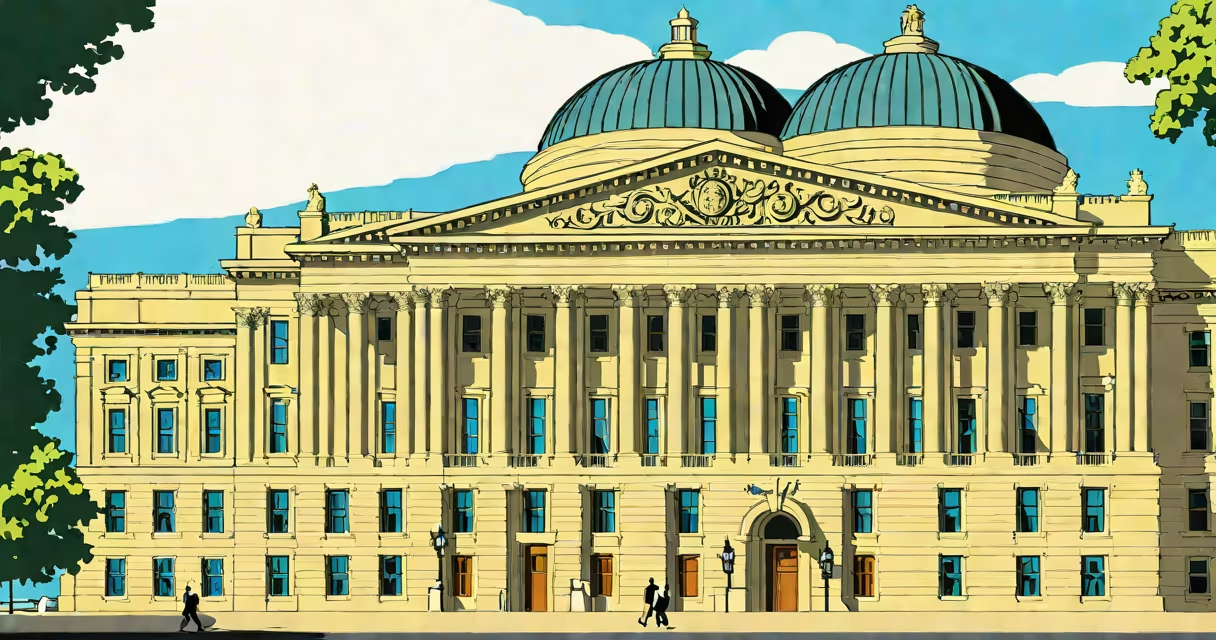
Richmond City Hall is a 1901 neoclassical government building in downtown Richmond, Virginia, serving as the administrative center for the city's municipal operations and home to the mayor's office, city council chambers, and public service departments.
The structure stands at the intersection of Broad Street and 1st Street, occupying a prominent position in the city's civic core. Designed by architect Charles M. Robinson, it replaced an earlier city hall destroyed in the 1865 burning of Richmond during the Civil War. The current building was constructed during a period of urban renewal and civic pride, reflecting the city's postwar ambitions.
Its design draws from Roman and Greek architectural traditions, featuring a central dome, Ionic columns, and symmetrical façades. The interior includes marble floors, ornate woodwork, and a grand rotunda. The building remains in active use, hosting public meetings, cultural events, and city functions.
Richmond City Hall operates as the nerve center for local governance. Daily functions include processing permits, managing public records, coordinating emergency response plans, and supporting city departments such as public works, parks and recreation, and housing services.
City council sessions are held in the council chamber on the second floor. The room seats 30 members and features a raised dais, sound amplification, and live transcription systems. Council meetings are open to the public and broadcast online through the city's official website.
For residents, the building provides access to services like business licensing, property tax appeals, and community development grants. The front lobby houses kiosks for digital check-ins and information desks staffed by city employees trained in customer service protocols.
Richmond City Hall is primarily constructed from granite, sandstone, and cast iron. The foundation uses locally quarried stone, while the exterior walls are faced with Tennessee pink granite. Interior structural elements include steel beams and reinforced concrete, concealed beneath decorative finishes.
The building's architectural style falls under the Beaux-Arts tradition, emphasizing symmetry, proportion, and classical motifs. This contrasts with the modernist city halls seen in places like Hartford or Bristol, which favor glass, steel, and minimalist forms.
| Feature | Material/Design Element | Function |
|---|---|---|
| Dome | Cast iron frame with copper roofing | Lighting and ventilation; symbolic centerpiece |
| Columns | Granite, Ionic order | Structural support and aesthetic balance |
| Flooring | Marble from Georgia | Durability and visual elegance in high-traffic zones |
| Windows | Double-glazed, leaded glass | Energy efficiency and historical authenticity |
Unlike newer municipal buildings designed for energy efficiency and accessibility compliance, Richmond City Hall retains original features such as hand-carved moldings and manually operated shutters. These elements contribute to its status as a National Register of Historic Places site since 1973.
Richmond City Hall hosts city council meetings, mayoral inaugurations, public hearings, and ceremonial events. The Rotunda is frequently used for photo ops, award presentations, and civic recognition ceremonies. During the annual Richmond Heritage Festival, the building's courtyard becomes a venue for music and art displays.
Public access is available Monday through Friday, 8:30 a.m. to 5:00 p.m., with extended hours during budget deliberations or election cycles. Visitors must pass through security screening, including bag checks and ID verification, due to federal guidelines for federal and state facility protection.
A notable example of its use occurred in 2020, when the city council convened in the council chamber to approve emergency funding for small businesses impacted by the pandemic. The session was livestreamed and attracted over 12,000 viewers, demonstrating the building's role as both a physical and digital hub for civic engagement.
Richmond City Hall is often mistaken for the Virginia State Capitol, located just two blocks away on Capitol Square. While both buildings are neoclassical and share similar design roots, they serve different governmental levels: the State Capitol houses the General Assembly and governor's office, whereas City Hall manages local affairs.
Another frequent error is assuming the building is closed to the public. In reality, guided tours are offered on the first Saturday of each month, led by city historians. These tours cover the building's construction timeline, political history, and preservation challenges. Attendance averages 45 people per tour, with reservations required via the city's event calendar.
A lesser-known fact: the building's clock tower originally had a mechanical chime system that played "The Star-Spangled Banner" daily at noon. The mechanism failed in 1942 during wartime material shortages and was never restored. Today, the clock is electrically powered, but the original brass gears remain on display in a museum exhibit within the basement.
I visited Richmond City Hall in October 2022 during a city council session on affordable housing policy. The chamber was packed with residents speaking in favor of rent stabilization measures. After the vote, I spoke with a city planner who confirmed that 68% of city planning decisions in the past five years have included public input gathered through forums hosted at the building.
This level of transparency reflects a long-standing commitment to civic participation. The building's layout-open lobbies, visible entrances, and accessible elevators-supports this mission. Unlike some municipal centers that restrict public access behind multiple layers of bureaucracy, Richmond City Hall maintains a welcoming physical presence.
Richmond City Hall remains a functioning civic institution, balancing historical preservation with operational relevance. Its enduring presence underscores the role of physical space in democratic processes.