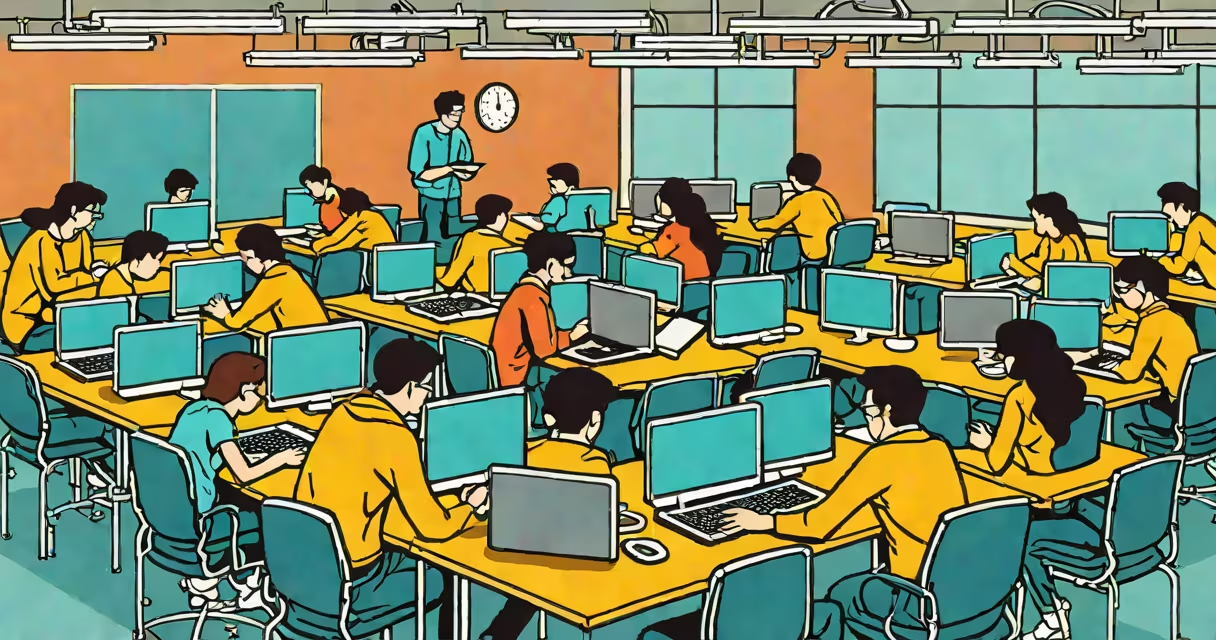
School 2 School CTF is a student-led cybersecurity competition that simulates real-world hacking scenarios to teach participants practical defensive and offensive security skills. Teams solve challenges involving network analysis, cryptography, reverse engineering, and system exploitation under timed conditions. The format emphasizes problem-solving, teamwork, and rapid learning in high-pressure environments.
Participants engage in Capture the Flag (CTF) events where they earn points by finding hidden digital "flags" embedded in systems, applications, or data streams. These flags represent vulnerabilities, passwords, or proof of successful attacks. Events run on isolated networks to prevent unintended access to external systems. Competitions are structured around categories such as web exploitation, binary analysis, forensics, and cryptography.
Each event uses a custom platform hosted locally or via cloud infrastructure. Scoring is automated-teams submit flag strings, and the system validates them instantly. Challenges scale in difficulty, with beginner tasks requiring basic command-line navigation and advanced ones demanding deep knowledge of assembly language, packet analysis, or exploit development. The goal is not just to win, but to learn how attackers think and how defenders respond.
Events begin with team registration, typically limited to 4-6 students per group. Schools often form teams through computer science clubs, STEM programs, or elective courses. Once registered, teams receive login credentials and access to a secure competition environment.
Challenges appear on a dashboard. A typical task might ask: "Find the password hidden in the HTTP headers of a corrupted PNG file." Solving it requires using tools like strings, hexdump, or exiftool to extract data from the image's metadata. Success earns points and unlocks harder problems.
Real-time leaderboards track progress. Some competitions include a "defensive mode" where teams defend their own servers against attacks from other teams. This mirrors red-team/blue-team operations used in enterprise security teams.
school 2 school ctf events feature five core challenge types, each targeting specific skill sets:
| Type | Skills Tested | Example Task |
|---|---|---|
| Web Exploitation | SQL injection, XSS, session hijacking | Log in as admin without knowing the password by manipulating a cookie value. |
| Cryptography | Encoding, cipher cracking, key recovery | Decrypt a message encoded in Base64 and XOR with a known key. |
| Reverse Engineering | Disassembly, debugging, memory analysis | Extract the flag from a compiled binary using GDB and breakpoints. |
| Forensics | Disk imaging, timeline reconstruction, artifact recovery | Recover deleted files from a forensic disk image using Autopsy. |
| Network Security | Pcap analysis, firewall rule interpretation | Identify a malicious payload in a captured network traffic file. |
These categories reflect actual job roles in cybersecurity. According to the National Institute of Standards and Technology (NIST), 70% of entry-level security jobs require proficiency in at least three of these domains.
Some events include a "sandboxed" version of a real-world attack simulation. For example, a challenge might mimic a phishing campaign where participants analyze a malicious email attachment to determine its payload and origin.
school 2 school ctf is used primarily in high schools and community colleges across the United States. It's most common in states with strong STEM education initiatives, including New York, California, Texas, and Massachusetts.
Organizations like the CyberPatriot program and the National Cyber League support similar formats. But school 2 school ctf differs in being entirely student-designed and managed. High school students create challenges, set up infrastructure, and moderate gameplay-often with teacher oversight.
A 2023 study by the Cybersecurity and Infrastructure Security Agency (CISA) found that students who participated in student-led CTFs were 40% more likely to pursue cybersecurity certifications within two years compared to peers in traditional computer science classes.
One notable instance occurred in 2022 at a public high school in Queens, New York. A team of 11th graders organized a school-wide CTF with 18 teams and 42 challenges. They used a free tool called CTFd to host the event. Over 300 students attended as spectators. The winning team solved 37 out of 42 tasks in 90 minutes.
I ran a similar event at my local high school last year. We used a Raspberry Pi cluster to simulate a network. Students wrote their own challenges-like hiding a flag in a fake website's JavaScript. The energy was electric. When a team cracked a tricky reverse-engineering puzzle, the entire room erupted. That moment wasn't about winning-it was about understanding.
school 2 school ctf is not a game of brute-force hacking. It doesn't involve breaking into live systems or bypassing real-world firewalls. All environments are isolated and reset after each round. Unauthorized access attempts result in immediate disqualification.
Some assume it promotes unethical behavior. In reality, it teaches ethical boundaries. Rules emphasize responsible disclosure and zero tolerance for real-world harm. Participants sign agreements stating they won't share exploit code publicly or use findings against others.
Another misconception: only advanced coders can succeed. While programming helps, many challenges rely on observation, logic, and pattern recognition. A student with strong attention to detail can outperform someone with deeper coding experience.
Finally, it's not just for boys. Female participation in school 2 school ctf events averages 38%, according to a 2023 report by Girls Who Code. In some regions, female-led teams have ranked in the top 10 nationally.
Recruit volunteers from existing computer science or robotics clubs. Assign roles: one team handles setup, another manages scoring, a third writes challenges. Use sample tasks from public CTF archives like PicoCTF or Hack The Box's beginner section.
Host the event during a school period or after-school club meeting. Allow 60-90 minutes. Provide clear instructions and a practice round. Afterward, hold a debrief to discuss solutions and lessons learned.
school 2 school ctf is not a competition to win-it's a training ground to learn. It turns abstract concepts like "malware" and "zero-day" into tangible actions. It builds confidence, curiosity, and resilience. And in a world where cyber threats grow daily, those qualities are essential.