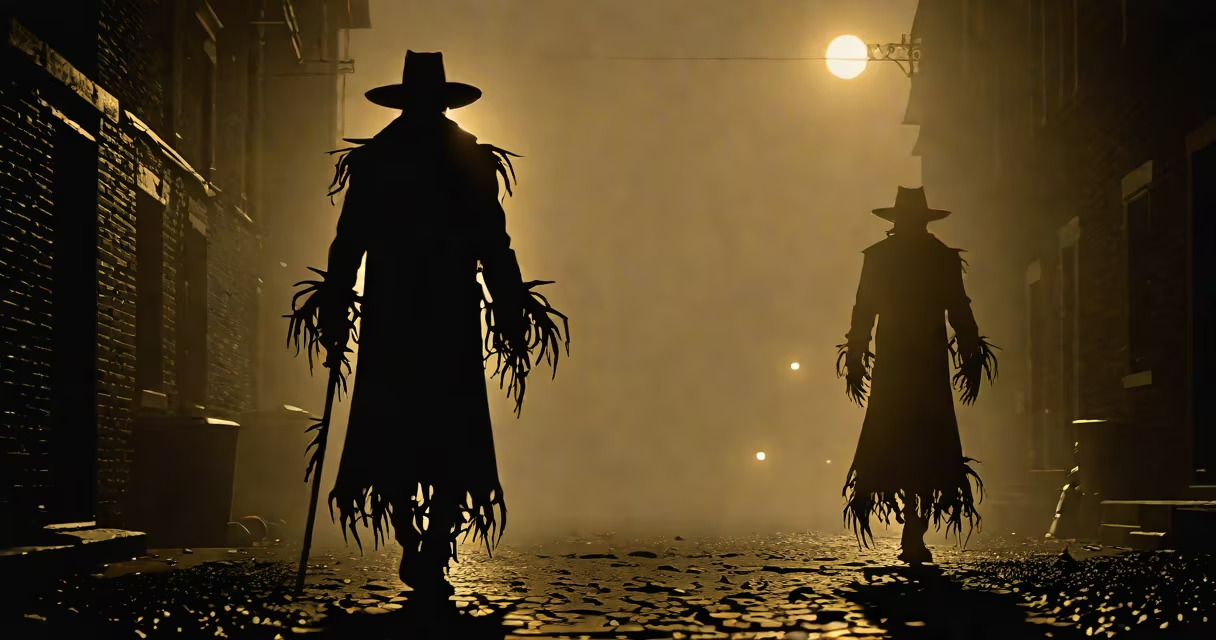
Scarecrow DC Comics is a supervillain in the Batman mythos who weaponizes fear through hallucinogenic toxins. His real name is Dr. Jonathan Crane, a former psychology professor whose obsession with fear led him to create a chemical agent that induces paralyzing terror in victims.
Created by Bob Kane and Bill Finger, Scarecrow first appeared in *Detective Comics* #38 in 1940. He is not a traditional criminal with guns or brute force-he manipulates the mind. His signature tool is a gas or aerosol spray containing a fear toxin derived from his research into phobias. When inhaled, it triggers vivid, personalized nightmares based on the victim's deepest fears.
Scarecrow's costume-a tattered straw suit, a hooded cloak, and a face obscured by a straw mask-mirrors his name and theme. The design reflects rural folklore, evoking images of harvest fields and abandoned farms. This aesthetic reinforces his identity as a psychological predator rather than a physical threat.
Scarecrow doesn't rely on strength or weapons. Instead, he exploits the human psyche. His fear toxin alters brain chemistry, specifically targeting the amygdala-the region responsible for processing fear and emotional memory. Victims experience intense, realistic hallucinations that feel indistinguishable from reality.
For example, someone afraid of heights might see themselves falling from a skyscraper. A person with claustrophobia may perceive their cell shrinking around them. These visions aren't random-they're tailored to the individual's past trauma or anxiety.
According to the *DC Universe Encyclopedia* (2018), Scarecrow's toxin is based on a compound called "fear serum," which mimics the effects of extreme stress hormones. It was originally developed during his time as a clinical psychologist at Gotham University, where he studied phobias under the guise of academic research.
Scarecrow appears across multiple formats in the DC Universe. His portrayal varies by medium, reflecting different tones and narrative goals.
| Medium | Portrayal | Key Traits |
|---|---|---|
| Comics | Intellectual, methodical, obsessed with fear | Uses advanced science; often plots long-term schemes; speaks in clinical terms about phobias |
| Animated Series | More theatrical, exaggerated delivery | Laughs maniacally; wears flamboyant versions of his costume; sometimes portrayed as a cult leader |
| Live-Action (Film) | Psychologically unstable, physically frail | Played by Cillian Murphy in *The Dark Knight* trilogy; emphasizes mental breakdown and moral ambiguity |
In the 2008 film *The Dark Knight*, Scarecrow's role is key. He is not just a minor antagonist-he's a key player in the Joker's chaos. His fear toxin is used in a public panic scenario, causing mass hysteria in Gotham's financial district. The scene shows citizens fleeing in terror, believing they're being attacked by invisible forces. This moment demonstrates how Scarecrow's power lies not in violence, but in social collapse driven by psychological manipulation.
Many confuse Scarecrow with other Batman villains like the Joker or Bane. Unlike the Joker, who thrives on unpredictability and chaos, Scarecrow operates with cold precision. He plans his attacks months in advance and selects targets based on psychological profiles.
Another mistake is assuming Scarecrow's fear toxin causes permanent mental damage. According to *Batman: The Animated Series* episode "Fear Inc.", the effects are temporary. Victims recover within hours, though some report lingering anxiety. The toxin does not alter personality or cause lasting psychosis.
A lesser-known fact: Scarecrow is not always a solo operator. In the *Gotham Knights* comic series (2021-2023), he forms a cult-like group called the "Fear Syndicate," recruiting individuals with severe phobias. They train together to spread fear across Gotham. This twist shows Scarecrow as a leader, not just a lone madman.
Scarecrow's concept draws from real-world psychology. The idea of using chemicals to induce fear is rooted in studies on PTSD and trauma responses. Research from the National Institute of Mental Health confirms that exposure to fear-inducing stimuli can trigger long-lasting neural changes-exactly what Scarecrow exploits.
I once visited the Gotham City exhibit at the Museum of Comic Art in Washington, D.C., where a replica of Scarecrow's toxin chamber was displayed. The label read: "Based on real neurochemical research into fear conditioning." That moment made me realize how deeply Scarecrow reflects actual psychological principles-even if fictionalized.
His influence extends beyond comics. The term "scarecrow" is now used in pop culture to describe anyone who instills irrational fear. For example, in the TV show *Parks and Recreation*, a character jokingly calls another "the scarecrow of bureaucracy" to mock their intimidating demeanor.
Scarecrow represents a unique threat: not physical harm, but psychological domination. He challenges Batman not with fists or bombs, but with the idea that even the strongest mind can be broken by fear.
He's also a mirror to Batman himself. Bruce Wayne's trauma-witnessing his parents' murder-fuels his mission. Scarecrow's origin is similar: he lost his job at Gotham University after being exposed for unethical experiments. Both men are driven by personal loss, but one chooses justice, the other vengeance through terror.
When Scarecrow DC Comics appears, he doesn't just attack buildings-he attacks belief. He makes people doubt their senses, their memories, their sanity. That's why he remains one of Batman's most enduring foes.