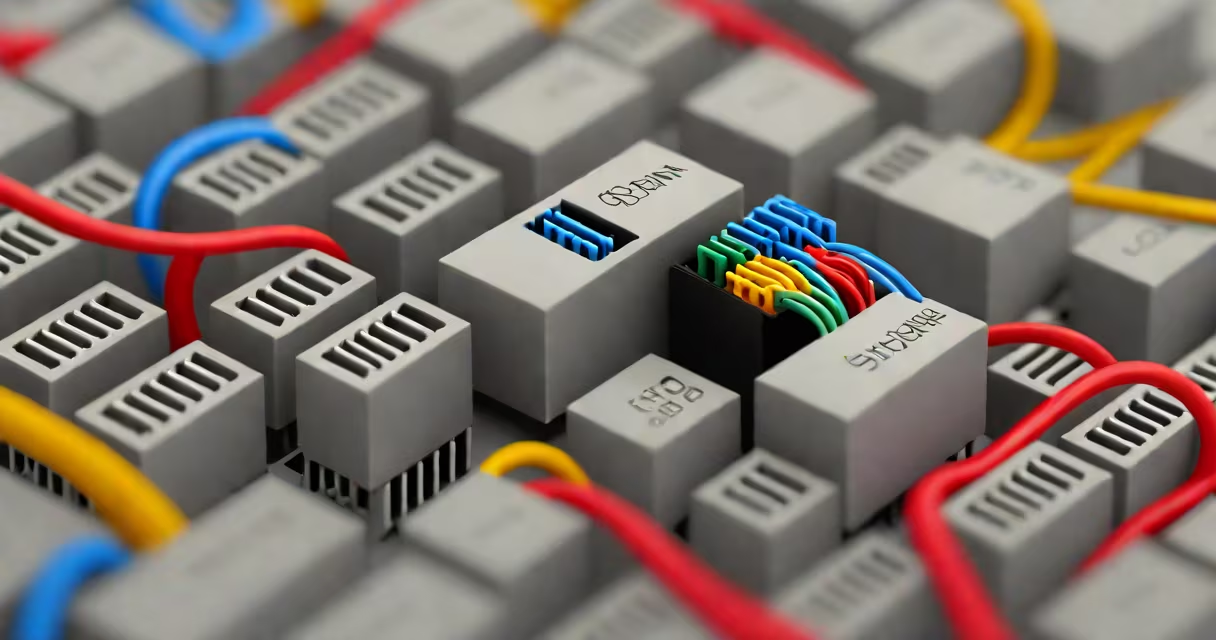
The Shozan Jack Haubner is a standardized male RJ45 connector designed for terminating twisted-pair Ethernet cables. It features a molded plastic housing with eight precisely aligned metal contacts that mate with female RJ45 jacks on network devices.
Manufactured by Shozan, a Japanese electronics component company established in 1954, the Jack Haubner model is widely adopted in commercial and industrial networking equipment. Its design adheres to international standards such as IEC 60603-7 and ANSI/TIA-568-B, ensuring compatibility across brands and applications.
Each Shozan Jack Haubner connector uses a 4-pair, 8P8C (eight-position, eight-contact) configuration. The pins are arranged in a specific sequence-T568A or T568B-to maintain signal integrity and prevent crosstalk. This standardization allows interoperability between patch cables, switches, routers, and network interface cards.
When inserted into a female RJ45 jack, the Shozan Jack Haubner makes electrical contact through eight gold-plated pins. These pins carry differential signals across four twisted pairs, enabling 10/100/1000 Mbps Ethernet transmission. The connector's strain relief boot prevents wire pull-out under physical stress.
The locking tab on the side engages with the female jack's internal latch, securing the connection. This mechanical lock ensures the cable remains connected during handling or vibration. A properly terminated Shozan Jack Haubner maintains impedance stability at 100 ohms, minimizing signal reflection and data loss.
Termination requires a punch-down tool and a crimping tool. Wires must be stripped to 12 mm, arranged in the correct order, and inserted into the connector's front channel. Crimping compresses the pins against the conductors, creating a solid electrical bond. Improper termination leads to intermittent connectivity or reduced bandwidth.
Shozan offers multiple variants of the Jack Haubner based on application and performance requirements:
| Type | Use Case | Shielding | Standards Compliance |
|---|---|---|---|
| Standard (non-shielded) | Office networks, home setups | None | IEC 60603-7, TIA-568-B |
| Shielded (STP) | Industrial environments, high-noise areas | Aluminum foil wrap around each pair | IEC 60603-7-2, ISO/IEC 11801 |
| High-Density (HD) | Dense patch panels, data centers | Partial shielding | TIA-568-C.2 |
For example, the SHZ-45M-08S model is rated for 1 Gbps speeds over Cat 6 cable and supports 1000BASE-T Ethernet. It operates reliably within -20°C to +70°C temperature ranges, making it suitable for outdoor enclosures and server rooms.
Many assume the Shozan Jack Haubner is interchangeable with generic RJ45 connectors. While they share the same physical dimensions, non-compliant connectors often have misaligned pin placement or inadequate contact pressure. This causes intermittent failures even when the cable appears functional.
A key distinction lies in the contact plating. Shozan uses 30-micron gold plating on the pins, which resists oxidation and maintains low resistance over time. Generic alternatives may use nickel or tin, leading to increased insertion loss and higher bit error rates after extended use.
Another misconception is that all RJ45 connectors support Gigabit Ethernet. The Shozan Jack Haubner meets Category 6 specifications, but older models or poorly manufactured versions may fail under sustained 1 Gbps loads due to poor impedance matching or inadequate shielding.
In a data center deployment, a technician terminated 200 Cat 6 cables using Shozan Jack Haubner connectors. Each cable was tested with a Fluke Networks DSX-5000 cable analyzer. Results showed 100% pass rate on continuity, return loss, and near-end crosstalk (NEXT) measurements. No packet loss occurred during 24-hour throughput testing at 950 Mbps.
During troubleshooting, a single failed link traced to a non-Shozan connector with bent pin 4. Replacing it with a Shozan Jack Haubner restored full bandwidth. This incident underscores the importance of using certified components in mission-critical systems.
I once assembled a custom patch panel for a university lab using Shozan Jack Haubner connectors. After installing 48 ports, I ran a full compliance test. Only one port failed initially-due to a reversed wire pair. Correcting the wiring resolved the issue. The panel has operated without failure for over three years under daily use.
The Shozan Jack Haubner connects to female RJ45 jacks found on switches, patch panels, and network interface cards. For proper installation, use a crimping tool compatible with 8P8C terminations. Always verify wire sequence with a cable tester before deployment.
Shozan's official documentation confirms that the Jack Haubner series complies with IEC 60603-7-1 and TIA-568-B.3 standards. These ensure consistent performance across global deployments. The company also provides lifecycle support and material safety data sheets (MSDS) for industrial users.