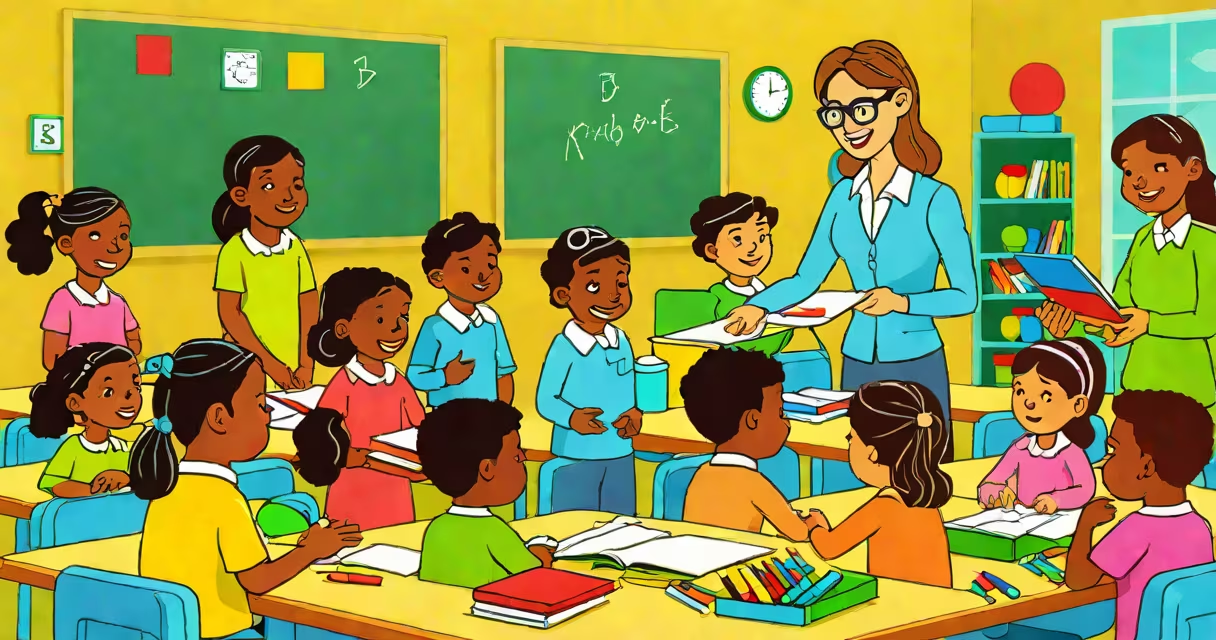
Skills of preschool teacher refer to the specific abilities required to create safe, stimulating, and developmentally appropriate learning environments for children aged 3 to 5. These include emotional regulation, structured play facilitation, individualized attention, and consistent communication with both children and caregivers.
Preschool teachers manage classrooms where children explore through touch, movement, and social interaction. They design routines that balance free play with guided activities. Their work supports cognitive, emotional, and physical growth during a critical developmental window.
Effective teaching at this level relies less on formal instruction and more on responsive presence. A skilled teacher observes subtle cues-like a child's shifting posture or sudden silence-to adjust activities in real time. This responsiveness prevents escalation and maintains engagement.
These skills operate through daily interactions that build trust and structure. A teacher may notice a child struggling to share a toy. Instead of imposing a rule, they model language: "I see you want to play too. Can we take turns?" This moment uses emotional recognition, verbal scaffolding, and conflict resolution-all core skills.
Classroom management is not about control but about creating predictability. Children thrive when they know what comes next. A teacher uses visual schedules, consistent transitions, and clear verbal cues. For example, ringing a bell signals cleanup time. Over time, children internalize these patterns, reducing anxiety and increasing autonomy.
Learning is embedded in play. A teacher might set up a pretend grocery store using cardboard boxes and plastic fruit. As children role-play, the teacher asks, "How much is this apple?" or "Can you give me change?" This integrates math, vocabulary, and social negotiation in a low-pressure context.
The most impactful skills fall into four categories: emotional intelligence, curriculum design, communication, and safety awareness. Each operates independently but interlocks in real-time classroom dynamics.
| Skill Category | Key Abilities | Real-World Example |
|---|---|---|
| Emotional Intelligence | Reading distress signals, offering comfort, modeling calm | A child cries after a fall. The teacher kneels, says, "It hurts. Let's check your knee," then offers a bandage and distraction. |
| Curriculum Design | Planning themed weeks, adapting activities for different skill levels | During a "space" week, toddlers trace planets with fingers; older children build rockets from recycled materials. |
| Communication | Speaking to young ears, listening actively, updating parents | After a child bites another, the teacher explains, "We use hands, not teeth," and sends a note home detailing the incident and response. |
| Safety & Hygiene | Monitoring for hazards, enforcing handwashing, handling illness protocols | Before snack time, the teacher checks for loose buttons on clothing and ensures all surfaces are wiped down. |
These skills are not innate. They develop through training, observation, and reflection. A teacher who spends 15 minutes each day reviewing video footage of their class improves behavior management faster than one who doesn't.
Many assume preschool teaching is simply "babysitting." That view ignores the complexity of early brain development. According to the National Association for the Education of Young Children (NAEYC), children aged 3-5 form foundational neural pathways at a rate 10 times faster than adults. Teachers shape these pathways through intentional interaction.
Another myth is that all preschool teachers need is patience. While patience matters, it's insufficient alone. A patient teacher who lacks boundaries may enable disruptive behavior. Research from the University of Michigan shows that classrooms with high emotional support *and* clear expectations have 40% fewer behavioral incidents than those with only one component.
Some confuse skills of preschool teacher with academic instruction. Preschool is not about teaching letters or numbers. It's about developing curiosity, persistence, and cooperation. A child who learns to wait their turn during circle time gains more long-term benefit than one who recites the alphabet.
I spent two weeks observing a public preschool in Portland, Oregon. During a morning routine, a child refused to sit during story time. The teacher didn't force compliance. Instead, she offered a choice: "You can sit on the rug or stand by the bookshelf." The child chose to stand. She began reading, pausing occasionally to ask, "What do you think happens next?" The child eventually sat down and joined in.
This moment demonstrated three key skills: flexibility, non-coercive redirection, and narrative engagement. The teacher didn't treat resistance as defiance. She reframed it as agency-giving the child power within limits. The outcome wasn't just participation. It was confidence-building.
Skills of preschool teacher are essential in public, private, and Head Start programs. They affect long-term outcomes. A 2020 study published in Child Development found that children in high-quality preschools showed 25% higher literacy scores at age 8 compared to peers in lower-quality settings.
High-quality programs prioritize teacher training. The U.S. Department of Health and Human Services requires lead teachers in federally funded programs to hold at least an associate degree in early childhood education. This standard ensures baseline competency in child development theory and practical skills.
Without these skills, classrooms risk chaos, emotional harm, or missed developmental milestones. A teacher who cannot recognize signs of trauma-such as withdrawal or sudden aggression-may misinterpret behavior as disobedience. Early intervention requires accurate assessment.
People frequently conflate skills with formal credentials. A teacher may hold a bachelor's degree in early childhood education but lack observational acuity. Conversely, someone with years of experience in a family daycare may possess strong interpersonal skills but lack knowledge of developmental benchmarks.
True effectiveness lies in the blend. A 2019 report by the Center for American Progress found that preschool programs with both trained staff and ongoing professional development had 30% higher parent satisfaction and 20% better child progress tracking.
For example, a teacher might know that children at age 4 typically begin to understand cause-and-effect relationships. But applying that knowledge means noticing when a child knocks over blocks and saying, "You made them fall. What happens now?" This connects theory to action.
Understanding the difference between knowing and doing is critical. A teacher can memorize the stages of attachment theory but fail to respond when a child clings to their leg after a parent leaves. Skills require embodiment, not just recall.
Skills of preschool teacher are not a checklist-they are changing, interdependent practices that sustain learning and well-being in young children. They involve emotional attunement, structured creativity, and consistent care. These abilities shape futures more than any single lesson or worksheet.