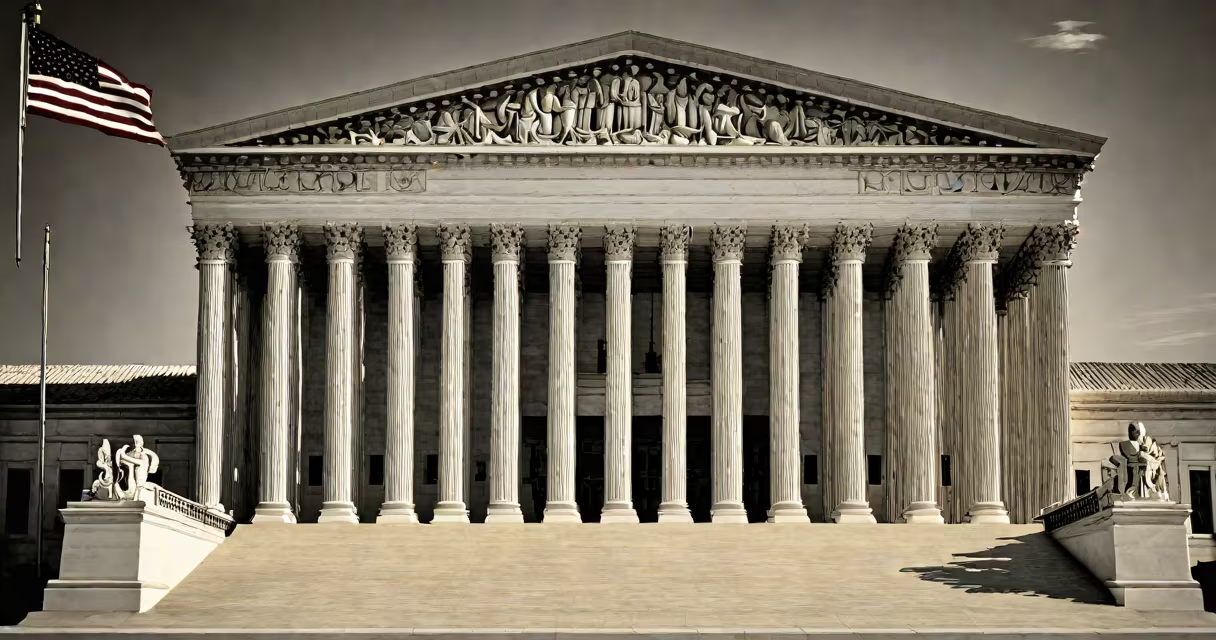
Supreme Court cases about the First Amendment are legal decisions that interpret and apply the First Amendment's protections of free speech, religion, press, assembly, and petition. These rulings define the limits and scope of constitutional rights in American public life.
The First Amendment, part of the Bill of Rights ratified in 1791, prohibits Congress from making laws that establish a religion or restrict freedom of expression. The Supreme Court has interpreted this text through decades of litigation, setting precedents that govern everything from political protests to religious symbols in public spaces.
These cases often arise when individuals or groups challenge government actions they claim violate their First Amendment rights. The Court weighs whether the restriction serves a compelling state interest and is narrowly tailored-especially in cases involving national security, public safety, or religious accommodation.
The process begins when a party files a lawsuit challenging a law, regulation, or government action. If lower courts uphold the restriction, the case may reach the Supreme Court via a writ of certiorari. The Court accepts fewer than 100 cases annually from over 7,000 petitions.
Once accepted, the Court reviews briefs submitted by the parties, amici curiae (friend of the court), and federal agencies. Oral arguments last 30 minutes per side. Justices then deliberate in private, often voting along ideological lines. A majority opinion explains the ruling, while dissenting opinions offer alternative interpretations.
For example, in *Tinker v. Des Moines Independent Community School District* (1969), students wore black armbands to protest the Vietnam War. The Court ruled that symbolic speech in public schools is protected under the First Amendment unless it causes substantial disruption. This decision established that student expression is not automatically subject to school censorship.
Supreme Court cases about the First Amendment fall into five core categories: free speech, religious liberty, press freedom, assembly, and petition. Each category reflects different tensions between individual rights and governmental authority.
| Type | Key Issue | Landmark Case | Outcome |
|---|---|---|---|
| Free Speech | Political expression in public spaces | Citizens United v. FEC (2010) | Corporate spending on political ads is protected speech |
| Religious Liberty | Government endorsement of religion | Employment Division v. Smith (1990) | Neutral laws of general applicability don't violate religious freedom |
| Press Freedom | Government access to news sources | Branzburg v. Hayes (1972) | Journals cannot claim absolute privilege against grand jury subpoenas |
| Assembly | Protests in public areas | Terry v. Adams (1953) | Primary elections cannot exclude minorities from participation |
| Petition | Right to seek redress from government | McDonald v. City of Chicago (2010) | Second Amendment applies to states-but petition rights were affirmed in earlier rulings |
*Citizens United v. FEC* (2010) expanded corporate political speech, allowing unlimited independent expenditures by corporations and unions. The decision split the Court 5-4, with Justice Anthony Kennedy writing the majority opinion. Critics argue it increased the influence of money in politics, while supporters say it protects free expression.
Supreme Court cases about the First Amendment affect daily life-from what people can say online to how schools handle student protests. They set binding precedent across all 50 states, meaning lower courts must follow them unless overruled.
For example, in *Brown v. Entertainment Merchants Association* (2011), the Court struck down a California law banning the sale of violent video games to minors. The majority held that video games are protected speech under the First Amendment, rejecting the argument that they harm children. This ruling reinforced that expressive media, even controversial ones, receive constitutional protection.
A lesser-known but critical point: the Court rarely strikes down laws solely because they burden speech. Instead, it applies a tiered standard. Content-based restrictions (those targeting specific ideas) face strict scrutiny. Content-neutral laws (those regulating time, place, or manner) are reviewed under intermediate scrutiny.
For instance, in *United States v. Stevens* (2010), the Court invalidated a federal law banning depictions of animal cruelty. The justices ruled that the law was overly broad and violated free speech, even though the content was disturbing. The decision emphasized that the government cannot ban speech simply because it is offensive.
Many assume the First Amendment guarantees absolute freedom of speech. It does not. The Court has consistently upheld limits on speech that incites violence, constitutes fraud, or threatens national security. In *Schenck v. United States* (1919), Justice Oliver Wendell Holmes Jr. introduced the "clear and present danger" test: speech that poses an immediate threat to public order can be restricted.
Another misconception is that the First Amendment applies only to government action. It does not bind private entities. A social media platform can remove posts based on its own rules-even if those posts involve protected speech. The First Amendment only restricts government interference, not private censorship.
Also, the First Amendment does not protect all forms of protest equally. In *Cox v. New Hampshire* (1941), the Court upheld a state law requiring permits for parades. The ruling clarified that peaceful assembly rights do not override public safety concerns. Permits can be denied if they pose a risk to traffic, health, or order.
One non-obvious fact: the Court has never ruled that the First Amendment protects a right to remain anonymous online. While anonymity can aid free expression, especially for whistleblowers, the Supreme Court has not extended constitutional protection to digital pseudonyms. Lower courts have sometimes granted temporary anonymity in cases involving sensitive disclosures, but no binding precedent exists.
In 2023, the Court heard *Garland v. Cargill*, a case concerning a man who posted a video threatening a politician. The government argued the video constituted "true threats," which are not protected speech. The Court ruled 6-3 that the video crossed the line into unprotected speech because it conveyed a serious intent to harm.
This decision reaffirmed that threats-especially those directed at public officials-are not shielded by the First Amendment. The ruling cited *Virginia v. Black* (2003), where the Court upheld a law banning cross burnings when done with intent to intimidate.
Even in high-profile cases, the Court avoids sweeping declarations. It interprets the Constitution through context, precedent, and evolving societal norms. The outcome in *Garland v. Cargill* did not overturn prior standards but refined the threshold for what constitutes a threat under the First Amendment.
Supreme Court cases about the First Amendment continue to shape American democracy. They balance individual liberties with societal order, ensuring that free expression remains both meaningful and responsible.