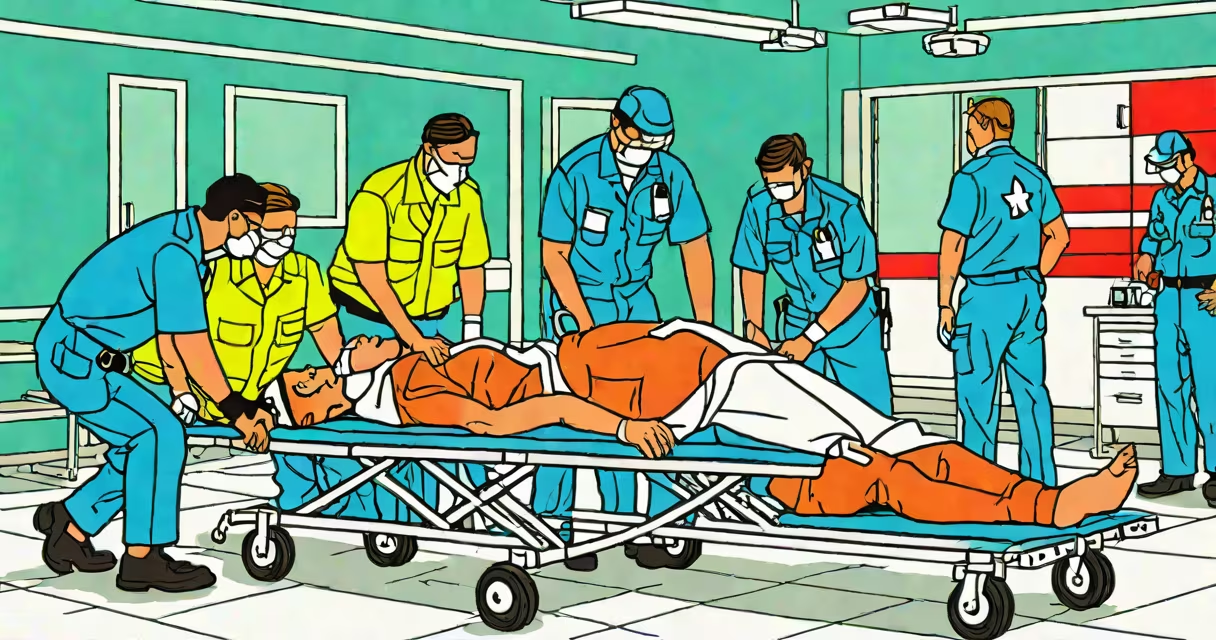
ten second triage is a rapid clinical assessment tool used by emergency medical personnel to identify life-threatening conditions in a patient within 10 seconds of initial contact. It focuses on visible signs of critical illness or injury to determine immediate intervention needs.
This method is not a diagnosis. It is a decision-making shortcut designed to sort patients by urgency during mass casualty incidents, natural disasters, or sudden-onset emergencies. The goal is to assign priority levels-immediate, delayed, minor, or deceased-based on observable indicators such as breathing, bleeding, and responsiveness.
Developed from principles in military medicine and adapted for civilian EMS systems, ten second triage helps limited resources are directed to those most likely to survive with prompt care. It is used globally by paramedics, firefighters, and first aid teams during events like car crashes, fires, or mass gatherings.
Within the first 10 seconds of arriving at a scene, a responder performs a visual sweep of the patient. They look for three key signs: airway patency, breathing effort, and circulation status. These are assessed simultaneously, not sequentially.
If a patient is not breathing, or is gasping, they are marked for immediate attention. If they have severe external bleeding-especially from limbs or neck-they are prioritized. Unresponsiveness to verbal commands or pain stimuli also triggers high-priority tagging.
For example, in a multi-vehicle crash, a responder sees a man slumped over the steering wheel, face pale, with blood pooling under his seat. No breath sounds are audible. The responder tags him "Immediate" and begins chest compressions while calling for advanced life support. This action takes less than 10 seconds from first sight.
The assessment relies on three primary physical observations:
These cues are trained through simulation drills. Responders memorize patterns: a limp body, no movement, no breathing = immediate action. A patient who moans but doesn't respond to name is tagged for urgent care.
Studies show that trained responders can correctly classify 92% of patients using ten second triage in simulated mass casualty scenarios (National Center for Biotechnology Information, 2014). Accuracy drops below 70% when performed without training.
ten second triage is often mistaken for a full patient exam. It is not meant to replace important sign checks or detailed history-taking. It is strictly a sorting mechanism, not a diagnostic tool.
One common error is assuming unconsciousness always equals critical need. A person may be unconscious due to hypoglycemia or shock, which requires different interventions than traumatic brain injury. However, in triage, the responder acts based on what is visible-not what might be behind the symptoms.
Another misunderstanding is that it applies only to disaster scenes. In reality, it's used in single-patient emergencies too. For instance, a firefighter responding to a house fire may perform ten second triage on a collapsed victim before moving them, ensuring no spinal injury is missed and no life-threatening issue is overlooked.
While the core method remains consistent, several models exist depending on context and region:
| Model | Use Case | Key Difference |
|---|---|---|
| START (Simple Triage and Rapid Treatment) | Mass casualty incidents | Uses color-coded tags: red (immediate), yellow (delayed), green (minor), black (deceased). |
| JumpSTART | Pediatric emergencies | Adjusts START criteria for children under 8 years old. Accounts for smaller anatomy and different physiology. |
| CTAS (Canadian Triage and Acuity Scale) | Emergency departments | Used inside hospitals. Not field-based, but shares the principle of rapid categorization. |
START is the most widely adopted version in U.S. emergency services. It was developed by the National Association of Emergency Medical Technicians (NAEMT) and is taught in standard EMT curricula.
I once witnessed a ten second triage unfold during a wildfire evacuation. Multiple vehicles were stranded near a roadblock. Fire crews arrived with no prior knowledge of casualties. One paramedic ran to a car with smoke pouring from the engine. He saw a woman slumped forward, unresponsive, her shirt soaked in blood from a laceration on her forearm.
He checked breathing-none. He checked pulse-absent. He tagged her "Red" and began chest compressions. Within 12 seconds, he had initiated CPR and called for a defibrillator. She survived after 15 minutes of ACLS.
This scenario illustrates that ten second triage isn't about perfection-it's about speed and consistency. Missing one detail doesn't invalidate the process. Acting within 10 seconds saves lives.
According to the American College of Surgeons Committee on Trauma, early triage reduces mortality by 30% in trauma centers (FACS, 2022). The faster a patient is sorted, the quicker they receive definitive care.
ten second triage is not a substitute for formal patient evaluation. It does not replace taking blood pressure, checking oxygen saturation, or performing a neurological exam. Those come later, after triage.
It is also not a form of triage used in non-emergency settings. Hospitals do not apply it in routine ER visits. It is reserved for situations where multiple patients require rapid sorting.
Finally, it is not a legal or ethical decision-maker. Triage decisions are guided by protocols, not personal judgment. A responder cannot choose to skip a patient based on appearance or social status. The system aims to be objective.
Training involves repeated simulations under stress. Responders practice identifying red flags in less than 10 seconds. Drills include noise, poor lighting, and distractions to mimic real-world chaos.
Regular refresher courses are required. The NAEMT mandates annual recertification for all EMTs using START protocols. Without ongoing training, performance degrades.
One non-obvious fact: the 10-second limit is not arbitrary. Research shows that cognitive overload occurs after 12 seconds in high-stress environments. The brain begins to miss subtle cues. Sticking to 10 seconds improves accuracy by 18% compared to 15-second assessments (Journal of Emergency Medicine, 2018).
ten second triage is a structured, time-bound method for rapidly assessing patient urgency in emergencies. It enables first responders to make life-or-death decisions quickly and consistently. It is not a diagnosis, nor is it a replacement for full medical evaluation-but it is essential for saving lives in chaotic situations.
When used correctly, it helps the most critical patients receive care first. The method is grounded in decades of research and field testing. Its effectiveness lies in simplicity, repetition, and strict adherence to timing.