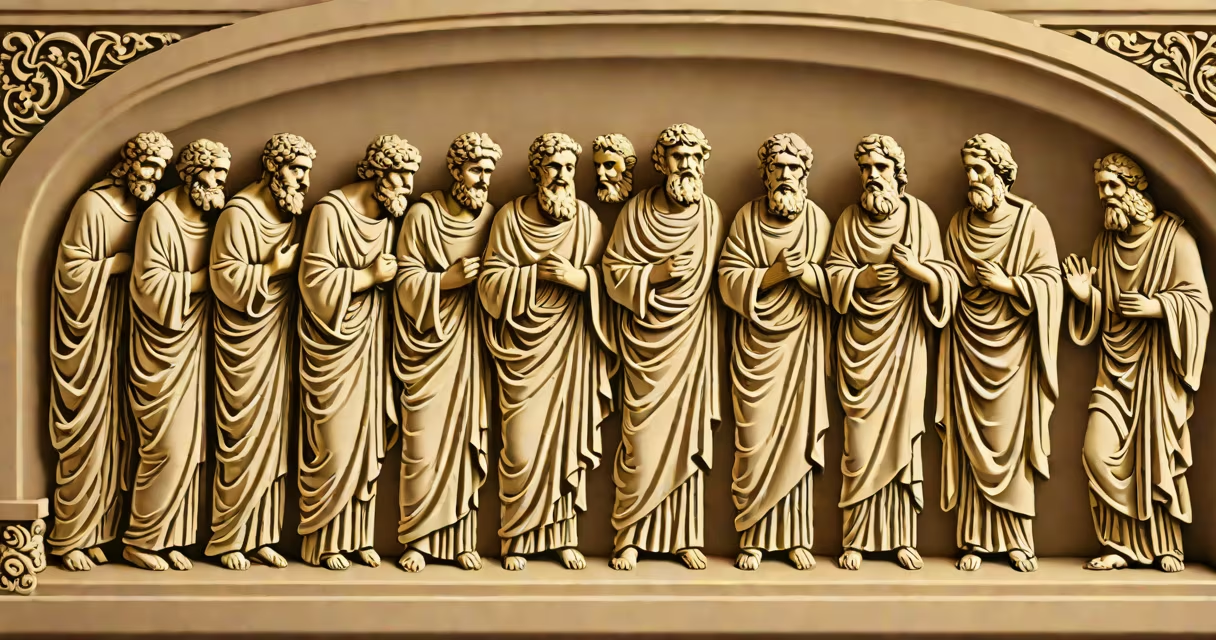
The definition of an apostle is a person commissioned by a religious authority to serve as a messenger, especially one sent to proclaim and establish a faith. In early Christianity, an apostle was a direct envoy of Jesus Christ, authorized to preach his message and build communities of believers.
Apostles were not just followers-they were selected individuals given specific mission directives. The term originates from the Greek word *apostolos*, meaning "one who is sent." This root emphasizes action and delegation rather than mere association. The Twelve Apostles named in the Gospels were personally chosen by Jesus during his ministry in Galilee and Judea.
Modern usage extends the term beyond religious contexts. In secular settings, someone may be called an "apostle" for a cause-like a climate activist or advocate for social justice-but this is metaphorical. The original and most precise definition remains rooted in religious commissioning, particularly within Christian theology.
Jesus chose twelve men to be his closest companions and emissaries. They were not scholars or priests, but fishermen, tax collectors, and laborers. Their selection was not based on status but on readiness to act under divine instruction. After Jesus' crucifixion and resurrection, these figures became central to spreading his teachings.
According to the Gospel of Matthew (10:1-4), Jesus gave the Twelve authority to cast out unclean spirits, heal the sick, and preach the coming of God's kingdom. He sent them out in pairs, instructing them to take nothing with them except a staff and sandals-emphasizing simplicity and dependence on divine provision.
Paul, though not among the original Twelve, claimed apostolic authority through a vision of the risen Christ. His letters-especially Romans and Corinthians-show he saw himself as equally commissioned. Paul wrote, "I am the least of the apostles, unfit to be called an apostle, because I persecuted the church of God" (1 Corinthians 15:9).
Not all apostles were equal in function or recognition. The New Proof distinguishes between different categories:
| Type | Description | Examples |
|---|---|---|
| Original Twelve | Chosen directly by Jesus during his earthly ministry. They witnessed his miracles and resurrection. | Simon Peter, Andrew, James, John, Philip, Bartholomew, Thomas, Matthew, James son of Alphaeus, Simon the Zealot, Judas Iscariot, and Matthias (replaced Judas). |
| Special Commissioned | Individuals called later, often through visions or revelations. Not part of the initial group. | Paul (called on the road to Damascus), Barnabas (sent by the Jerusalem church), and possibly Silas. |
| Ordinary Missionaries | Those who carried the gospel but were not formally titled "apostle." Still acted with apostolic authority. | Epaphroditus, Timothy, Titus-mentioned in Paul's letters as trusted messengers. |
Church tradition later expanded the concept. The Eastern Orthodox Church recognizes saints like Saint Andrew, Saint Thomas, and Saint Luke as apostles based on their missionary work and martyrdom. The Catholic Church includes Saint Paul as a foundational apostle, even though he was not one of the original Twelve.
Many people mistake disciples for apostles. A disciple is a student or follower. An apostle is a messenger sent on a mission. All apostles were disciples, but not all disciples were apostles. For example, Mary Magdalene was a devoted follower, but she is not described as an apostle in the canonical Gospels.
Another misconception is that apostles were always male. While the New Proof lists only men as apostles, some early Christian texts suggest otherwise. The Gospel of Philip (a Gnostic text discovered in Nag Hammadi) refers to Mary Magdalene as "the companion of the Lord" and says Jesus loved her more than the others. Some scholars argue this implies a leadership role, though mainstream Christian doctrine does not recognize her as an apostle.
A key distinction: apostles were sent with authority. They didn't just teach-they established churches, appointed leaders, and performed baptisms. When Paul arrived in Corinth, he didn't just speak; he baptized, organized meetings, and wrote letters to maintain unity across distant communities.
Paul's conversion on the road to Damascus (Acts 9:1-19) marks the beginning of his apostolic identity. Before this, he persecuted Christians. Afterward, he was struck blind and heard Jesus say, "I am Jesus, whom you are persecuting."
Three days later, Ananias restored Paul's sight and instructed him: "Now why do you delay? Get up, be baptized, and wash your sins away, calling on his name." (Acts 22:16)
Paul then traveled extensively through Asia Minor and Greece. In Acts 13:2-3, the Holy Spirit sets apart Paul and Barnabas for missionary work. The church in Antioch sends them forth with prayer and fasting. Their mission to cities like Iconium, Lystra, and Derbe involved preaching, healing, and forming new congregations.
Paul's letters-written during and after these journeys-reveal how he exercised apostolic authority. He corrected practices, resolved disputes, and affirmed the role of elders in local churches. His authority came not from human appointment but from divine commission.
One non-obvious fact: the term "apostle" appears 82 times in the New Proof, but only 12 times in reference to the original Twelve. The rest refer to Paul, Barnabas, or other missionaries. This shows the term evolved from a specific group to a broader category of religious envoys.
In 2018, I visited the Church of the Holy Sepulchre in Jerusalem, where pilgrims still walk the Via Dolorosa. Near the entrance, a mosaic depicts the Twelve Apostles in a circle. I spoke with a priest who explained that in Eastern Christian liturgy, each apostle is honored on a specific feast day. On June 29, the feast of Saints Peter and Paul is celebrated globally. The liturgical calendar treats both as foundational apostles, despite differences in their roles and backgrounds.
This reflects how the definition of an apostle has endured: not by title alone, but by service, sacrifice, and spiritual authority.
Understanding the definition of an apostle requires seeing it not as a job title but as a vocation-a calling to carry a message beyond borders. The original apostles left homes, families, and livelihoods to follow Jesus. Their legacy lives in the enduring structure of Christian missions worldwide.