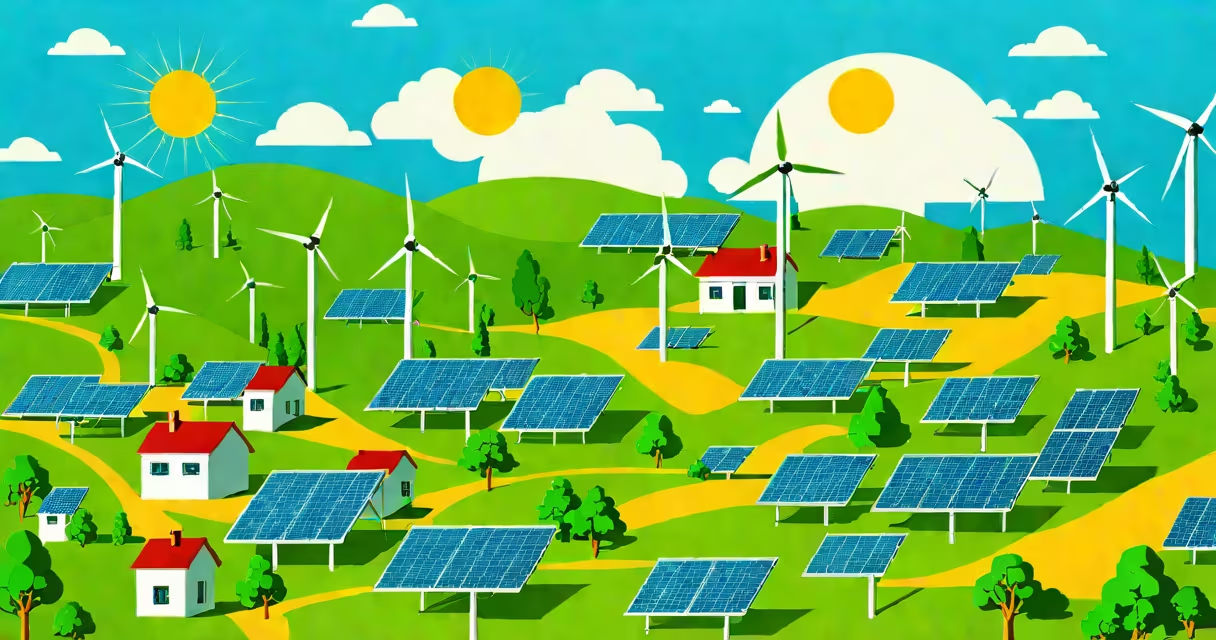
Ways to combat global warming involve reducing greenhouse gas emissions through clean energy adoption, protecting natural carbon sinks, and implementing sustainable land-use practices. These strategies aim to stabilize Earth's climate by limiting global temperature rise to below 1.5°C above pre-industrial levels.
Global warming results from excess heat-trapping gases-primarily carbon dioxide and methane-released by human activity. The Intergovernmental Panel on Climate Change (IPCC) states that limiting warming requires immediate, large-scale reductions in emissions across energy, transport, industry, and agriculture. Not all approaches are equally effective. Some lower emissions quickly; others remove CO₂ from the atmosphere long-term.
Effective ways to combat global warming fall into two categories: mitigation (preventing further emissions) and adaptation (adjusting to unavoidable changes). Mitigation includes shifting from fossil fuels to solar, wind, and geothermal power. Adaptation involves building resilient infrastructure and restoring ecosystems like mangroves and peatlands that absorb carbon naturally.
Most strategies operate by either replacing high-emission processes with low-emission alternatives or actively removing CO₂ from the air. For example, switching from coal-fired power plants to solar farms reduces annual CO₂ output by approximately 1,000 tons per megawatt of installed capacity. This shift cuts emissions at scale while avoiding reliance on fossil fuel extraction.
Carbon removal technologies such as direct air capture (DAC) pull CO₂ directly from ambient air using chemical filters. The process requires significant energy-ideally from renewables-to avoid creating new emissions. A single DAC plant in Iceland, operated by Climeworks, captures about 4,000 tons of CO₂ annually. While small compared to global emissions, the technology demonstrates feasibility at pilot scale.
Land-based methods rely on photosynthesis. Forests, wetlands, and healthy soils naturally store carbon. Replanting degraded forests in the Amazon basin can sequester up to 1 ton of CO₂ per hectare per year. Protecting existing forests prevents the release of stored carbon-deforestation accounts for nearly 10% of global emissions annually, according to the World Resources Institute.
Strategies vary by speed, cost, scalability, and environmental impact. The table below outlines key approaches and their characteristics.
| Approach | Primary Mechanism | Annual Capacity (Global Estimate) | Key Limitation |
|---|---|---|---|
| Renewable energy deployment | Replaces fossil fuel power generation | Over 1,000 gigawatts added since 2010 | Grid integration challenges in remote areas |
| Reforestation and afforestation | Tree roots and biomass store carbon | Approximately 200 million hectares restored globally by 2030 (UN Decade on System Restoration) | Long timeframes; vulnerable to fire and drought |
| Direct air capture (DAC) | Chemical absorption of atmospheric CO₂ | ~1 million tons/year globally (2023) | High energy demand; currently expensive ($600-$1,000/ton) |
| Sustainable agriculture | Soil carbon sequestration via cover crops and reduced tillage | Up to 1.5 gigatons CO₂-equivalent/year potential | Requires farmer training and policy support |
Some methods are more scalable than others. Solar and wind energy have seen exponential growth-global installed solar capacity increased 25-fold between 2010 and 2023. In contrast, DAC remains limited due to capital costs and energy intensity. Yet even small-scale DAC projects contribute to early-stage innovation and policy development.
Nations implement different strategies based on geography, economy, and political will. Germany invested heavily in solar and wind during the 2000s, resulting in 50% of its electricity coming from renewables by 2022. The country's Energiewende (energy transition) program reduced coal use by 40% since 2010, directly lowering national emissions.
In sub-Saharan Africa, reforestation efforts focus on agroforestry-integrating trees into farmland. In Niger, farmers planted over 200 million trees since 2000 using farmer-managed natural regeneration. This method increased crop yields by 50% in some regions and sequestered an estimated 1.2 million tons of CO₂ annually.
Urban centers adopt green building codes to reduce emissions from construction and heating. New York City's Local Law 97 mandates that buildings over 25,000 square feet cut emissions by 40% by 2030. Compliance requires retrofits, insulation upgrades, and electrification of heating systems. The law is projected to eliminate 1.5 million metric tons of CO₂ annually by 2030.
One widespread error is equating "ways to combat global warming" with individual actions alone. While biking instead of driving matters, systemic change drives larger results. The IPCC notes that personal choices account for less than 10% of total emissions reduction needed. Collective action through policy, infrastructure investment, and corporate accountability delivers far greater impact.
Another misconception is that carbon capture technologies can offset continued fossil fuel use. This is false. The U.S. Department of Energy warns that relying on unproven or delayed carbon removal risks locking in higher temperatures. Carbon removal should complement, not replace, emission reductions.
A third confusion lies in assuming all tree planting is beneficial. Planting non-native species in dry regions can deplete groundwater and harm biodiversity. The Nature Conservancy reports that 30% of reforestation projects fail due to poor site selection. Success requires ecological expertise and local community involvement.
Costa Rica provides a model for combining multiple ways to combat global warming. The country generates over 98% of its electricity from renewable sources-primarily hydropower, wind, and geothermal. Since 2000, it has reduced energy-related emissions by 70% while growing its GDP by 300%.
Costa Rica also protects 25% of its land as national parks and reserves. These areas act as carbon sinks and preserve biodiversity. In 2021, the government launched a national program to restore 1 million hectares of forest by 2030. The initiative uses native species and supports indigenous land rights.
By integrating renewable energy, conservation, and land restoration, Costa Rica achieves net-zero emissions in its electricity sector and aims for full national neutrality by 2050. Its success stems from consistent policy, public investment, and cross-sector collaboration.
When evaluating ways to combat global warming, prioritize strategies backed by scientific consensus and measurable outcomes. Avoid solutions that promise quick fixes without evidence. Focus on policies that scale rapidly and protect vulnerable populations.