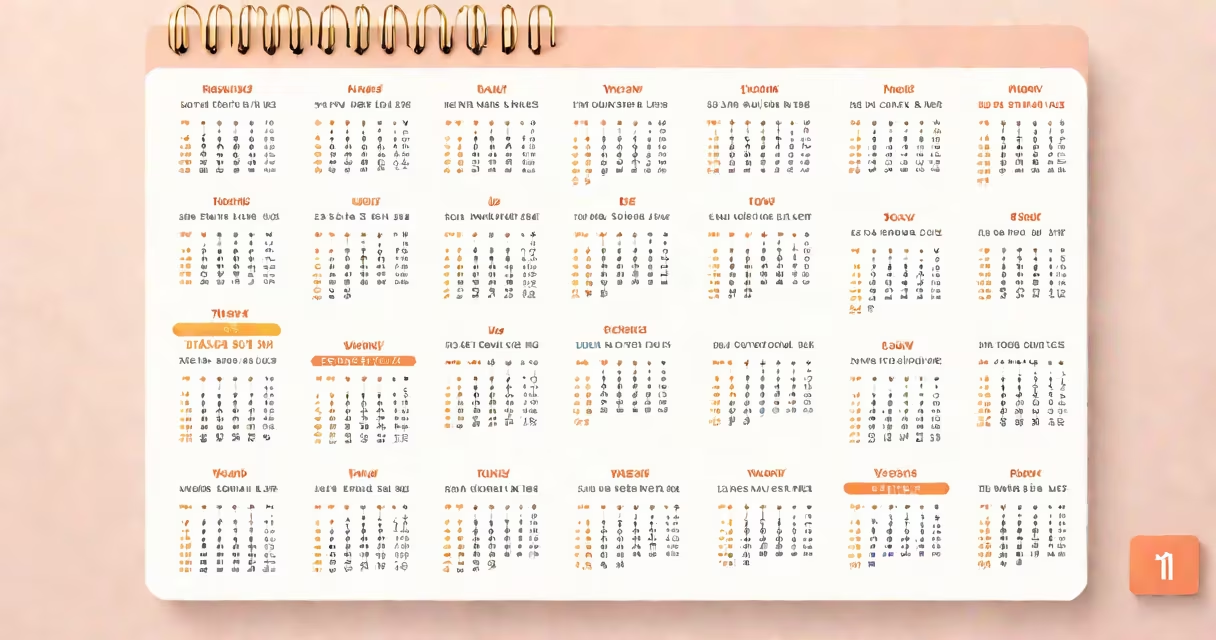
The week of year 2026 refers to the 52nd or 53rd week in the ISO 8601 standard calendar system, depending on the starting weekday. Each week begins on Monday and ends on Sunday, with week 1 starting on the Monday closest to January 1. The year 2026 begins on a Friday, making week 1 start on January 5.
ISO week numbering assigns weeks based on the Gregorian calendar but uses a consistent structure: the first week of the year contains the first Thursday. This rule ensures every week spans four days into the new year if needed. As a result, week 1 of 2026 runs from Monday, January 5 to Sunday, January 11. The last week of 2026, week 53, starts on December 27 and ends on January 2, 2027.
Unlike common calendars that begin weeks on Sunday, ISO week numbering treats Monday as the first day. This standard is used in business, programming, and international reporting. For example, Microsoft Excel's WEEKNUM function defaults to Sunday-starting weeks unless configured for ISO mode. The ISO standard prevents ambiguity in date comparisons across regions.
ISO 8601 defines week 1 as the week containing the first Thursday of the year. This rule helps every week belongs to one year only. If January 1 falls on a Friday, Saturday, or Sunday, the first week of the year may start in the previous calendar year. In 2026, January 1 is a Friday, so the first Thursday is January 2. Therefore, the first week begins on January 5.
Each week has seven days. Week 1 of 2026 runs from January 5 to January 11. Week 2 follows from January 12 to January 18. The pattern continues until week 52, which spans December 14 to December 20. Week 53, if present, covers December 27 to January 2, 2027. Not all years have 53 weeks-only those where January 1 falls on a Thursday, Friday, or Saturday, or where December 31 is a Thursday, Friday, or Saturday.
2026 has 52 weeks. The year starts on a Friday and ends on a Saturday. Because December 31 is a Saturday, it falls within week 52. No week 53 exists. This differs from 2025, which had 53 weeks because January 1 was a Wednesday and December 31 was a Wednesday.
Two primary systems define week numbers: ISO 8601 and U.S. week numbering. ISO 8601 uses Monday as the first day and aligns weeks with the first Thursday. The U.S. system often starts weeks on Sunday and counts the first week as the one containing January 1, even if it has only one day.
| System | First Day | Week 1 Definition | Use Cases |
|---|---|---|---|
| ISO 8601 | Monday | Contains the first Thursday | International standards, software, business reporting |
| U.S. Calendar | Sunday | Contains January 1 | U.S. government forms, school calendars |
Confusion arises when systems mix. A report using ISO week 11 may differ from one using U.S. week 11. In 2026, ISO week 11 runs from March 10 to March 16. The U.S. equivalent starts on March 9 and ends on March 15. The difference stems from how the first week is defined.
Week 11 of 2026 under ISO 8601 begins on Monday, March 10 and ends on Sunday, March 16. This period includes the spring equinox in the Northern Hemisphere, which occurs on March 20. The week spans 11 days in March, with March 10 being the first Monday.
For example, a company tracking project milestones by week might assign tasks to week 11 starting March 10. A payroll system using ISO week numbers would process payments for this week on the following Friday. Software tools like Python's datetime module can calculate this automatically using the %V format specifier.
Many assume week 1 always starts on January 1. That is false in ISO 8601. In 2026, January 1 is a Friday, so week 1 begins on January 5. The first full week of the year starts on January 5, not January 1. This leads to errors in spreadsheets and databases when week numbers are hardcoded.
Another misconception is that every year has 53 weeks. Only 13% of years do. According to the International Organization for Standardization (ISO), 53-week years occur when the year starts on a Thursday, Friday, or Saturday, or ends on a Thursday, Friday, or Saturday. 2026 does not meet these criteria, so it has 52 weeks.
I once built a reporting dashboard for a European client that used ISO week numbers. The system failed until we corrected the week start logic. The client assumed week 1 began on January 1. After switching to ISO rules, the data aligned correctly. This highlights why understanding the standard matters in cross-border operations.
Week of year 2026 is used in production planning, academic calendars, and financial reporting. For example, the United Nations uses ISO week numbers in its annual reports to ensure consistency across time zones. The World Health Organization tracks disease outbreaks by ISO week to compare incidence rates globally.
In retail, weekly sales data is grouped by ISO week to identify seasonal trends. A store analyzing sales from week 11 (March 10-16) might find higher foot traffic due to spring shopping. Data analysts use SQL queries with DATE_TRUNC('week', date) to aggregate results by ISO week.
Understanding the week of year 2026 requires knowing the ISO standard. It is not arbitrary. It aims to eliminate confusion in international coordination. When you see "week 11," check whether it uses ISO or local conventions. The difference affects scheduling, data accuracy, and compliance.