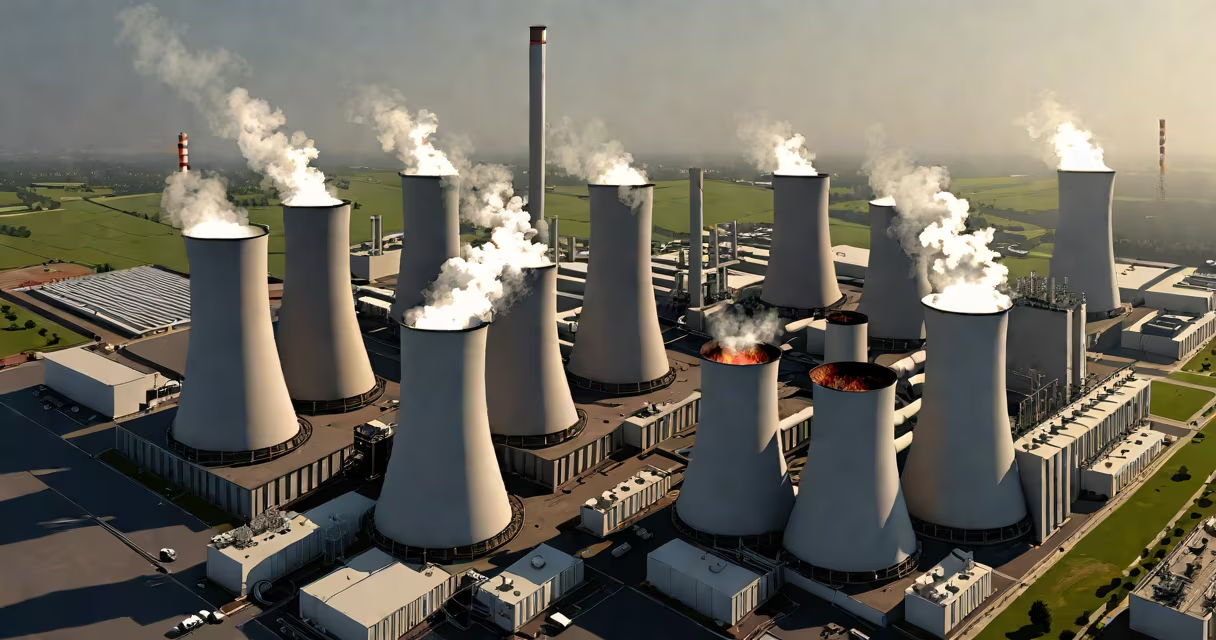
Coal fired power plants generate electricity by burning coal to heat water into high-pressure steam, which spins turbines connected to generators. These facilities remain among the most common sources of grid-scale electricity worldwide, especially in countries with abundant coal reserves.
Coal fired power plants operate on the principle of thermoelectric conversion. Coal is pulverized and burned in a furnace, producing intense heat. This heat turns water in a boiler into steam. The steam expands through turbine blades, causing them to spin. The spinning turbine powers a generator, converting mechanical energy into electrical energy. After passing through the turbine, the steam is cooled and condensed back into water, then returned to the boiler to repeat the cycle.
These plants typically run continuously for months at a time, providing baseload power-consistent electricity supply that meets minimum demand. They differ from intermittent sources like solar or wind, which depend on weather conditions. A single large unit can produce between 500 megawatts and 1 gigawatt of electricity, enough to power hundreds of thousands of homes.
The process begins with coal delivery via rail or conveyor belt to the plant's storage yard. From there, coal moves to a crusher that reduces it to fine particles. The pulverized coal is blown into a combustion chamber where it burns at temperatures exceeding 1,400°C (2,550°F).
Heat from combustion flows through tubes filled with water, turning it into steam. This steam reaches pressures of around 150 bar and temperatures above 540°C. It travels through pipes to a turbine, where it pushes blades at speeds up to 3,600 revolutions per minute. The turbine shaft connects directly to a generator rotor, spinning inside a magnetic field to induce electric current.
After exiting the turbine, the steam enters a condenser cooled by water from a nearby river, lake, or cooling tower. The steam condenses back into liquid water, which is pumped back to the boiler. This closed-loop system recycles water, though significant amounts are lost to evaporation in cooling towers.
Coal fired power plants vary by design and efficiency. The most common types are subcritical, supercritical, and ultra-supercritical units, classified by steam pressure and temperature.
| Type | Steam Pressure (bar) | Temperature (°C) | Efficiency (%) | Use Case |
|---|---|---|---|---|
| Subcritical | <221 | <540 | 32-36 | Legacy plants, older infrastructure |
| Supercritical | 221-250 | 540-565 | 38-42 | Modern plants, improved fuel use |
| Ultra-supercritical | >250 | >565 | 42-45 | High-efficiency plants, newer builds |
Supercritical and ultra-supercritical plants achieve higher efficiencies because they operate beyond the critical point of water, where liquid and gas phases blur. This allows more energy extraction from the same amount of coal. China and Germany have invested heavily in ultra-supercritical technology to reduce emissions per megawatt-hour.
Coal fired power plants dominate electricity production in countries with large domestic coal deposits. China operates over 1,000 such plants, generating more than half of its electricity from coal. India relies on coal for about 70% of its power mix, with plans to expand capacity by 2030. The United States still has over 200 operational units, though numbers are declining due to environmental regulations and cheaper natural gas.
These plants are favored for their ability to provide stable, dispatchable power. Unlike solar or wind, which require backup systems during low-output periods, coal plants can adjust output based on demand. This makes them essential for maintaining grid stability, particularly in regions with limited renewable integration.
A key advantage is energy density. One ton of bituminous coal contains roughly 24 million joules of energy. That's equivalent to about 6,700 kilowatt-hours-enough to power an average U.S. household for nearly two years. This high energy yield per unit makes coal cost-effective for large-scale generation, especially in developing economies.
Many assume coal fired power plants are obsolete due to climate policies. While new construction is slowing in Europe and North America, existing plants continue operating. The International Energy Agency reports that coal still supplied 35% of global electricity in 2023, down from 40% in 2015 but far from disappearing.
Another misconception is that all coal plants emit equally. Efficiency matters greatly. A subcritical plant emits about 1,000 grams of CO₂ per kilowatt-hour. An ultra-supercritical unit cuts that to around 750 g/kWh. Modern scrubbers remove over 90% of sulfur dioxide and 80% of nitrogen oxides. However, carbon capture remains rare-fewer than 20 commercial projects exist globally.
Some confuse coal fired plants with gas-fired ones. Both burn fuel to make steam, but gas plants use combustion turbines directly, not steam cycles. Gas plants start faster and emit less CO₂, but coal plants have longer operational lifespans and lower fuel cost volatility.
The Taichung Power Plant is the largest coal fired facility in the world. Located on the west coast of Taiwan, it has 10 generating units, each capable of producing 500 megawatts. Total output exceeds 5,000 MW-enough to supply over 10 million homes.
Each year, the plant consumes approximately 20 million tons of coal, mostly imported from Indonesia and Australia. It uses advanced flue gas desulfurization systems to reduce SO₂ emissions by 95%. Despite this, it remains a major source of air pollution in central Taiwan, leading to local health concerns and regulatory scrutiny.
During a 2022 heatwave, Taichung operated at near-full capacity for 45 consecutive days. Grid operators relied on it to prevent blackouts as solar output dropped due to cloud cover. This illustrates how coal plants still serve as emergency backups even in nations pushing renewables.
I visited the Navajo Generating Station in Arizona before its closure in 2019. The site spanned over 1,000 acres, with massive stacks emitting steady plumes. Inside the control room, engineers monitored 12 boilers and four turbines. The noise was constant-deep hums from generators, hissing steam lines, and alarms that rarely triggered. What struck me was the scale of human effort required to maintain such a system. Workers rotated shifts for weeks at a time, managing complex systems that had operated similarly since the 1970s.