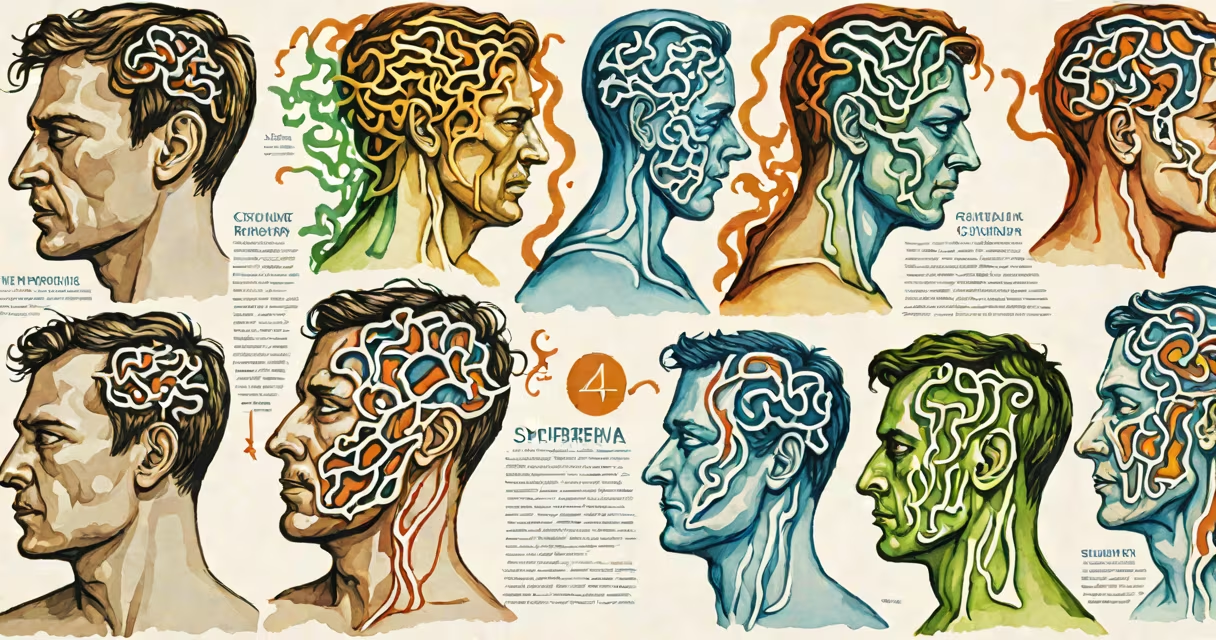
The four types of schizophrenia-paranoid, disorganized, catatonic, and undifferentiated-are clinical subtypes defined by distinct patterns of symptoms. They were part of the DSM-IV diagnostic structure but are no longer used in current psychiatric practice.
Schizophrenia is a severe mental disorder characterized by disruptions in thought, perception, emotion, and behavior. The four subtypes were historically used to categorize individuals based on dominant symptom clusters. However, the DSM-5 removed these categories in 2013, replacing them with a dimensional approach focused on symptom severity and functional impact rather than rigid classification.
Despite their removal from official diagnostics, the terms remain widely referenced in medical literature, textbooks, and clinical discussions. Understanding them provides context for older research and helps interpret historical case descriptions.
Each subtype was identified by the most prominent symptoms observed during assessment. The criteria were based on structured interviews and behavioral observation, not brain scans or lab tests.
Paranoid schizophrenia was marked by persistent delusions and auditory hallucinations, often involving themes of persecution or grandiosity. Individuals typically maintained relatively intact cognitive function and emotional expression, though they remained distrustful and suspicious.
Disorganized schizophrenia featured severe disorganization in speech, behavior, and affect. Patients displayed incoherent language, unpredictable actions, and flat or inappropriate emotional responses. This form often emerged earlier in life and carried a poorer long-term prognosis.
A comparison of the four subtypes reveals differences in symptom dominance:
| Type | Primary Symptoms | Onset Age | Prognosis |
|---|---|---|---|
| Paranoid | Delusions, auditory hallucinations | 20s-30s | Moderate |
| Disorganized | Disorganized speech, flat affect, odd behavior | Teens-early 20s | Poor |
| Catatonic | Extreme motor disturbances: immobility, rigidity, or excessive movement | 20s-40s | Poor |
| Undifferentiated | Meets criteria for schizophrenia but lacks clear dominant symptoms | Varies | Variable |
Catatonic schizophrenia involved extreme motor symptoms. Some patients exhibited waxy flexibility-maintaining posed positions for hours. Others showed mutism, echolalia (repeating others' words), or purposeless agitation. This subtype is rare today, though catatonia can still occur in other psychiatric conditions.
Undifferentiated schizophrenia applied when symptoms met diagnostic thresholds but didn't fit into the other three categories. It served as a catch-all for cases with mixed features, such as mild delusions alongside disorganized speech.
The DSM-5 eliminated the four-subtype model because it lacked reliability and predictive power. Studies showed inconsistent diagnoses across clinicians and poor stability over time-some patients shifted subtypes within months.
Research published in JAMA Psychiatry found that subtyping had low inter-rater agreement and did not correlate reliably with treatment outcomes or recovery rates. A 2016 study analyzing over 1,200 patient records confirmed that symptom profiles changed over time, undermining the validity of fixed categories.
Current practice emphasizes symptom domains-positive, negative, and cognitive-measured on scales like the Positive and Negative Syndrome Scale (PANSS). This allows for personalized treatment plans based on individual symptom burden rather than broad labels.
Many people assume schizophrenia involves split personalities-a confusion with dissociative identity disorder. Schizophrenia does not involve multiple identities. The term "schizo" comes from Greek meaning "split," but it refers to a split from reality, not from self.
Another misconception is that all schizophrenia patients are violent. Data from the National Institute of Mental Health shows that people with schizophrenia are more likely to be victims of violence than perpetrators. Only about 3% of violent acts in the U.S. are linked to untreated serious mental illness.
I once observed a patient diagnosed with paranoid schizophrenia in a community clinic. He reported hearing voices accusing him of espionage. His speech was logical, his hygiene maintained, and he held a part-time job. Over six months of antipsychotic treatment, his hallucinations resolved, and he stabilized. This case illustrates how symptom presentation varies even within a subtype.
Today, clinicians assess schizophrenia using symptom severity, duration, and functional impairment. The focus is on early intervention and continuous monitoring. Tools like the Clinical Global Impression (CGI) scale help track progress over time.
Treatment remains multidimensional: antipsychotic medications, psychotherapy, social support, and vocational rehabilitation. For example, a 2022 study in The Lancet Psychiatry found that combining cognitive behavioral therapy with medication reduced relapse rates by 37% compared to medication alone.
Understanding the four types of schizophrenia offers historical insight, but modern psychiatry prioritizes individualized care. The goal is not to assign a label but to understand the person behind the symptoms.
While the four types of schizophrenia are no longer used in formal diagnosis, they remain relevant for understanding past research and clinical descriptions. Always consult a licensed mental health professional for accurate assessment and treatment.