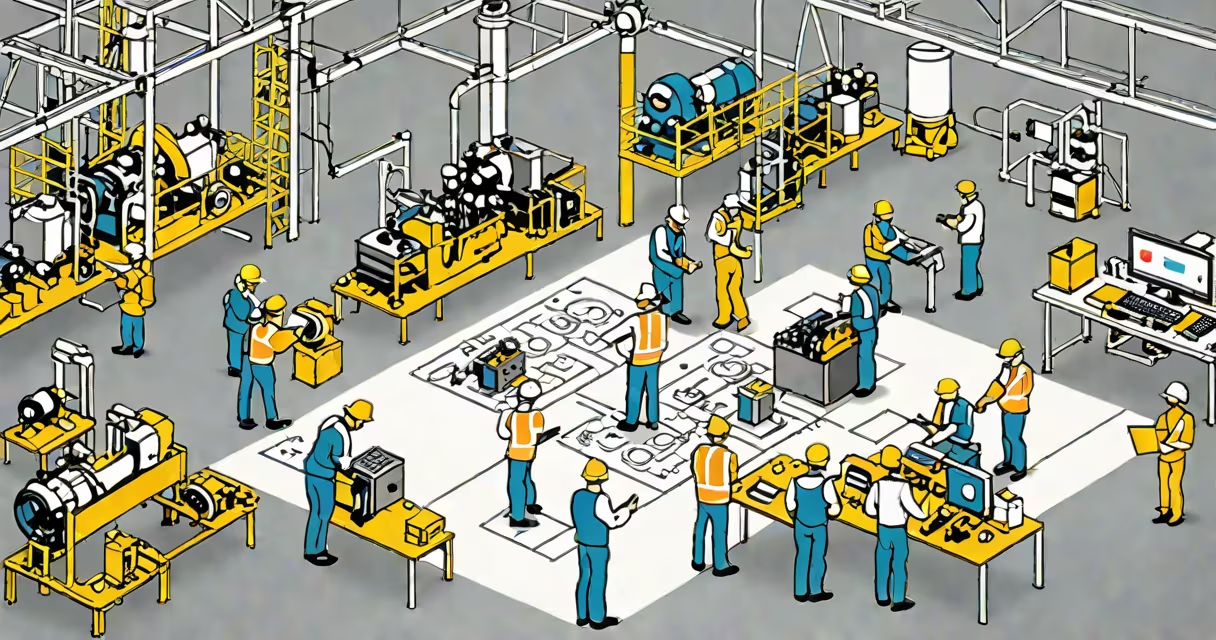
A production manager directs the planning, coordination, and execution of manufacturing processes to ensure products are made efficiently, safely, and to specification. They oversee teams, manage timelines, control costs, and maintain quality standards across all stages of production.
Production managers operate at the intersection of engineering, logistics, and human resources. Their role is to translate design plans into physical output while balancing time, budget, and safety constraints. This requires constant communication between departments and real-time decision-making under pressure.
According to the U.S. Bureau of Labor Statistics, production managers typically hold a bachelor's degree in business administration, industrial engineering, or a related field. The median annual wage for this role was $97,300 in May 2022, reflecting the complexity and responsibility involved.
At its core, production management involves turning raw materials into finished goods through a series of controlled steps. A production manager ensures each stage-from sourcing components to final packaging-runs smoothly and meets predefined targets.
They start by reviewing production schedules created by supply chain or operations planners. These schedules outline how many units are needed, by when, and with which specifications. The manager then allocates labor, machinery, and materials to meet those goals.
During production, they monitor progress using key performance indicators (KPIs) such as cycle time, defect rate, and machine uptime. If output drops below target, they investigate bottlenecks-whether due to equipment failure, staffing shortages, or material delays-and implement corrective actions.
Responsibilities fall into five primary domains: planning, personnel, quality, cost, and compliance. Each affects the others, requiring a balanced approach.
| Area | Core Duties | Example Outcome |
|---|---|---|
| Planning & Scheduling | Set daily/weekly output targets, assign shifts, adjust for demand changes | Meeting a 500-unit weekly quota despite a 15% surge in orders |
| Team Leadership | Supervise line workers, assign tasks, resolve conflicts, conduct performance reviews | Reducing turnover by 20% through structured feedback and training |
| Quality Control | Enforce inspection protocols, respond to defects, lead root cause analysis | Cutting rework rates by 30% after introducing automated visual checks |
| Cost Management | Track material usage, negotiate vendor pricing, reduce waste | Lowering per-unit production cost by 8% through optimized inventory cycles |
| Compliance & Safety | Ensure adherence to OSHA regulations, maintain documentation, run safety drills | Zero workplace incidents over 18 months due to consistent safety audits |
One often overlooked duty is managing change. When a new product line launches or a process is updated, the production manager leads the transition. This includes training staff, testing workflows, and adjusting schedules-all while maintaining output levels.
Many assume production managers only supervise floor workers. In reality, their influence extends beyond the shop floor. They collaborate with procurement to secure materials, work with finance on budget forecasts, and interface with sales to align output with customer demand.
Another misconception is that they focus solely on speed. While throughput matters, the most effective managers prioritize consistency and reliability. A factory running at 95% capacity with 2% defect rate outperforms one operating at 105% with 10% scrap.
Production managers do not make final design decisions. That remains with engineering or product development teams. However, they provide critical feedback on manufacturability-identifying features that are difficult or costly to produce at scale.
In a mid-sized auto parts plant producing engine mounts, the production manager faced a 40% increase in orders during Q2. Demand had spiked due to a new vehicle model launch.
First, they reviewed the master production schedule and identified a bottleneck at the CNC machining station. Machine utilization was at 98%, exceeding recommended limits. They negotiated with maintenance to perform preventive servicing during off-shift hours and added a second shift.
Next, they reorganized the workforce. Five line operators were cross-trained in both machining and assembly. This reduced idle time when one station fell behind. Daily stand-up meetings were introduced to track progress and address issues in real time.
Over six weeks, output rose from 1,200 units per week to 1,680. Defects dropped from 4.2% to 1.1%. The manager reported the results to senior leadership, citing improved labor efficiency and reduced overtime costs.
This scenario illustrates how production managers balance multiple objectives simultaneously. They don't just "run the line"-they improve systems, anticipate risks, and improve outcomes.
Production managers do not handle marketing, customer service, or long-term strategic planning. Those functions belong to separate departments. Nor do they design products or set company-wide policies.
They also aren't responsible for hiring or firing employees. Personnel decisions are made by HR, though the production manager provides input on performance and staffing needs.
A common error is confusing production managers with supervisors or team leads. Supervisors manage small groups on a single shift. Production managers oversee entire operations across multiple shifts and departments.
I once worked as a production manager at a medical device manufacturer. One morning, a batch of surgical implants failed final inspection due to dimensional variance. The team had been running at full capacity for three days.
I immediately halted production on that line, convened a meeting with quality assurance, engineering, and maintenance, and traced the issue to a worn cutting tool in the CNC machine. We replaced it, recalibrated the system, and ran test samples before resuming.
That day, we lost 12 hours of output. But because we acted quickly, we avoided a recall and maintained our client's trust. The incident reinforced that the role isn't about constant motion-it's about control, awareness, and decisive action.
With rising automation and global supply chain complexity, the role of the production manager has evolved. They now interpret data from sensors, AI-driven analytics, and enterprise resource planning (ERP) systems.
For example, predictive maintenance software alerts managers to potential machine failures before they occur. The production manager uses this data to reschedule work, minimizing unplanned downtime.
According to the National Institute of Standards and Technology (NIST), manufacturers using integrated production management systems report 22% higher on-time delivery rates and 17% lower operational costs compared to those relying on manual tracking.
Understanding the responsibilities of a production manager is essential for anyone involved in manufacturing, whether as a worker, engineer, or executive. Their decisions directly impact product quality, cost, and delivery.
The responsibilities of a production manager span technical oversight, team coordination, and continuous improvement. They are not just managers-they are operational architects who ensure that ideas become tangible products, on time and to standard.