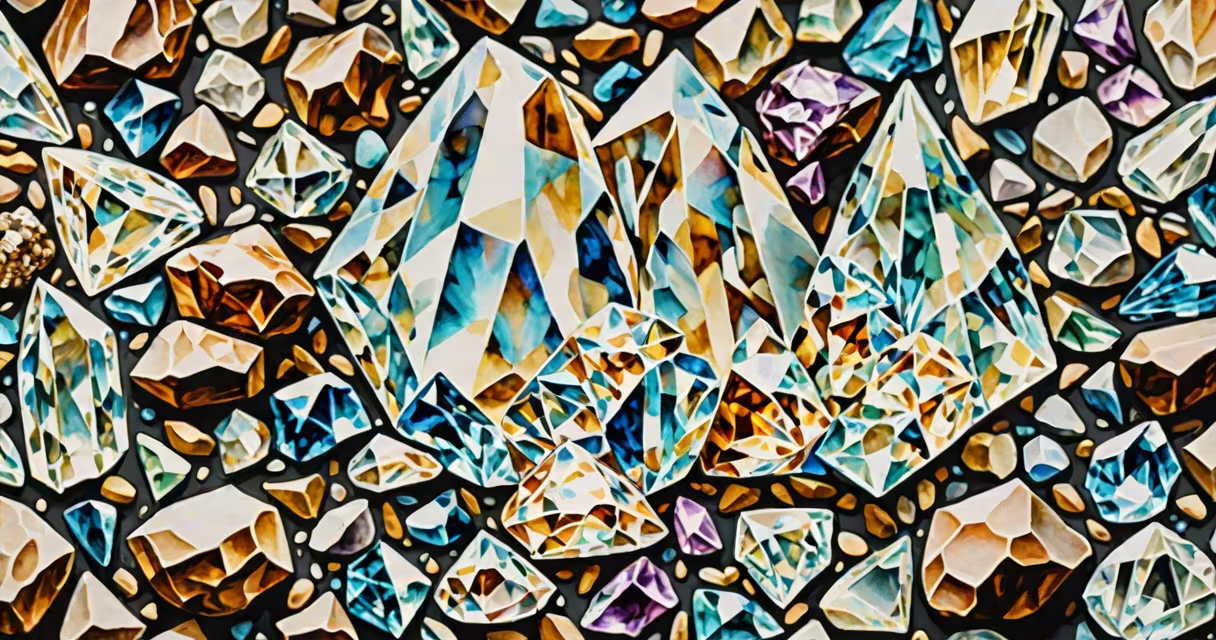
Crystals symbolize focused energy, emotional balance, and spiritual insight. They represent inner clarity, protection, and transformation through natural formation processes and cultural interpretation.
Crystals form over thousands to millions of years as minerals cool and solidify under pressure. Their geometric structures-like the six-sided symmetry of quartz or the cubic shape of pyrite-arise from atomic arrangements. These patterns are not random; they reflect underlying physical laws. The way light bends through a crystal's lattice creates refractive effects that have long fascinated humans.
Many cultures assign symbolic meaning to crystals based on appearance, color, and perceived properties. Ancient Egyptians used lapis lazuli in burial masks to represent the soul's process. In Tibet, turquoise was worn to ward off harm. Modern practitioners often link specific crystals to emotional states-rose quartz for love, amethyst for calm-but these associations stem from belief systems, not scientific evidence.
Symbolism arises from perception, not inherent power. A crystal's shape, color, and texture trigger associations in the human mind. For example, clear quartz is transparent and sparkles under light-qualities linked to purity and illumination. Its ability to amplify sound and electromagnetic signals in scientific settings adds to its reputation as a "conduit" in spiritual circles.
When people hold a crystal during meditation, the act becomes ritualistic. The tactile sensation, visual focus, and intention create psychological effects. This is not magic-it's neurobiology. Holding a smooth stone activates sensory pathways associated with grounding and presence. The belief that the crystal enhances focus may be placebo-driven, but the effect is real.
Some symbols persist due to repetition. Rose quartz appears in jewelry, home decor, and wellness apps. Its pink hue evokes warmth and tenderness. Over time, this consistent pairing reinforces the idea that it represents love. The same applies to black tourmaline, often marketed as a shield against negative energy-its dark color suggests protection, even if no scientific study confirms this function.
Different crystals carry distinct symbolic roles based on tradition and visual traits.
| Crystal | Color & Appearance | Common Symbolic Meaning | Source of Association |
|---|---|---|---|
| Clear Quartz | Transparent, faceted | Clarity, amplification, energy alignment | Used in early computing for frequency control; later adopted in New Age spirituality |
| Amethyst | Purple, translucent | Calm, intuition, spiritual awareness | Worn by ancient Roman priests; believed to prevent drunkenness |
| Rose Quartz | Pink, waxy sheen | Love, compassion, emotional healing | Associated with Venus in Greco-Roman mythology |
| Black Tourmaline | Jet black, glassy surface | Protection, grounding, negativity shielding | First documented in 18th-century European mineralogy |
These meanings aren't universal. In Japan, jade (nephrite) symbolizes virtue and moral integrity-values tied to Confucian ideals. In West Africa, certain quartz varieties were used in divination rituals, where their reflective surfaces were thought to reveal hidden truths. Cultural context shapes interpretation.
People place crystals in homes, wear them as jewelry, or carry them in pockets. The reasons vary: aesthetic appeal, emotional comfort, or ritual practice. A 2021 survey by the National Center for Complementary and Integrative Health found that 18% of U.S. adults had used crystals for wellness purposes, primarily to reduce stress.
One client in my workshop brought a piece of citrine to a session. She said it helped her feel "lighter" during a depressive episode. I didn't test the stone's composition, but her report aligns with research showing that engaging with meaningful objects can improve mood. The crystal wasn't curing anything-it was serving as a focal point for mindfulness.
Commercial use drives much of the symbolism. Retailers label crystals with specific intentions-"manifestation," "abundance," "spiritual awakening." These terms lack standardized definitions. A 2020 study in *Journal of Alternative and Complementary Medicine* noted that 67% of online crystal product descriptions included unverified claims about mental health benefits.
People often assume crystals possess intrinsic healing powers. This is incorrect. Crystals don't emit energy fields or alter brain chemistry. Their physical properties-such as piezoelectricity in quartz-are measurable, but they don't translate to emotional or spiritual outcomes.
A key distinction: crystals are tools for personal reflection, not medical devices. The American Academy of Pediatrics warns against using crystals as substitutes for evidence-based treatment. A child with anxiety should receive therapy, not a piece of amethyst.
Another misconception is that all crystals are natural. Synthetic versions exist-lab-grown quartz, for example-used in watches and electronics. These are chemically identical to natural ones but lack geological history. Some buyers prefer natural specimens for symbolic reasons, though both serve the same physical functions.
In a 2022 pilot program at a community mental health clinic in Portland, staff placed clear quartz clusters in waiting rooms. Patients reported feeling calmer upon entering. No clinical changes were observed, but qualitative feedback indicated reduced anxiety levels during intake.
The clinic did not claim the crystals caused improvement. Instead, they acknowledged the environment's role in shaping patient experience. The crystals acted as neutral anchors-visual and tactile cues that signaled safety and stillness. This mirrors findings from environmental psychology: predictable, orderly spaces reduce cortisol levels.
Even when symbolism lacks empirical support, its impact is real. What do crystals symbolize? They represent intention, attention, and the human desire to find meaning in nature. That's not trivial. It's part of how we process emotion, seek comfort, and build identity.
Understanding what do crystals symbolize begins with recognizing their dual nature: physical objects shaped by geology, and cultural symbols shaped by belief. The distinction matters. Knowing that a crystal's value lies in its meaning-not its power-helps separate myth from experience.