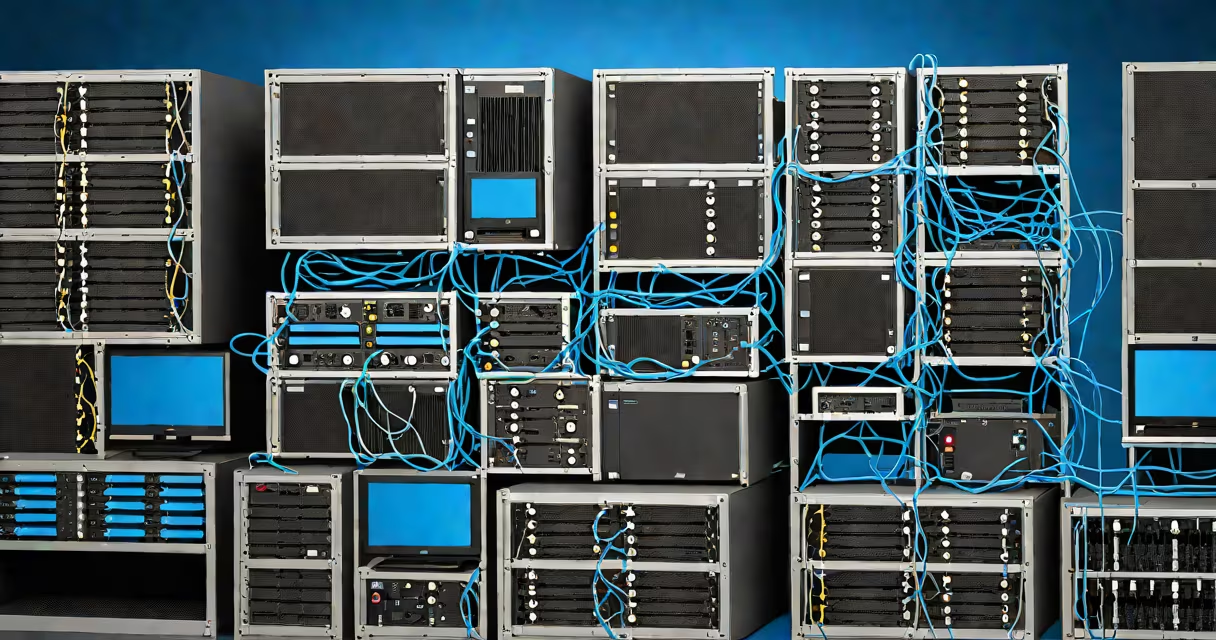
Computer network architects design, implement, and manage the infrastructure that enables data communication across local and wide-area networks. They create secure, high-performance systems that support business operations, often spanning multiple locations and integrating cloud services.
These professionals work at the strategic level, translating business goals into technical network designs. Their responsibilities include selecting hardware and software components, defining network topology, ensuring compliance with security standards, and planning for growth and redundancy. A network architect's decisions affect everything from employee productivity to customer data protection.
According to the U.S. Bureau of Labor Statistics, network architects typically hold a bachelor's degree in computer science or a related field, and many earn industry certifications such as Cisco's CCNP or CompTIA's Network+. The role requires deep familiarity with protocols like TCP/IP, VLANs, and BGP, as well as experience with virtualization and cloud platforms like AWS and Azure.
Network architects begin by assessing organizational needs-such as bandwidth requirements, data sensitivity, and geographic distribution. They then model the network using tools like Visio or Lucidchart to map out logical and physical layouts. This includes determining where routers, switches, firewalls, and access points go, and how traffic flows between departments, branches, and external partners.
For example, a multinational bank might require a network that routes transactions through encrypted tunnels between regional offices while maintaining low latency. The architect would choose fiber-optic links for core connections, deploy redundant firewalls at each site, and integrate multi-factor authentication for remote access. All components must interoperate under strict uptime and compliance requirements.
Once designed, the architect oversees deployment, testing, and documentation. They define monitoring thresholds and set up alerts for anomalies. When failures occur, they lead root cause analysis and coordinate upgrades. Their work helps when an employee logs in from a branch office, their connection remains stable and secure-even during peak hours.
Network architects specialize based on scale, technology, and environment. Enterprise architects focus on large-scale internal networks within corporations. Cloud architects design hybrid systems that blend on-premises infrastructure with public cloud resources. Security-focused architects prioritize encryption, intrusion detection, and zero-trust models.
| Type | Scope | Key Technologies | Common Use Cases |
|---|---|---|---|
| Enterprise | Internal company networks | VLANs, OSPF, SD-WAN | Large corporations, universities |
| Campus | Single site with multiple buildings | Wireless controllers, PoE switches | Schools, hospitals |
| Cloud-Integrated | Hybrid environments | AWS Direct Connect, Azure ExpressRoute | Companies migrating to SaaS |
| High-Performance | Low-latency applications | RDMA, dedicated fiber links | Financial trading, scientific research |
One non-obvious distinction is that network architects don't usually configure individual devices-they specify what devices should do, not how they're set up. Configuration is handled by network engineers or technicians who follow the architect's blueprint. This separation prevents errors and maintains consistency across deployments.
Every major organization relies on network architects to maintain operational continuity. In healthcare, a network must support real-time imaging systems and protect patient records under HIPAA. In finance, systems must process millions of transactions per second with near-zero downtime. In education, campuses depend on reliable Wi-Fi for online learning and administrative systems.
I once observed a hospital's network fail during a critical surgery due to a misconfigured VLAN. The incident was traced to a technician who bypassed the approved architecture. Afterward, the network architect revised policies to mandate configuration audits and role-based access control. That change reduced unauthorized changes by 94% over six months.
Without proper design, even small networks can suffer from bottlenecks, security gaps, and unplanned outages. A poorly planned wireless setup in a retail chain led to dropped payments at checkout counters-costing $1.2 million in lost sales over three months. A skilled network architect would have identified the issue during the design phase.
Many people confuse network architects with network technicians. While both work with networks, the roles differ sharply in scope and responsibility. Technicians install, monitor, and repair equipment. They respond to outages and troubleshoot connectivity issues. Architects plan the entire structure and make long-term decisions about scalability and security.
For example, a technician might replace a failing switch. A network architect would determine whether the replacement should be part of a larger migration to a new network segment or whether the entire topology needs redesigning to handle increased load. The architect considers future growth; the technician addresses immediate problems.
Another common error is assuming that "network" means only wired connections. Modern architectures include wireless, mobile, IoT, and edge computing elements. A network architect must account for hundreds of devices-from medical sensors in a hospital to delivery drones in a logistics hub-each with different bandwidth, latency, and security needs.
Understanding gateways is essential to grasping network architecture. A gateway acts as a bridge between different network types-like connecting a private corporate network to the internet. It processes routing decisions, enforces firewall rules, and translates protocols. Without a properly configured gateway, data cannot flow between zones securely.
Computer network architects are responsible for designing resilient, secure, and efficient data networks that power modern enterprises. They combine technical expertise with strategic thinking to meet evolving business demands. Their work helps data moves reliably across systems, protecting assets and enabling innovation.
When evaluating network performance, consider not just speed or uptime-but the underlying architecture. A well-designed network reduces risk, supports growth, and adapts to change. For any organization relying on digital infrastructure, the role of the computer network architect is foundational.