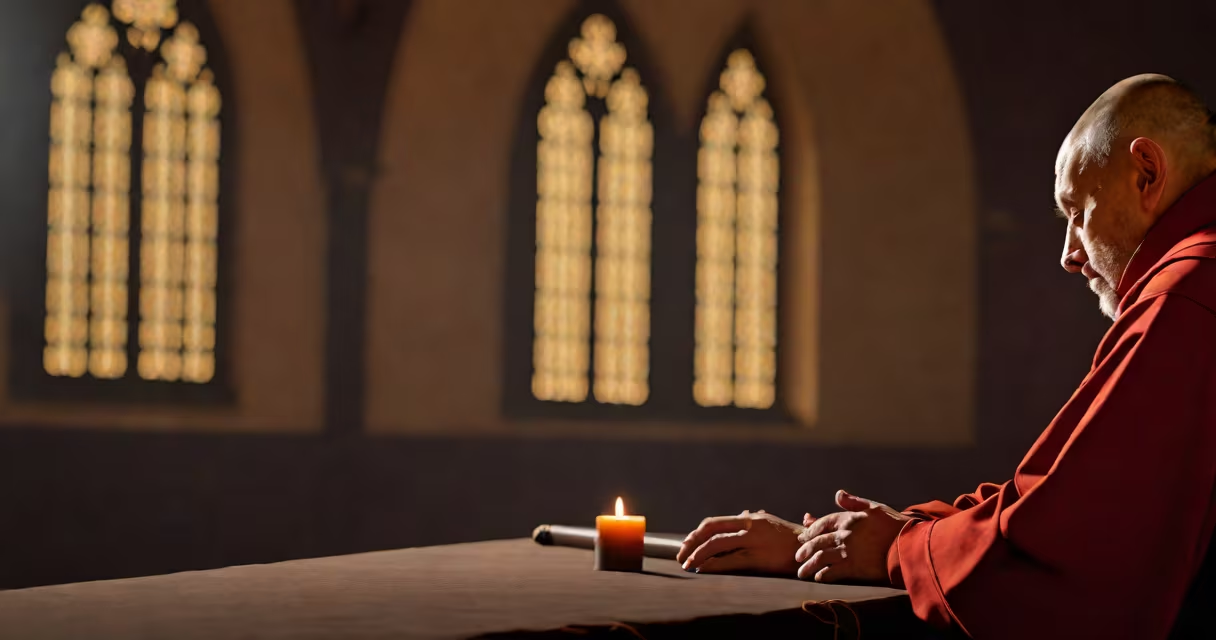
A Catholic monk is a man who lives a religious life within a monastic community, committing himself to prayer, manual labor, study, and communal worship under vows of poverty, chastity, and obedience. His days revolve around structured prayer, work, and silence, guided by the Rule of Saint Benedict.
Monks follow a strict daily schedule known as the Liturgy of the Hours, which divides the day into fixed prayer times. These include Matins (midnight), Lauds (dawn), Prime (6 a.m.), Terce (9 a.m.), Sext (noon), None (3 p.m.), Vespers (sunset), and Compline (before bed). Each service includes psalms, scripture readings, hymns, and intercessory prayers. Monks recite these prayers collectively in a choir, often in Latin, though many modern communities use vernacular languages.
The core of a monk's life is silence and solitude. He avoids distractions, limits personal communication, and spends time in meditation and reading sacred texts. The monastery itself functions as both home and workplace. Monks may grow food, maintain buildings, copy manuscripts, or run small businesses like bakeries or bookstores to support their community.
Catholic monks live in communities governed by a shared rule, most commonly the Rule of Saint Benedict, written in the 6th century. This document outlines a balanced life of ora et labora-"pray and work." A monk's day typically begins at 2 a.m. with Matins, followed by breakfast, then hours of manual labor or study. Midday prayer interrupts the workday, and evening prayer concludes the day.
Monks wear simple habits-usually black or gray robes-with a hood and belt. The habit symbolizes detachment from worldly goods and marks the wearer as part of a spiritual order. They take vows not just for a period but for life. Breaking any vow requires formal penance and reconciliation with the community.
Not all monastic communities are the same. Some focus on contemplation, others on education or healthcare. For example, the Trappists (Cistercians of the Strict Observance) emphasize silence and solitude, while the Benedictines may engage in teaching or hospitality. The Cistercian Abbey of Our Lady of Gethsemani in Kentucky runs a retreat center and publishes books on spirituality.
Monastic orders differ in lifestyle, liturgical practices, and mission. Below are the major groups:
| Order | Focus | Daily Routine | Example Location |
|---|---|---|---|
| Benedictines | Prayer, work, study | Structured prayer cycle, farming, copying texts | St. John's Abbey, Minnesota |
| Trappists (Cistercians) | Contemplation, silence | Extended periods of silence, minimal contact | Mount Michael Abbey, Colorado |
| Carthusians | Extreme solitude | Living alone in cells; meeting only weekly | Grande Chartreuse, France |
| Premonstratensians | Pastoral care, preaching | Active ministry, regular sermons | St. Mary's Priory, Germany |
One key distinction often missed: not all monks are priests. Most monks are lay brothers or professed religious who have not received priestly ordination. Only those who have studied theology and been ordained can celebrate Mass or hear confessions. A monk may spend years in formation before being ordained, and even then, his role remains service-oriented rather than pastoral leadership.
Many assume monks live in isolation, but most communities are open to visitors. Retreat centers in monasteries welcome pilgrims seeking peace. At St. Meinrad Archabbey in Indiana, guests stay in guesthouses and attend daily services. Monks may also teach, write, or serve as chaplains in hospitals or prisons.
Another misconception is that monks are "running away" from the world. In reality, they choose intentional withdrawal to deepen their relationship with God. As the Vatican's Congregation for Institutes of Consecrated Life and Societies of Apostolic Life states, "The monastic vocation is not escape, but a radical commitment to the Gospel."
I once visited the Abbey of New Clairvaux in California during a retreat. I sat in the cloister courtyard during Vespers. The chant was low, rhythmic, and unbroken. No one spoke. No phones rang. The air smelled of incense and old stone. That silence wasn't empty-it was full of presence. It was the kind of stillness that makes you feel small, not because you're insignificant, but because you're in the right place.
Despite declining numbers-fewer than 10,000 Catholic monks in the U.S. according to the U.S. Conference of Catholic Bishops-their influence persists. Monks preserve ancient manuscripts, translate religious texts, and offer spaces for reflection amid modern noise. The Abbey of St. Gall in Switzerland holds over 160,000 medieval manuscripts, many copied by hand over centuries.
Monastic communities also contribute to social justice. The Benedictine Sisters of Perpetual Adoration in Missouri provide housing and meals for homeless people. Monks don't preach from pulpits-they serve through action and example.
For those considering the path, entry requires years of discernment. Prospective monks spend time in a novitiate-typically two years-learning the rule, language, and way of life. They make temporary vows first, then perpetual vows after further evaluation. The process ensures the commitment is not impulsive but deeply considered.
Understanding what a Catholic monk does reveals a life shaped by intentionality, not avoidance. It is not about escaping society but offering a different way of being in it-one rooted in stillness, service, and faith. The monk's work is not visible in headlines, but it sustains something essential: the quiet persistence of meaning.