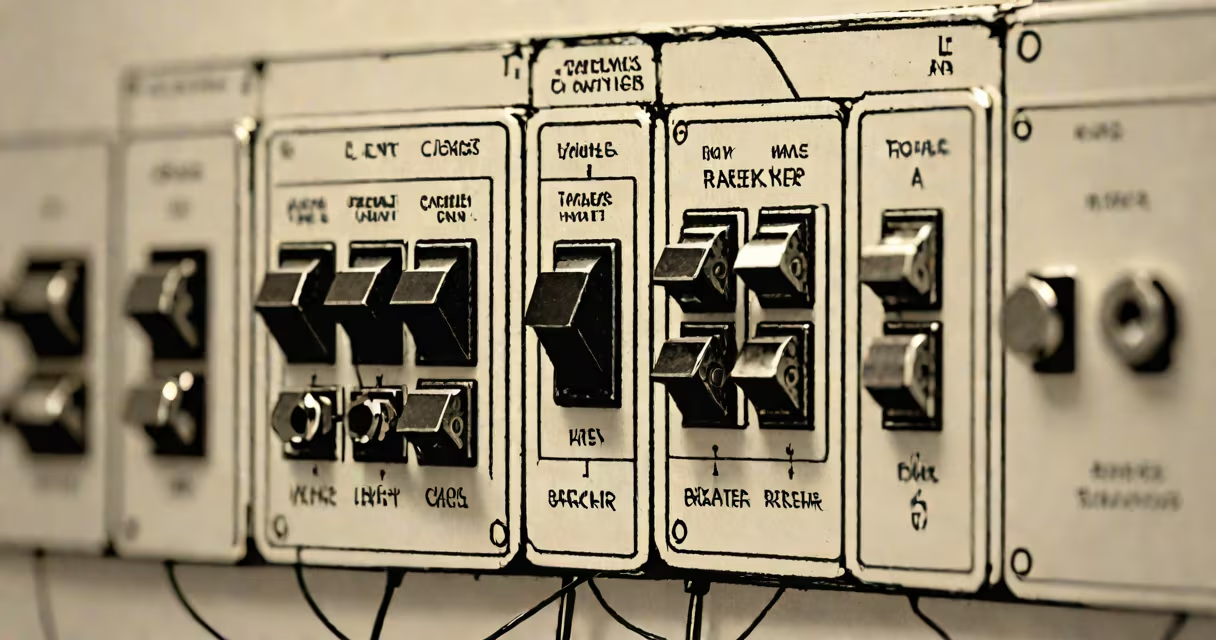
A circuit breaker is a safety device shaped like a small rectangular switch with a movable toggle lever. It mounts inside an electrical panel and automatically cuts power when it detects an overload or short circuit. The device prevents overheating, fire risk, and damage to wiring.
Circuit breakers come in standard sizes that fit into common electrical panels. Most residential models are 1-inch wide and 1.5 inches tall, with a plastic housing and metal contacts inside. The toggle lever moves between "on" (up) and "off" (down) positions. A label on the front identifies the circuit it controls-such as "Kitchen," "Bathroom," or "Garage."
Breakers differ in size based on amperage. A 15-amp breaker is typically smaller than a 50-amp model. Double-pole breakers, which handle 240 volts, span two slots and have a single toggle that operates both poles. These are used for large appliances like electric dryers and air conditioners.
When current exceeds the rated amperage, an internal bimetallic strip heats and bends, triggering a mechanical release. This disconnects the circuit instantly. The process is reversible-the breaker can be reset manually by flipping the toggle back to "on."
Modern breakers also respond to short circuits, where current spikes suddenly due to a fault. In such cases, an electromagnet inside the device activates within milliseconds, tripping the breaker even if the overload hasn't yet caused heat buildup.
For example, if a hair dryer draws 16 amps on a 15-amp circuit, the breaker trips after about 10 seconds. This prevents wires from melting or igniting insulation. The National Fire Protection Association (NFPA) reports that properly installed breakers reduce electrical fires by over 60% in homes.
Breakers fall into several categories based on function and voltage. The most common types are single-pole, double-pole, ground fault circuit interrupter (GFCI), and arc fault circuit interrupter (AFCI).
| Type | Voltage | Use Case | Appearance |
|---|---|---|---|
| Single-pole | 120V | Standard outlets, lights, small appliances | One slot wide, single toggle |
| Double-pole | 240V | Electric ranges, water heaters, HVAC systems | Spans two slots, single toggle, often larger |
| GFCI | 120V | Bathrooms, kitchens, outdoor outlets | Same size as single-pole, but has "test" and "reset" buttons |
| AFCI | 120V | Bedrooms, living rooms | Has a "self-test" indicator light and may show a small LED |
Some breakers feature colored indicators. For example, a red LED on an AFCI breaker blinks when a fault is detected. GFCI breakers have a test button that checks whether the device responds to ground faults.
One lesser-known detail: many breakers have a small window near the toggle. If the breaker has tripped due to a fault, you'll see a visible red or orange indicator through the window. This helps identify which circuit failed without opening the panel.
People often mistake circuit breakers for fuses. Fuses are one-time-use devices that melt when overloaded. They're not reusable. Breakers, by contrast, can be reset after tripping. This makes them safer and more convenient for home use.
Another confusion arises with double-pole breakers. Because they occupy two slots and control 240 volts, they're sometimes mistaken for two separate switches. But they're a single unit with a shared trip mechanism. A faulty connection in one leg still causes the entire breaker to trip.
Some homeowners assume that a breaker labeled "15A" can safely power any 15-amp device. That's incorrect. The wire gauge matters too. Using a 15-amp breaker with 14-gauge wire is acceptable. But using it with 12-gauge wire is unnecessary and potentially dangerous if the wire is undersized for the load.
I once encountered a homeowner whose kitchen lights kept flickering. The breaker was labeled "Kitchen," but it had tripped. I inspected the panel and saw the toggle was in the middle position-indicating a trip. The red indicator was visible through the window.
After turning off the main power, I checked the wiring. The neutral wire had loosened at the terminal. When I tightened it, the breaker stayed on. Resetting the toggle restored power. The issue wasn't a fault in the breaker-it was poor installation.
This case shows that breakers don't fail randomly. They respond to real conditions. A tripped breaker is a warning sign, not a problem to ignore.
Circuit breakers live in electrical panels, usually located in basements, garages, or utility closets. Residential panels are typically 100-, 150-, or 200-amp service panels. They contain 10 to 40 breakers depending on the home's size.
Commercial buildings use larger panels with higher amperage ratings. Industrial settings may use molded-case circuit breakers (MCCBs) that are much larger and rated for thousands of amps.
Breakers are not visible in wall outlets or switches. Those are just connections. The actual protection happens behind the scenes in the panel.
Understanding what a circuit breaker looks like helps you identify problems quickly. A standard breaker is a small, flat switch with a toggle and a label. Double-pole versions span two slots and control high-power circuits. Always verify the breaker's rating matches the circuit it protects.