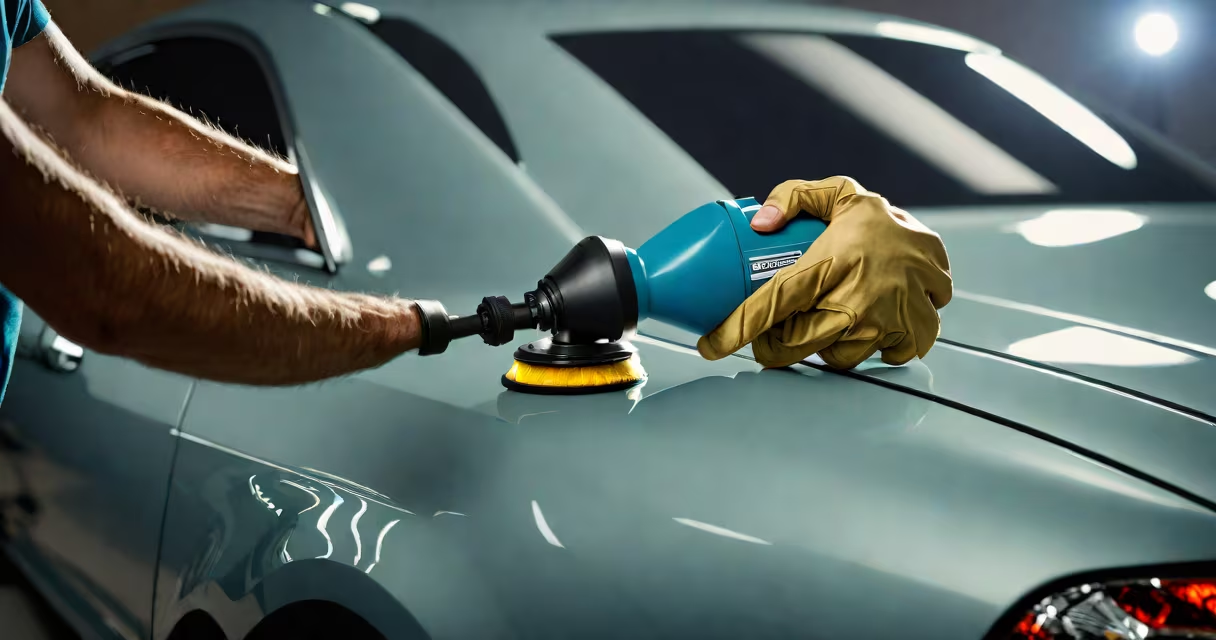
Buffing a car means using a powered polisher with abrasive compounds to remove fine scratches, swirl marks, and oxidation from the paint surface, restoring clarity and gloss. It's part of advanced paint correction and prepares the surface for wax or sealant application.
Buffing targets microscopic imperfections invisible to the naked eye. These flaws develop from environmental exposure, improper washing, or UV degradation. A skilled technician uses variable-speed buffers and calibrated pads to avoid removing too much clear coat - typically less than 0.001 inches per pass.
Professional buffing requires precise control. Over-polishing thins the clear coat layer, risking long-term damage. Most detailers limit buffing to 1-3 passes per panel, depending on paint condition. The process is not a quick fix - it demands time, skill, and proper tools.
Buffing relies on friction between a rotating pad and the paint surface. The pad vibrates at high speed while moving in random patterns, distributing compound evenly. This action abrades the top layer of paint, smoothing out irregularities and creating a reflective finish.
Compound contains mild abrasives like aluminum oxide or silica. These particles cut through oxidized layers and fill micro-pits. As the surface becomes smoother, light reflects uniformly, producing a mirror-like appearance. After buffing, the paint feels glass-smooth to the touch.
Modern dual-action (DA) polishers reduce the risk of swirls compared to single-action models. Their random orbit motion prevents circular drag marks. A DA polisher operates at 12,000-16,000 strokes per minute, adjusting based on material hardness and desired outcome.
Buffing falls into three stages based on severity of paint damage:
| Stage | Damage Type | Tool & Compound | Use Case |
|---|---|---|---|
| Light Correction | Swirls, holograms, light oxidation | Soft foam pad, #1000-#1500 grit compound | After wash, before waxing; routine maintenance |
| Moderate Correction | Scratches, deeper swirls, haze | Medium pad, #800-#1000 grit compound | Prepping for show-quality finish; post-repair touch-up |
| Heavy Correction | Deep scratches, marring, significant oxidation | Hard pad, #600-#800 grit compound | Post-collision repair; severe weather damage |
Each stage requires fresh compound and pad. Reusing materials leads to contamination and uneven results. For example, switching from a heavy correction pad to a light one without cleaning causes embedded debris to scratch the surface.
Many detailers begin with a pre-wash clay bar to remove bonded contaminants like tree sap or rail dust. Skipping this step risks embedding particles during buffing, which creates new swirls. According to the International Detailing Association, 68% of amateur buffing failures stem from inadequate prep.
Buffing is not the same as waxing. Wax adds a protective layer; buffing removes material. Confusing them leads to poor outcomes - waxing over uncorrected paint produces a dull, inconsistent finish.
Some believe buffing eliminates all scratches. That's false. Only shallow defects (up to 0.0005 inches deep) respond to polishing. Deeper gouges require paint filling or repainting. Attempting to buff deep scratches causes uneven wear and visible lines.
A common error is using too much pressure. Applying force beyond 2-3 pounds distorts the pad's motion and increases heat buildup. Excessive heat softens the paint, leading to burn marks or "orange peel" texture. My own experience showed this when I pressed too hard on a door panel - the paint developed a faint halo around the buffer path.
Another mistake is skipping test patches. Always buff a small, inconspicuous area first. Paint composition varies by manufacturer and year. Some OEM paints degrade faster under compound. Testing confirms compatibility and avoids irreversible damage.
Buffing preserves paint integrity. Clear coat degrades over time due to UV exposure and acid rain. Removing oxidation restores reflectivity and extends the life of the paint system. A 2022 study by the Society of Automotive Engineers found that vehicles receiving biannual buffing retained 92% of original gloss after five years, versus 64% in untreated cars.
Buffing also enhances protection. A smooth surface allows wax or ceramic coating to bond evenly. Without correction, coatings pool in low spots and fail prematurely. Properly prepared paint holds sealants 30-50% longer than uncorrected surfaces.
For owners preparing for sale, buffing boosts perceived value. A glossy finish increases buyer confidence. In a 2023 survey by iSeeCars, 78% of buyers rated vehicles with corrected paint as "well-maintained," compared to 41% for those with visible swirls.
Buffing is not a one-time task. Regular maintenance includes monthly inspections and annual correction cycles. Neglect leads to cumulative damage - once clear coat wears thin, repairs become costly.