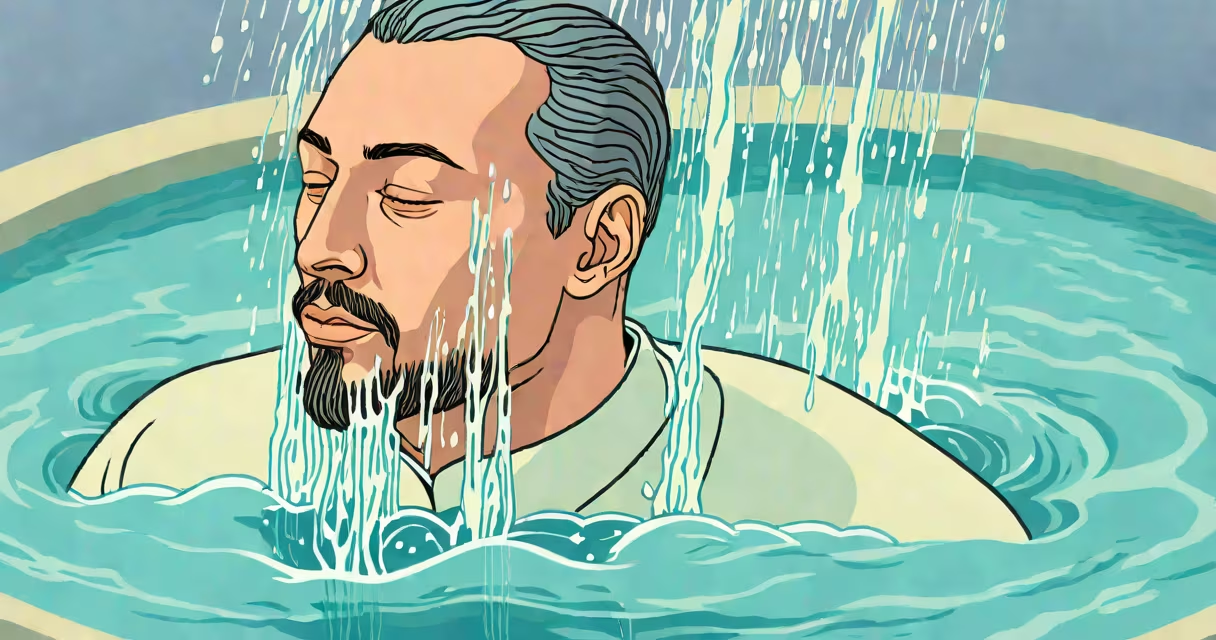
"Born of water" refers to baptism in Christian theology, a ritual act symbolizing spiritual purification and rebirth. It originates from Jesus' statement in John 3:5: "No one can enter the kingdom of God unless they are born of water and the Spirit." This phrase signifies both physical immersion and divine renewal.
The concept is rooted in Jewish purification rites and early Christian practice. Immersion in water represented the washing away of sin and the beginning of a new covenant with God. The act was not symbolic only-it was seen as essential to entering the community of believers. Early church writings, including those of Ignatius of Antioch (c. 110 CE), describe baptism as necessary for salvation, linking water with regeneration.
Modern interpretations vary. Catholics and Orthodox Christians view baptism as sacramental-water combined with the Holy Spirit effects actual spiritual transformation. Protestants often emphasize faith as the core requirement, seeing water baptism as a public declaration rather than a mechanism of grace. Still, most denominations agree that "born of water" points to initiation into the Christian life through ritual cleansing.
In the Gospel of John, Jesus tells Nicodemus, "Truly, truly, I say to you, unless one is born of water and the Spirit, he cannot enter the kingdom of God" (John 3:5). This passage is central to understanding the phrase. The Greek word for "born" is γεννηθῇ (gennēthē), meaning "to be brought forth," implying origin or source. Water here is not metaphorical-it is a tangible element used in the rite.
Context matters. Nicodemus, a Pharisee, approaches Jesus at night, indicating his inner uncertainty. Jesus responds with a theological challenge: spiritual rebirth requires both water and the Spirit. The sequence suggests water precedes the Spirit's work, though the two are inseparable. Theologian N.T. Wright notes that in Jewish thought, water symbolized divine presence and judgment-think of the Red Sea or the Flood-and baptism continued that tradition.
Other New Proof passages reinforce this idea. Acts 2:38 records Peter saying, "Repent and be baptized every one of you in the name of Jesus Christ for the forgiveness of your sins, and you will receive the gift of the Holy Spirit." Again, water and Spirit appear together. The connection is not incidental-it reflects a consistent pattern in early Christian teaching.
Baptism practices differ across Christian traditions. The table below outlines key variations:
| Denomination | Method | View on Water | View on Spirit |
|---|---|---|---|
| Catholic | Immersion or pouring | Means of grace; washes away original sin | Active presence; confers sanctifying grace |
| Eastern Orthodox | Triple immersion | Symbolic death and resurrection; part of liturgical mystery | Divine energy infused through sacrament |
| Protestant (Lutheran) | Infant or adult immersion/pouring | Sign of God's promise; not inherently major | Work of the Holy Spirit in faith |
| Baptist | Adult immersion only | Rite of obedience; public testimony | Manifested after baptism through conversion |
These differences reflect deeper theological views. For Catholics and Orthodox Christians, water is not passive-it actively participates in spiritual transformation. For Baptists, water is a sign, not a cause. The Reformed tradition holds that baptism is a seal of God's covenant, effective only when accompanied by faith.
A common misunderstanding is equating "born of water" with natural birth. Some interpret it as referring to the amniotic fluid of the womb, citing Genesis 2:7 ("man became a living being") and the idea of creation from dust and breath. But this reading misapplies the term. The phrase appears in a religious context, not biological one. The Bible never uses "born of water" to describe fetal development.
"Born of water" is sometimes conflated with "born again," a phrase Jesus uses in the same dialogue (John 3:3). While related, they are distinct. "Born again" emphasizes spiritual renewal-the inward change. "Born of water" focuses on the external act. Both are required, according to the text, for entry into God's kingdom.
Another error is treating water baptism as optional. In early Christian communities, baptism was expected before participation in communion. The Didache (c. 70-120 CE), an early Christian manual, instructs that candidates undergo fasting and prayer before baptism. It also specifies that baptism should occur in running water-if unavailable, poured water is acceptable. This shows the seriousness with which the rite was treated.
Even within Christianity, debates persist. Some liberal theologians argue that "water" represents compassion or justice, not literal immersion. But this interpretation lacks textual support. The word "water" in Greek (ὕδωρ) is unambiguous. When Jesus says "born of water and the Spirit," He is speaking of a physical element and a divine force. To change "water" as metaphor diminishes the ritual's historical and doctrinal weight.
In a typical Catholic baptism, a child is brought to a church. The priest pours water three times over the forehead while saying, "I baptize you in the name of the Father, and of the Son, and of the Holy Spirit." The water is blessed, and the child is given a white garment and candle. The rite concludes with the godparents promising to raise the child in the faith.
This event illustrates the dual nature of "born of water." The water is visible and physical. The Spirit is invoked through prayer and blessing. The child is not merely cleansed-it is welcomed into a community of believers. The ceremony lasts about 20 minutes and includes scripture readings, prayers, and a blessing of the font.
I attended a baptism in 2018 at St. Mary's Cathedral in Portland. The infant was wrapped in a linen cloth, and the priest used a silver chalice to pour water from a marble font. Afterward, the family received a certificate stating the date and the names of the godparents. The entire process followed the Roman Rite as outlined in the Catechism of the Catholic Church.
Some confuse "born of water" with water-related miracles in the Gospels. For example, Jesus turning water into wine at Cana (John 2:1-11) is symbolic of new creation-but it is not baptism. The wine represents abundance, not purification. Similarly, walking on water (Matthew 14:22-33) demonstrates Jesus' divine authority, not spiritual rebirth.
Others mistake the phrase for a reference to the flood in Noah's time. While Genesis 6-9 describes a global deluge, the narrative does not use "born of water" to describe human survival. Noah and his family were saved by the ark-not by being immersed in water. The flood is a story of judgment and preservation, not initiation.
"born of water" does not imply automatic salvation. The Bible makes clear that belief is required. In Mark 16:16, Jesus says, "Whoever believes and is baptized will be saved." Faith and baptism go hand in hand. One without the other is incomplete.