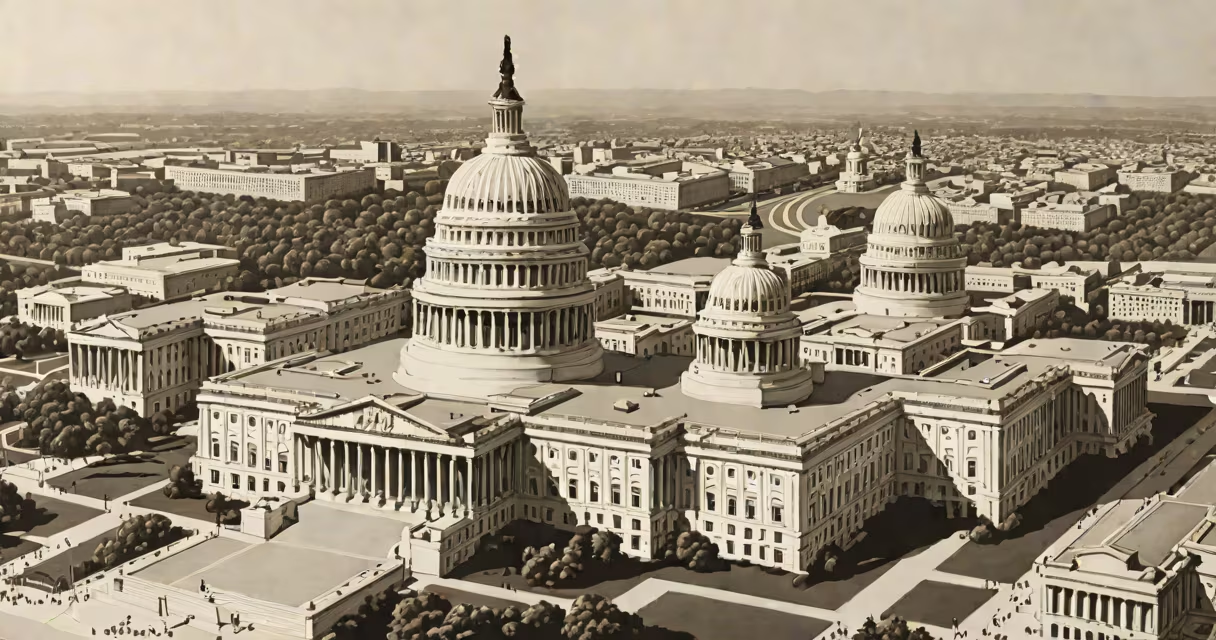
The word "capitol" refers specifically to the building where a legislative body meets, most famously the U.S. Capitol in Washington D.C., home of the United States Congress. It is not synonymous with "capital," which denotes a city serving as the seat of government.
Capitol buildings house lawmakers who debate and pass legislation. The term derives from the Latin "capitōlīnum," referring to the Temple of Jupiter Optimus Maximus on Rome's Capitoline Hill. This historical link underscores the idea of a capitol as a center of political power.
Confusion between "capitol" and "capital" is common. "Capital" refers to a city-such as Washington D.C., the capital of the United States-while "capitol" refers to the structure where laws are made. Misusing the terms undermines precision in civic discourse.
Capitol buildings serve as physical hubs for legislative activity. Inside, chambers host elected representatives who deliberate on proposed laws, approve budgets, and confirm appointments. The U.S. Capitol includes the House of Representatives and Senate chambers, both located on the east and west wings of the central rotunda.
Security protocols, architectural design, and public access are standardized across capitol buildings. For example, the U.S. Capitol has 540 rooms, 658 windows, and 108 columns. Its central dome rises 180 feet above ground level, symbolizing national unity and democratic ideals.
Visitors must pass through metal detectors and security screening before entering. The U.S. Capitol Visitor Center, opened in 2008, handles over 1 million visitors annually. Guided tours are available through a member of Congress, though advance reservations are required during peak seasons.
Capitol buildings exist at multiple levels of government. Each state in the U.S. has its own state capitol, such as the California State Capitol in Sacramento and the Texas State Capitol in Austin. These structures often reflect regional architecture and local history.
| Level | Example | Function | Location |
|---|---|---|---|
| Federal | U.S. Capitol | House and Senate sessions | Washington D.C. |
| State | California State Capitol | State legislature meetings | Sacramento, CA |
| Local | Los Angeles City Hall | Municipal council meetings | Los Angeles, CA |
While "capitol" typically implies a legislative chamber, some cities use the term loosely. For example, the New York State Capitol in Albany is sometimes referred to as the "New York Capitol" in media reports. However, the correct usage remains tied to the building itself, not the city.
One frequent error is writing "capital" when "capitol" is intended. For example, "The capital of the United States is Washington D.C." is correct. But "The capitol of the United States is Washington D.C." is incorrect because Washington D.C. is a city, not a building.
Another mistake is assuming all capitol buildings are grand or historic. While many are iconic-like the U.S. Capitol or the Michigan State Capitol-some are modest. The Vermont State House in Montpelier, for instance, is a neoclassical building completed in 1859 but lacks a dome or extensive ornamentation.
A lesser-known fact: the U.S. Capitol was designed by William Thornton, whose original plan won a competition in 1793. The building's construction spanned 30 years, with the dome added in 1863. The current structure stands on the site of the original foundation laid by George Washington himself.
Consider the January 6, 2021, attack on the U.S. Capitol. Protesters breached the building during a joint session of Congress to certify the 2020 presidential election results. The event highlighted the symbolic and functional role of the capitol as a place of democracy and lawmaking.
After the breach, the Capitol Police conducted a full review of security measures. The U.S. Capitol Complex now features reinforced entry points, surveillance systems, and emergency response protocols. The building remains open to the public, but access is tightly controlled.
During the 117th Congress (2021-2023), 114 bills were introduced related to capitol security improvements. The Architect of the Capitol oversees maintenance, restoration, and accessibility projects. In 2022, $1.2 billion was allocated for long-term repairs, including the replacement of aging electrical systems and the repair of marble façades.
Using "capitol" correctly reinforces clarity in public communication. According to the Merriam-Webster Dictionary, "capitol" is defined as "a building in which a legislative body meets." The word "capital" is defined as "a city that is the seat of government of a country or state." These definitions are distinct and non-interchangeable.
Journalists, educators, and civic leaders must maintain this distinction. A 2020 study by the Pew Research Center found that 42% of Americans incorrectly used "capitol" when referring to a city. This confusion can distort understanding of governmental structure and function.
As someone who once helped organize a school field trip to the U.S. Capitol, I saw firsthand how students misused the terms. One student wrote, "We visited the capital in Washington D.C.," when they meant the capitol building. Correcting that misconception improved their grasp of civic institutions.
Understanding what "capitol" means ensures accurate communication about government institutions. It is not a city. It is a building. And it matters.