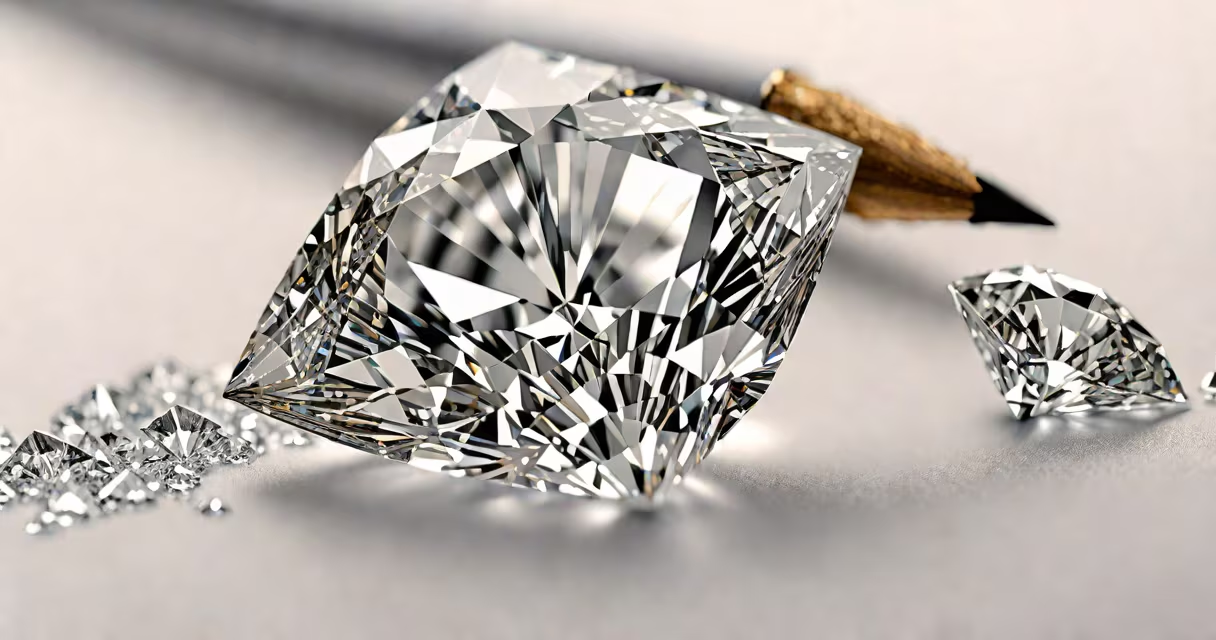
Clarity in diamonds refers to the presence and visibility of internal imperfections (inclusions) and surface flaws (blemishes), assessed under 10x magnification. The Gemological Institute of America (GIA) uses a standardized scale from Flawless (FL) to Included (I3), with most consumer diamonds falling between VS1 and SI2.
Clarity is determined by examining a diamond under 10x magnification using a jeweler's loupe or microscope. Graders assess the size, number, position, nature, and visibility of inclusions and blemishes. A diamond with no visible flaws at 10x magnification earns a Flawless (FL) grade. As flaws increase in size, quantity, or visibility, the grade drops through Internally Flawless (IF), Very Slightly Included (VS1, VS2), Slightly Included (SI1, SI2), and Included (I1, I2, I3).
The GIA clarity scale is the global benchmark. A diamond graded SI1 by GIA may appear flawless to the naked eye, while an I1 diamond shows visible inclusions even without magnification. This distinction matters because many buyers assume higher clarity always means better appearance-but that's not true. A well-cut SI1 diamond can look brighter and clearer than a poorly cut FL diamond due to light performance.
Grading begins with placing the diamond face-down on a flat surface under controlled lighting. A trained grader examines each facet under 10x magnification, recording the location and characteristics of every inclusion and blemish. The final grade depends on whether flaws are visible to the unaided eye, especially in larger stones.
For example, a 2-carat diamond with a VS2 clarity grade may show minor inclusions under magnification, but they remain invisible to the naked eye when viewed from above. In contrast, a 1-carat diamond with a SI1 grade might display a small cloud-like inclusion near the girdle that becomes noticeable in certain lighting. Size and placement affect visibility more than sheer numbers.
One non-obvious fact: Clarity grades do not account for how light behaves inside the stone. A diamond with a lower clarity grade but excellent cut and polish can outperform a higher-clarity stone in brilliance and fire. The cut determines how much light reflects back to the viewer-not the clarity score alone.
The GIA clarity scale divides diamonds into six categories. Here's how they compare:
| Grade | Internal Flaws | External Flaws | Naked Eye Visibility | Typical Price Range |
|---|---|---|---|---|
| Flawless (FL) | None | None | Never visible | Extremely high |
| Internally Flawless (IF) | None | Very minor | Never visible | High |
| Very Slightly Included (VS1, VS2) | Small, hard to see | Minor | Not visible to unaided eye | Moderate to high |
| Slightly Included (SI1, SI2) | Visible under 10x, often not to naked eye | Minor to moderate | SI1: usually not visible; SI2: sometimes visible | Low to moderate |
| Included (I1, I2, I3) | Large, obvious | Obvious | Often visible | Low |
SI1 and SI2 are common in retail diamonds. Many SI1 diamonds appear clean to the naked eye, especially in smaller sizes. A 0.75-carat SI1 diamond with a good cut can look indistinguishable from a VS1 stone when worn.
One mistake people make is assuming that SI1 is inferior to VS2. In reality, SI1 often has fewer, smaller inclusions than VS2. The difference lies in the nature of the flaw: SI1 may have one large inclusion that's hidden under the bezel setting, while VS2 may have multiple small ones scattered across the stone. Placement matters more than category.
Clarity is frequently mistaken for sparkle or brightness. A diamond with a low clarity grade can still appear brilliant if it has a precise cut and high polish. Conversely, a high-clarity diamond with poor symmetry or a shallow cut will look dull.
Consider a 1.2-carat round diamond with a GIA clarity rating of SI1 and a D-color. Under 10x magnification, a small feather inclusion appears near the pavilion. To the naked eye, this flaw is invisible. When set in a solitaire ring, the stone sparkles with excellent fire and scintillation. Its price is 25% lower than a comparable FL diamond, yet it performs better visually.
Another misconception is that clarity grades apply uniformly across all cuts. A cushion-cut diamond with SI1 clarity may show inclusions more easily than a round brilliant with the same grade. The cushion cut's larger facets and softer angles concentrate light differently, making flaws more apparent.
I once examined a 1.5-carat emerald-cut diamond with a GIA SI2 clarity report. At first glance, it looked flawless. Upon close inspection under a loupe, a thin, hairline fracture ran through the center. The stone was priced 30% below similar diamonds with VS1 clarity. After consulting a gemologist, I learned that such fractures are common in emerald cuts due to their step-cut geometry and are often stable. The stone performed well in light return and had no visual impact when worn.
Clarity influences both price and perception. A diamond with a higher clarity grade commands a premium, but only up to a point. Beyond VS2, the price jump per grade becomes disproportionate to visual improvement. For most consumers, SI1 or SI2 offers the best balance of cost and appearance.
When buying online, always request a high-resolution image or video of the diamond from multiple angles. Some sellers use angled photos to hide inclusions. A 360-degree video allows you to rotate the stone and spot flaws that static images miss.
For engagement rings, clarity is less critical than cut and carat weight. A well-cut SI1 diamond can outshine a poorly cut FL diamond in brilliance. Prioritize cut quality, then choose clarity based on budget and preference.
Understanding clarity helps avoid overpaying. A diamond with a GIA SI1 grade and a well-executed cut may be more valuable than a higher-clarity stone with poor proportions. Always review the full certificate, including the plot diagram that maps inclusion locations.