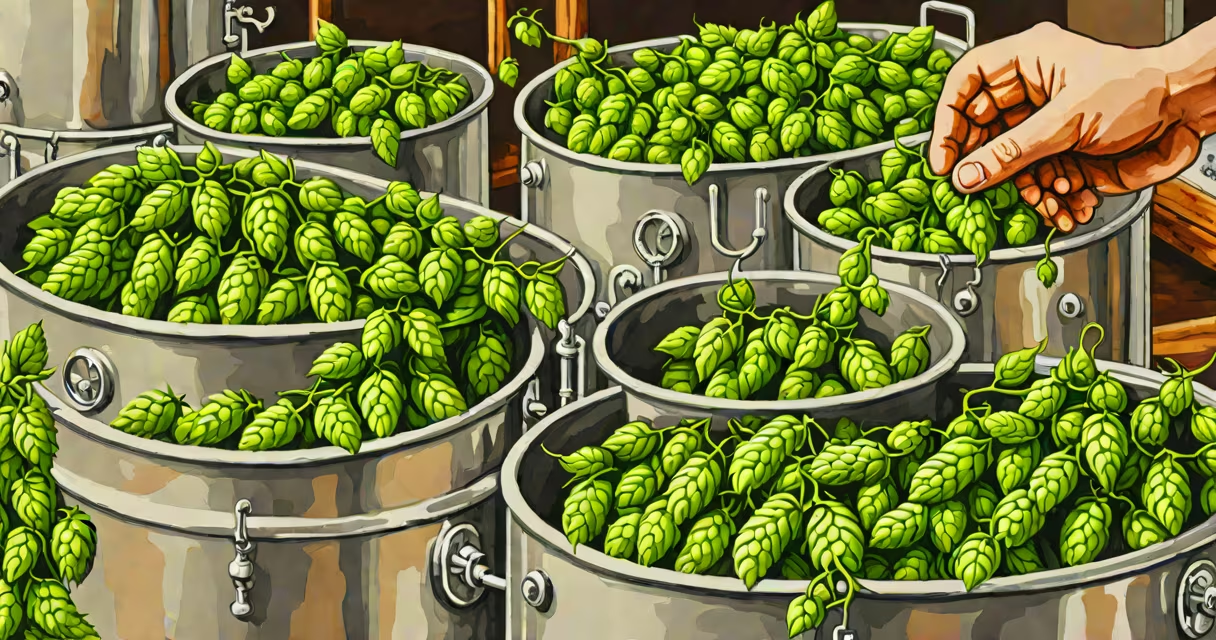
Double dry hopped means adding hops to beer twice during fermentation to intensify aroma and flavor without increasing bitterness. This method maximizes volatile hop oils that contribute to fruity, floral, or resinous scents in styles like New England IPAs and pale ales.
Dry hopping occurs after primary fermentation ends, when yeast activity slows. Adding hops at this stage extracts essential oils responsible for aroma-without adding significant bitterness. Double dry hopping amplifies those oils by repeating the process, often with different hop varieties.
For example, a brewer might add Citra hops at day 5 of secondary fermentation, then add Mosaic hops at day 10. The result is a layered nose with notes of mango, passionfruit, and citrus zest. This technique is common in craft beer but not used in lagers or traditional ales where clean profiles are preferred.
During fermentation, yeast consumes sugars and produces alcohol. After this phase, the wort contains minimal fermentable sugars. Adding hops at this point avoids extracting bitter alpha acids, which are released during boiling. Instead, the volatile terpenes and essential oils in hop cones dissolve slowly into the liquid.
Double dry hopping increases surface contact between hops and beer. The first addition saturates the beer with initial aroma compounds. A second addition introduces new layers-often from different hop strains-to build complexity. This is especially effective in high-ABV or high-hopping recipes where balance matters.
Brewers typically wait 3-7 days between additions. Leaving hops in too long risks grassy or herbal off-flavors from oxidation. Most double dry hops last 5-7 days total. Some commercial breweries use a 3-day interval between batches to avoid over-extraction.
Not all double dry hops are identical. Brewers choose timing, hop variety, and form based on desired outcome.
| Method | Timing | Use Case | Example |
|---|---|---|---|
| Sequential | First addition at day 5, second at day 10 | Layered aroma, complex profile | Citra → Mosaic in NEIPA |
| Simultaneous | Both additions at same time | Maximized aroma, reduced risk of over-extraction | Two batches of Cascade in pale ale |
| Extended | First addition at day 5, second at day 14 | Long-term flavor development | Wet hops in farmhouse ale |
Some brewers use pellet hops for consistency. Others prefer whole leaf for better oil extraction. Pellets have higher surface area and dissolve faster. Whole leaf retains more aromatic compounds due to intact resins.
A key distinction: double dry hopping doesn't increase IBUs (bitterness units). IBUs come from boiling hops. Dry hopping adds only aroma. A double dry hop may raise perceived intensity by 30-50% compared to single dry hopping, according to a 2021 study by the American Society of Brewing Chemists.
Many assume double dry hopping makes beer more bitter. This is false. Bitterness comes from alpha acid isomerization during boil. Dry hopping adds no bitterness. The perception of "stronger" beer comes from aroma, not taste.
Another myth: double dry hopping requires more hops. Not necessarily. A single 10g/5L addition can deliver similar results to two 5g/5L doses. The key is timing and hop variety compatibility. Using overlapping flavor profiles (e.g., Citra and Mosaic) enhances synergy.
Some think double dry hopping ruins beer. Over-hopping can lead to vegetal or papery notes. But this happens only with prolonged exposure-typically beyond 10 days. Proper sanitation prevents bacterial contamination, which can spoil the batch.
In 2022, Tree House Brewing Company released "Julius" a double dry hopped IPA using Simcoe and Citra. They added 1.5 kg of hops at day 6, then another 1.5 kg at day 10. The beer scored 94/100 on Beer Advocate, praised for "explosive grapefruit and pine" aroma.
On average, double dry hopped beers contain 15-30 mg/L of myrcene, a terpene linked to citrus and pine notes. Single dry hopped versions average 8-12 mg/L. This difference explains why double dry hopped IPAs feel more aromatic despite identical ABV.
I brewed a double dry hopped pale ale using Cascade and Centennial. I added 10g of each at day 5, then 10g of each at day 10. After 7 days, the aroma was noticeably richer-citrus forward with a hint of floral spice. The flavor held up through a week of aging, showing stability in hop retention.
Double dry hopped is not the same as double IPA. A double IPA refers to beer strength (higher ABV, usually 7-10%) and hop intensity. A double dry hop is a technique applied within any style. You can have a double dry hopped lager or stout, though it's rare.
It's also not synonymous with wet hopping. Wet hopping uses fresh, un-dried hops harvested that season. These are more perishable and require immediate use. Double dry hopping can use dried or fresh hops-but wet hops are typically used only once due to their short shelf life.
Finally, double dry hopping doesn't replace cold crashing. Cold crashing removes yeast and particulates, improving clarity. It's done after fermentation, often before dry hopping. Skipping cold crash can leave haze, but it doesn't affect hop aroma directly.
Use food-grade plastic or stainless steel containers for dry hopping. Avoid metal contact with hops, which can cause oxidation. Keep the beer below 20°C (68°F) during dry hopping to preserve delicate aromatics.
Always sanitize equipment. Even small microbes can produce off-flavors. A 2020 study by the Institute of Brewing and Distilling found that 12% of homebrews failed due to contamination during dry hopping.
Label batches. Track hop variety, weight, and date. This helps replicate successful batches. Many commercial brewers use digital logs to track dry hop schedules across multiple tanks.
For beginners, start with a single dry hop. Once comfortable, experiment with timing and variety. A 5g/5L dose of Citra at day 5 yields noticeable results without risk.
Understanding what does double dry hopped mean improves your ability to read beer descriptions and choose styles that match your palate. a drinker, this technique defines modern hop-forward beers.